
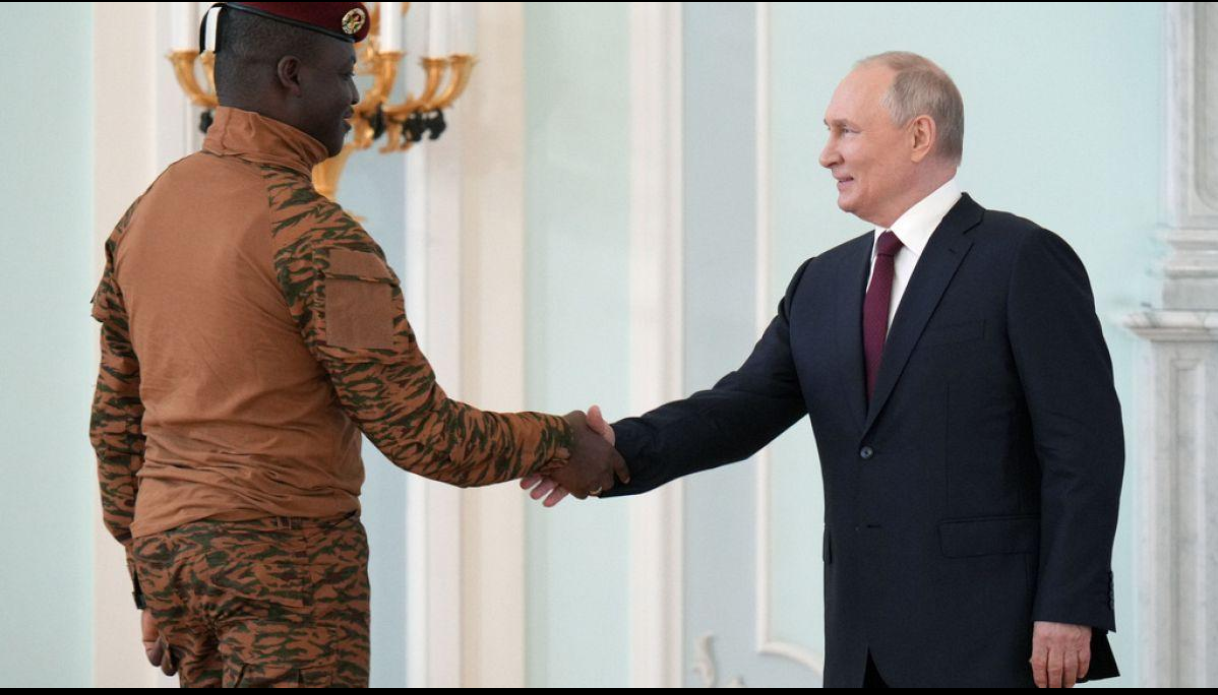
As Burkina Faso navigates turbulent political waters, a high-stakes question emerges: does the country’s gold industry fund its controversial security pact with Moscow? The answer could redefine the balance of power between Ouagadougou and its powerful ally.
From economic asset to political lifeline: the dual role of Burkina Faso’s gold
The glitter of gold in Burkina Faso is no longer confined to its market value. Since Captain Ibrahim Traoré assumed power in September 2022, the country’s vast gold reserves have become a cornerstone of its shifting geopolitical strategy. While Ouagadougou deepens ties with Moscow, a critical question looms over the partnership: what role do gold mining revenues play in securing Traoré’s grip on power?
The mine of Bissa, operated by Russia’s Nordgold, serves as a microcosm of this complex dynamic. Here, economic interests, security contracts, and regime consolidation intersect—revealing how Burkina Faso’s most valuable resource is being leveraged in ways that go far beyond simple extraction.
Competing security firms expose hidden tensions in Ouagadougou-Moscow ties
The security landscape around Bissa mine has exposed fractures within Russia’s expanding footprint in Burkina Faso. A bitter rivalry between Russian private military companies underscores a struggle for influence that blends commercial competition with strategic positioning.
One firm, RSB-Group, was recently ousted from the mine’s security framework—a decision it contests vigorously. In a documented lobbying effort, RSB-Group allegedly accused rival contractors of exacerbating insecurity in Fulani villages, framing their eviction as a threat to local stability. While these claims require independent verification, they spotlight how security operations around gold sites are increasingly entangled with political and communal tensions.
Security contracts as instruments of power
For Traoré’s administration, the stakes are high. Since a failed coup in September 2023, regime survival has depended on two pillars: domestic legitimacy and external backing. Reports indicate that Russian paramilitary units have been deployed not only in counterterrorism roles but also in elite protection and intelligence networks within Ouagadougou. Their presence suggests a broader mandate—one that may extend to safeguarding the transition government itself.
This raises an uncomfortable parallel: in several African nations, Russia’s military presence has coincided with favorable contracts for its extractive firms. While no public agreement explicitly links Traoré’s personal protection to gold concessions, the coincidence of interests paints a compelling picture of mutual reinforcement.
Gold as leverage: Moscow’s growing stake in Burkina Faso’s mining sector
Russia’s economic footprint in Burkina Faso’s gold industry is substantial. Nordgold, controlled by billionaire Alexei Mordashov, holds stakes in key operations like Bissa and Bouly mines. These assets give Moscow a direct stake in the country’s stability—and in the continuity of mineral production.
In February 2023, the Burkinabè government requisitioned 300 kilograms of gold from Bissa Gold, citing public necessity. Though framed as a temporary measure, the move underscores how gold reserves are being treated as strategic reserves—available for state mobilization during crises. Such decisions hint at a broader reorientation: from private enrichment to state-controlled resource governance.
For Russian companies, privileged access to mine security not only protects their investments but also strengthens their negotiating position with Burkinabè authorities. In a country facing chronic underfunding of its armed forces and escalating jihadist violence, outsourced security offers a lifeline—and an opportunity for influence.
Is there an unspoken quid pro quo in Traoré’s alliance with Russia?
The Bissa mine controversy highlights the blurred lines between security cooperation and resource extraction. While no formal deal has been confirmed, the pattern is familiar: Russian military support in exchange for commercial concessions. Analysts at West Point’s Combating Terrorism Center suggest that protecting Russian mining interests may have been an initial draw for Moscow’s engagement in Burkina Faso. Yet, their research indicates that the primary objective of Russian forces is likely the consolidation of Traoré’s regime.
The absence of public agreements doesn’t negate the possibility of informal arrangements. In a context of political fragility and resource scarcity, both sides have incentives to keep the terms of their cooperation opaque. What is clear, however, is that gold and security form a potent—and potentially explosive—combination.
What this means for local communities and international observers
The ripple effects extend far beyond Ouagadougou’s corridors of power. For communities near gold sites, the militarization of mining areas threatens livelihoods and exacerbates social tensions. Fulani villages, already caught in the crossfire of jihadist violence, now face additional risks from competing Russian security contractors. Civilians bear the cost when commercial and political rivalries turn mining zones into conflict hotspots.
From an international perspective, the Burkina Faso-Russia partnership signals a new chapter in Africa’s resource geopolitics. By coupling security assistance with economic penetration, Moscow is embedding itself in the Sahel’s fragile states—not just as a partner, but as an actor whose interests are tightly aligned with those of host governments.
The future of Burkina Faso’s gold: resource or ransom?
Whether Burkina Faso’s gold becomes a shield for Traoré’s regime—or a commodity traded in exchange for survival—remains uncertain. What is undeniable is that gold no longer flows freely. It is now part of a high-stakes calculus where sovereignty, security, and sovereignty are up for negotiation.
The battle unfolding at Bissa mine is more than a corporate feud. It is a glimpse into a broader transformation: In Burkina Faso, gold isn’t just wealth—it’s a currency of power, and Moscow holds the ledger.