
When state policies cross into collective punishment
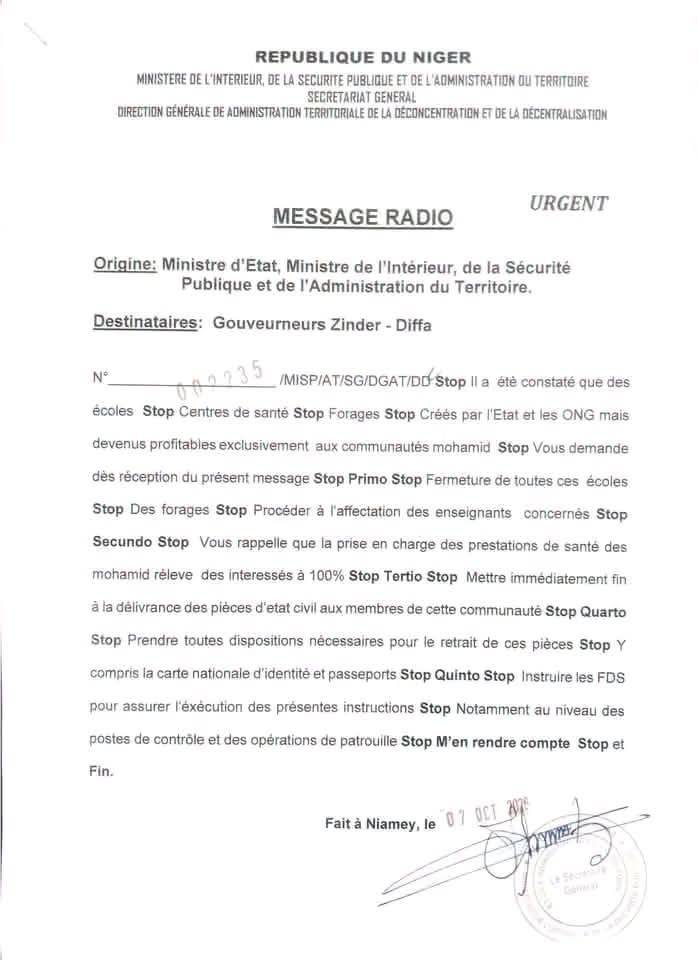
Niamey — A recent order from Niger’s Interior Ministry has sent shockwaves through the Mohamid community. A radio broadcast dated October 7, 2026 instructed regional governors to close schools, restrict water access, suspend healthcare support, and revoke identity documents for members of this ethnic group. The question now arises: Can a nation truly secure its people while stripping entire communities of fundamental rights?
The directive, reportedly implemented across Zinder and Diffa, frames these measures as security precautions. But when schools close, wells run dry, and birth certificates vanish overnight, the line between protection and persecution blurs. What legal or humanitarian justification could possibly support such sweeping exclusions?
Education, water, healthcare: the pillars of dignity under attack
The Interior Ministry’s order targets four pillars of daily life: education, access to clean water, healthcare, and legal identity. Each plays a non-negotiable role in human survival and societal participation. Yet these are being systematically dismantled for an entire community — not due to individual crimes, but based solely on ethnic affiliation.
School closures risk leaving children without education, their futures suspended mid-lesson. Closed water wells threaten both families and livestock in a region where water scarcity already defines survival. The suspension of healthcare support could force families into impossible choices between health and starvation. And revoked identity documents don’t just complicate bureaucracy — they erase legal existence, making daily life an obstacle course of discrimination.
Identity as a weapon: the silent erosion of rights
A national ID card, birth certificate, or passport isn’t a privilege — it’s proof of belonging. When authorities threaten to withdraw these documents based on group membership, they weaponize bureaucracy. The message is clear: your legal existence depends not on citizenship, but on favor. How can a state demand loyalty from citizens it refuses to recognize?
Security at what cost? The myth of collective guilt
Niger faces real threats from armed groups operating near the Diffa region. Yet the response — blanket punishment of an entire ethnic community — reveals a dangerous flaw in governance. Responsibility is individual. Guilt should never be inherited.
If crimes have been committed, let evidence be gathered. Let courts weigh guilt. Let justice proceed through due process. But punishing thousands for the actions of a few isn’t security — it’s scapegoating. It doesn’t protect the nation; it fractures society.
Under the leadership of General Abdourahamane Tiani, Niger has seen growing restrictions on freedoms since the 2023 coup. The pattern is familiar: when institutions weaken, vulnerable groups often bear the brunt. But history judges governments not by their harshness, but by their adherence to justice.
The human and economic fallout of exclusion
The Mohamid community contributes to local economies through trade, transport, and livestock. When entire families lose access to education, water, healthcare, and legal recognition, the ripple effects spread far beyond their homes. Markets shrink. Livelihoods collapse. And communities fracture under the strain of state-imposed isolation.
The cost isn’t just moral — it’s economic. A society that denies opportunity to any group weakens its own resilience. When children can’t attend school, when families can’t access clean water, when workers can’t prove their identity, the entire nation suffers.
Where is the accountability? The demand for transparency
Who authorized these measures? On what legal basis were they justified? And what recourse exists for those stripped of their rights? A government that rules by decree without explanation forfeits its claim to legitimacy.
The Interior Ministry’s radio message raised urgent questions that demand answers. Collective punishment violates both national law and international human rights standards. When a state weaponizes its institutions against a community, it doesn’t strengthen security — it corrodes the very foundations of governance.
Can Niger’s government reclaim the moral high ground?
The path forward is clear. Authorities must immediately restore access to education, water, and healthcare for the Mohamid community. They must halt the revocation of identity documents unless backed by individualized legal processes. And they must allow independent oversight of these measures to assess their impact and rectify any abuses.
Niger’s strength lies not in the breadth of its power, but in the depth of its justice. When a state confuses security with punishment, when it sacrifices principle for control, it doesn’t protect its people — it betrays them. The treatment of the Mohamid community is not just a question of their rights. It is a test of whether Niger remains a nation of laws, or slides into one of decrees.