
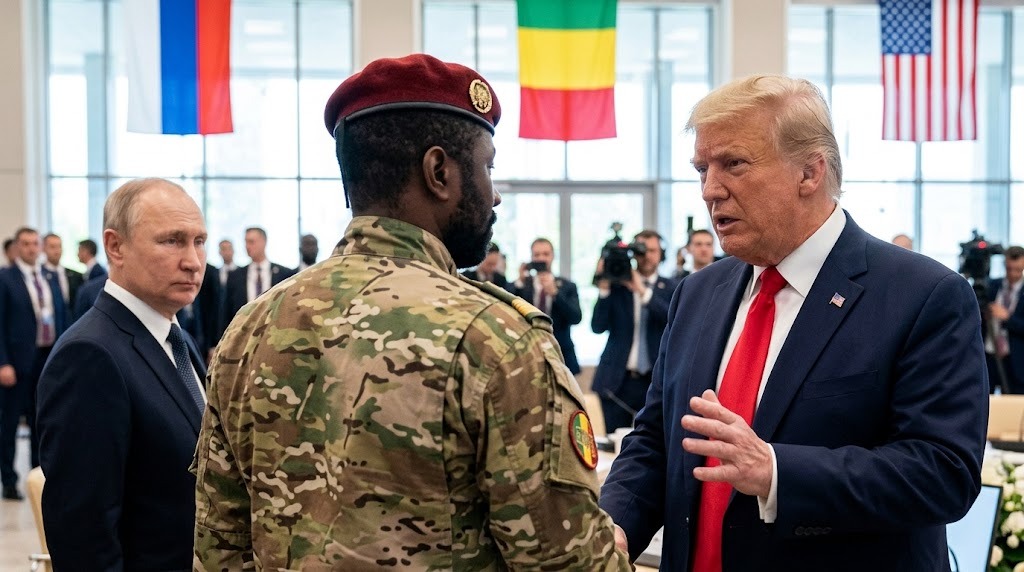
For years, the narrative was straightforward: after expelling France and European forces, Mali chose Russia. Under General Assimi Goïta, Bamako made Moscow its primary security partner, welcoming Wagner fighters and later Africa Corps, while progressively severing ties with Western partners.
But in 2026, that narrative is beginning to crack. Mali is not officially breaking with Russia. Yet signs of a rapprochement with the United States are multiplying. Intelligence cooperation, talks on American surveillance flights, and the lifting of sanctions on senior Malian officials all point to a shift. Mali now appears to be seeking to diversify its alliances — and Washington has once again become a privileged interlocutor.
The quiet return of Washington
The most striking sign of this shift concerns military intelligence.
In March 2026, it emerged that Washington and Bamako were close to an agreement allowing the United States to resume aircraft and drone flights over Mali to monitor jihadist groups, notably JNIM, an Al-Qaeda affiliate. The discussions followed the American decision in February to lift sanctions against Mali’s defense minister and several senior officials.
This development is far from trivial.
During the period of tension with Western powers, Bamako presented Russia as the partner capable of replacing former Western powers. Today, Malian authorities are once again willing to discuss with Washington capabilities they clearly need: intelligence, surveillance, and reconnaissance.
The United States had already shared intelligence with Malian authorities, some of which reportedly contributed to an operation against JNIM leaders. Washington now seeks to further institutionalize this cooperation.
The paradox is striking: Mali, which had turned its back on the West to move closer to Moscow, may be rediscovering the strategic utility of Washington.
The Russian security record that embarrasses Bamako
Why is this change happening now? The answer lies partly in the security record of recent years.
To be precise: Wagner’s arrival in Mali does not mean that the entire security deterioration is attributable to Russia. The country was already facing a jihadist insurgency before French forces left. Armed groups have deep local roots and benefit from political, social, economic, and geographic factors that far exceed the presence of a foreign power.
But statistics show a reality that is hard to circumvent: replacing Western partners with Russian forces did not sustainably curb the violence.
The 2022 U.S. State Department report indicated that terrorist activities had increased in number and lethality. That year, France completed its withdrawal from Mali, with the last French soldier leaving on August 15, 2022. Meanwhile, Malian forces occupied former French positions with Wagner’s support. The State Department called 2022 the deadliest year in Mali’s history in terms of terrorist violence and counterterrorism operations.
The following year did not reverse the trend.
According to the 2023 U.S. terrorism report, terrorist activities increased further in number and intensity. The document describes 2023 as the deadliest year in Mali’s history, taking into account both terrorist attacks and operations by Malian forces conducted with Wagner.
The observation is therefore particularly embarrassing for the narrative that presented the Russian partnership as the solution to Mali’s security problem.
From Wagner to Africa Corps: Moscow has not disappeared
However, it would be premature to announce Russia’s departure.
Wagner has been progressively replaced by Africa Corps, directly linked to the Russian Ministry of Defense. Moscow therefore retains a significant military and political presence in Mali.
But this presence is also experiencing setbacks.
In April 2026, an offensive by JNIM and Tuareg fighters inflicted serious reversals on Malian forces and their Russian allies. Mali’s defense minister, Sadio Camara, trained in Russia, was killed in an attack. Africa Corps also had to withdraw from Kidal, a strategic northern city it had helped retake in 2023.
It was reported at the time that these setbacks had seriously damaged Russia’s image as a guarantor of security in Mali. ACLED analyst Héni Nsaibia even estimated that JNIM’s successive campaigns, the fuel blockade, and recent events illustrated the failure of the Russian intervention.
This is obviously an analysis, not a universal verdict. But it illustrates a problem that has become difficult to ignore: Moscow has not succeeded in ending the insurgency.
Security still under pressure
Data available in 2025 reinforces this question.
According to ACLED data cited by Reuters, Malian forces and Russian paramilitary groups Wagner and Africa Corps reportedly killed 918 civilians in Mali in 2025, compared to 232 attributed to JNIM and Islamic State in the Sahel. These figures cover documented deaths and must therefore be interpreted with caution. They nevertheless testify to the scale of violence and accusations against government forces and their Russian allies.
At the same time, jihadists continued to advance. JNIM notably managed to disrupt the country’s supply routes and impose considerable pressure on Bamako.
In March 2026, Malian authorities even released around 200 people detained for alleged links to jihadists as part of an arrangement to secure a truce on fuel convoy attacks, according to Le Monde.
For a junta that came to power promising to restore sovereignty and security, the symbol is heavy.
Mali may no longer be choosing between Moscow and Washington
It would still be too early to speak of a break with Russia.
Moscow retains considerable interests in Mali, particularly in the gold, lithium, and energy sectors. Russia has supported mining and energy projects and continues to affirm its commitment alongside Bamako.
Mali’s strategy thus seems to be evolving toward a pragmatic logic: no longer depending on a single partner.
After making Moscow its main security recourse following the French departure, Bamako now seems to recognize that Russia alone cannot meet all its military and intelligence needs.
This is where the United States reappears.
Washington offers what Moscow does not necessarily provide under the same conditions: aerial and satellite intelligence capabilities, considerable technological means, and deep knowledge of jihadist networks.
The rapprochement with America may therefore be less an ideological conversion than a pragmatic observation: Mali needs multiple partners to confront a threat that its alliance with Russia has not succeeded in eliminating.
From Western rupture to pragmatism
Mali’s recent history is thus undergoing a new reversal.
Yesterday, Bamako denounced the French and European presence and presented Russia as the sovereign alternative. Today, discussions with Washington are resuming at a level that would have seemed improbable just a few years ago.
Russia remains in Mali. But its security record is contested, its forces are experiencing setbacks, and jihadists continue to threaten the country.
In this context, the American-Malian rapprochement appears as much more than a simple diplomatic episode. It could mark the beginning of a new foreign policy for Bamako: no longer replacing one partner with another, but using rivalry between great powers to obtain from each what Mali needs.
Mali has therefore not yet abandoned Russia. But one thing is now clear: Russia’s monopoly on Mali’s security partnership may already be a thing of the past.