
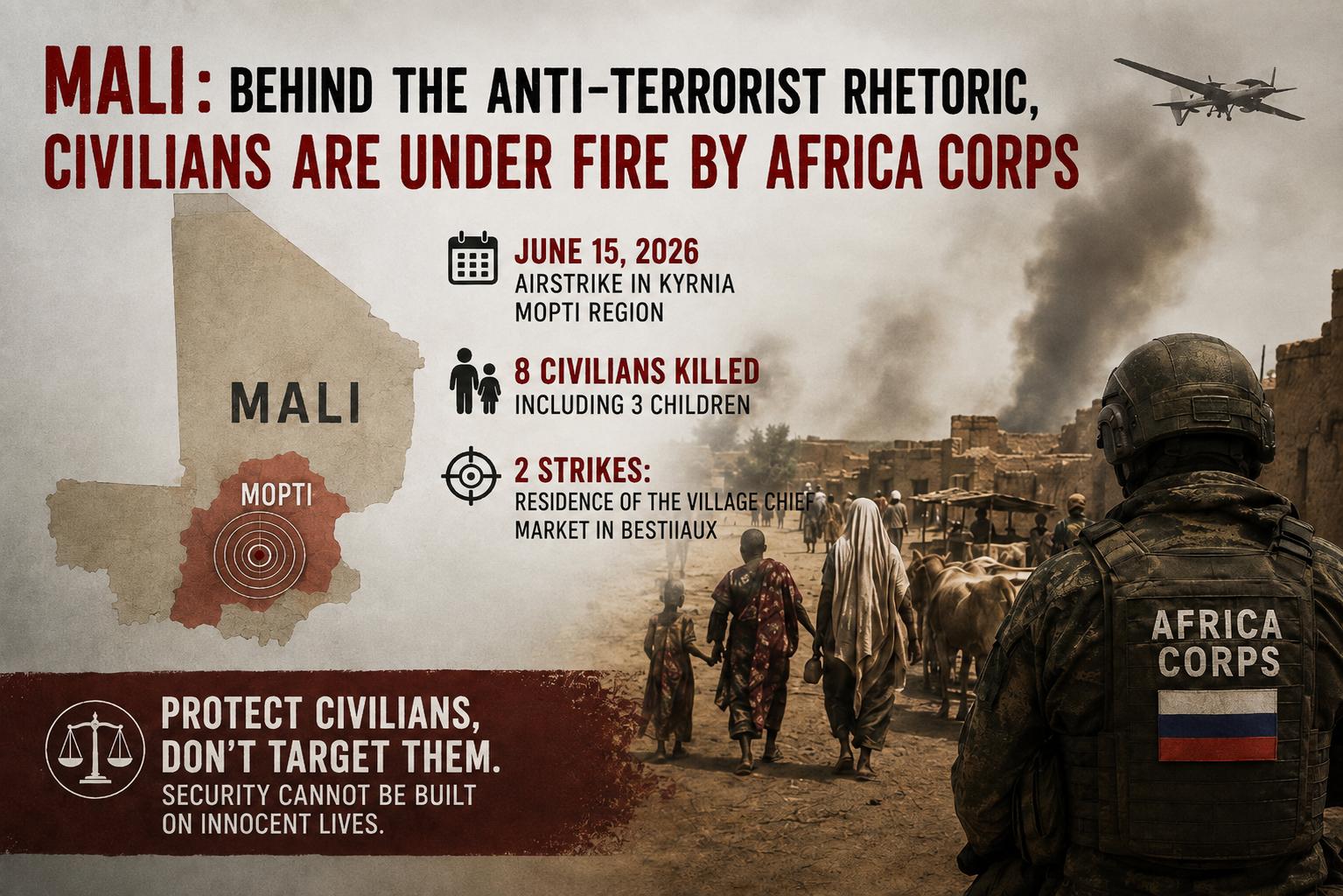
The issue of civilian casualties linked to military operations in central Mali has resurfaced following a June 2026 airstrike attributed to Africa Corps, the Russian-backed force operating in the country. According to investigations, the attack struck the village of Kyrnia in the Mopti region, resulting in eight civilian deaths, including three children. Human rights monitors have characterized the operation as potentially unlawful based on collected evidence.
An attack with devastating consequences for civilians
The strike targeted two locations in Kyrnia: the residence of the village chief and a livestock market. Witness testimonies, satellite imagery, and visual evidence have confirmed that the victims were exclusively civilians, with no combatants among the dead. Investigators interviewed 19 local residents and cross-referenced data to reconstruct the events leading to the tragedy. The incident has intensified scrutiny over the conduct of military operations in areas where civilians and armed groups coexist.
Military strategy under scrutiny
The operation reflects broader concerns about the Malian government’s security approach, particularly its reliance on Africa Corps a force operating under direct Russian oversight. Since assuming power, the transitional authorities have prioritized partnerships with external security providers, but the human cost of such collaborations is becoming increasingly difficult to ignore. The attack raises critical questions about proportionality, target identification, and the obligation to minimize civilian harm in counterterrorism efforts.
Flaws in intelligence and target selection
Reports indicate that a drone was observed over Kyrnia the day before the strike, and members of the Jama’at Nusrat al-Islam wal Muslimin (JNIM) were reportedly present in the area. However, the presence of armed groups does not absolve attacking forces of their duty to distinguish between combatants and civilians. The strike’s impact on a civilian residence and market suggests a failure to adhere to international humanitarian law’s principles of distinction and precaution.
Discrepancies between official claims and ground realities
Africa Corps initially described the operation as a successful strike against a « terrorist gathering » and claimed the elimination of several commanders. Independent investigations, however, found no evidence to support these assertions. Such discrepancies underscore the need for transparent verification mechanisms to prevent the misuse of military narratives that may obscure civilian harm.
Humanitarian and security implications
The civilian toll of military operations extends beyond immediate loss of life. In regions like Mopti, communities already grappling with insurgent violence now face additional threats from state-led operations and allied forces. This dual burden erodes trust in security institutions and risks fueling further instability. When populations perceive themselves as targets rather than protected, the very objectives of counterterrorism become compromised.
Accountability gaps fuel impunity
Investigations into civilian casualties remain scarce, and accountability for violations is rarely enforced. The lack of independent inquiries and prosecutions perpetuates a cycle of impunity, leaving victims without recourse and emboldening further abuses. For a state claiming sovereignty, the failure to address such violations undermines its legitimacy and the trust of its citizens.
Reassessing counterterrorism strategies
The Kyrnia incident demands a reevaluation of Mali’s military tactics. Effective counterterrorism cannot rely solely on airstrikes or firepower. It requires precise intelligence, rigorous target verification, community protection measures, and robust mechanisms to investigate civilian harm. Without these safeguards, operations risk inflicting greater harm than the threats they aim to eliminate.
The human cost of Kyrnia eight lives lost, including three children serves as a stark reminder of the stakes involved. For the families affected, this was not merely a failed operation but a profound injustice. As Mali navigates its security challenges, the priority must shift from the volume of operations to their ability to restore peace without sacrificing the very people they seek to protect.