
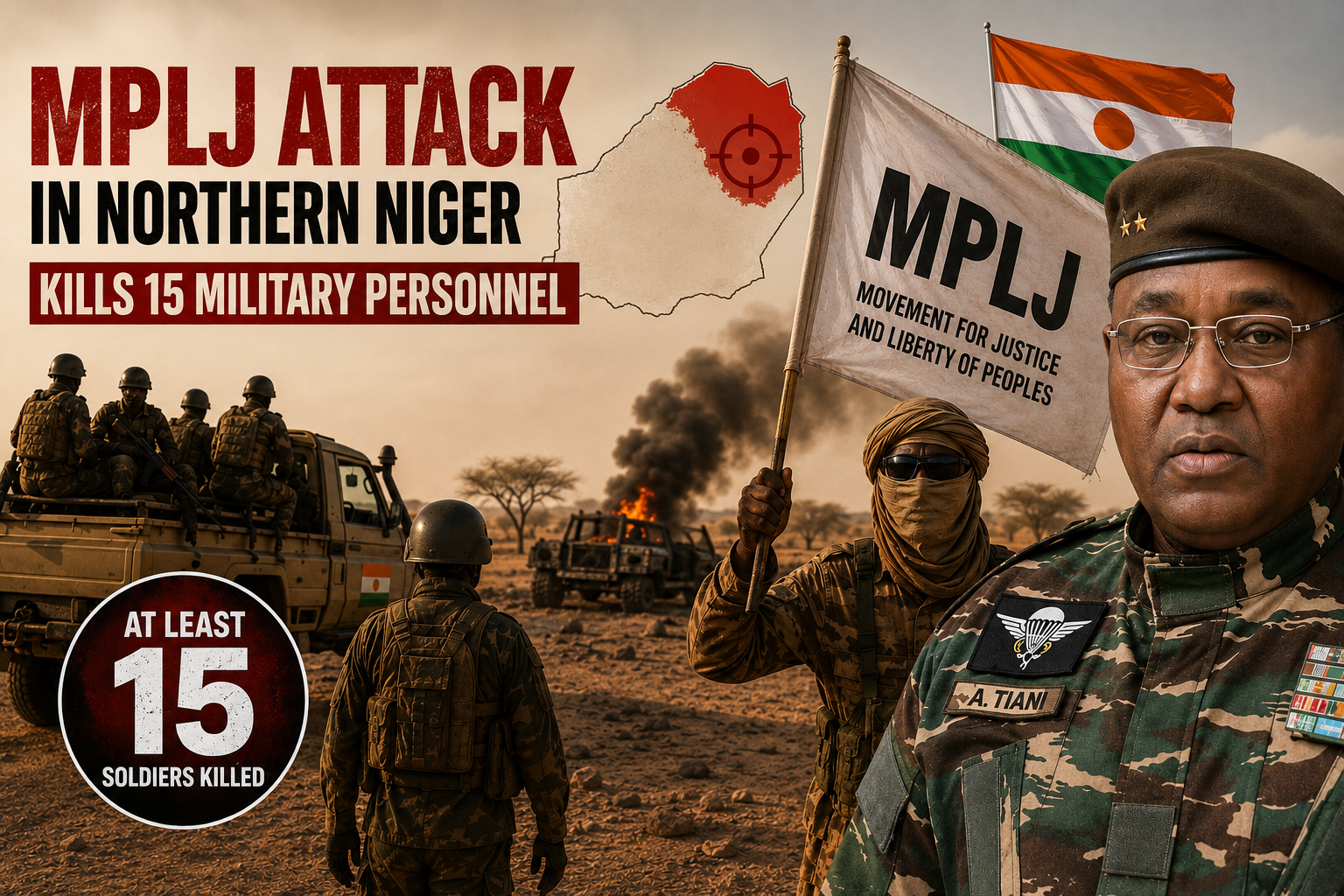
Military losses highlight struggles of Niger’s ruling junta
The latest double ambush in northern Niger, claimed by the Movement for Justice and People’s Liberation (MPLJ), has left at least 15 soldiers dead, casting further doubt on the military government’s ability to secure the nation’s vast and porous borders. The attack underscores a harsh truth: since seizing power in July 2023, the junta led by General Abdourahamane Tiani has failed to fulfill its most basic duty—protecting citizens and asserting state control over its territory.
The MPLJ’s assault, carried out in a remote desert region, is not an isolated incident but part of a broader pattern of insecurity gripping Niger’s northern provinces. The country’s immense and sparsely populated terrain, coupled with long, poorly monitored borders with multiple conflict-ridden states, creates an environment where armed groups can strike, retreat, and regroup with alarming ease.
Beyond immediate retaliation: the need for a comprehensive security strategy
The attack raises critical questions about Niger’s security approach. While military responses remain essential, the threat demands a more holistic strategy—one that combines proactive intelligence, sustained administrative presence, cross-border cooperation, and long-term efforts to prevent armed groups from establishing permanent footholds.
The junta’s narrative of sovereignty and rejection of foreign influence has dominated its communications, yet the reality on the ground tells a different story. For civilians in affected regions, security means more than political declarations; it means the freedom to live, work, and travel without constant fear of violence.
Diplomatic isolation and shifting blame
Since the 2023 coup, the military leadership has sought legitimacy through a break with former allies, including regional blocs and Western partners. However, the latest attack leaves the regime with few targets for blame. After accusing France, severing ties with ECOWAS, and criticizing neighboring states, the government now faces a credibility gap. Will it redirect accusations toward Algeria, a key neighbor and ally, or will it reassess its new strategic partnerships? The pattern of scapegoating has reached its limits.
While the junta has framed its policies as a rejection of external interference, the absence of effective local governance in vulnerable regions reveals a stark contradiction. Sovereignty, as the regime often declares, is not merely about rejecting foreign influence—it is about exercising real authority, securing borders, and protecting citizens.
A test for military governance
The persistence of attacks in distant regions serves as a litmus test for the military’s leadership. With each incident, the government must demonstrate that its diplomatic and operational changes since 2023 are yielding tangible results. For Niger’s population, political announcements offer little consolation when the human cost continues to rise.
The search for new alliances is not inherently flawed. When executed strategically, such partnerships can enhance national defense capabilities. However, shifting allegiances do not automatically translate into a stronger security doctrine. What truly matters are outcomes: timely intelligence, preemptive action, civilian protection, secure supply routes, and a visible state presence in at-risk areas.
The cost of diplomatic tensions
Niger’s growing isolation from some regional partners could hinder its counterterrorism efforts. Armed groups operating in the Sahel thrive in the gaps left by weak coordination and fractured alliances. Combating them requires seamless intelligence sharing, joint operations, and mutual trust—elements that diplomatic rifts can undermine.Attributing military failures solely to frontline troops oversimplifies the issue. The effectiveness of armed forces depends on multiple factors: reliable intelligence, robust logistics, a clear command structure, aerial and ground capabilities, and a coherent long-term strategy. The recent losses should prompt a thorough review of the entire security apparatus rather than a futile search for external scapegoats.
Restoring stability through constitutional order
The current crisis, marked by the collapse of institutional order without a corresponding improvement in security, demands urgent reflection. For long-term stability and effective counterterrorism, both the military and civil society must consider a swift return to constitutional governance—a framework that can restore democratic legitimacy and forge stronger, more reliable alliances.
True sovereignty cannot rest on slogans alone. It requires resilient institutions, a clear national strategy, pragmatic regional cooperation, and an administration willing to extend its reach even into the most remote territories. The MPLJ attack is more than another violent episode in the Sahel conflict; it is a reminder that sovereignty begins with the state’s ability to protect those it governs.