
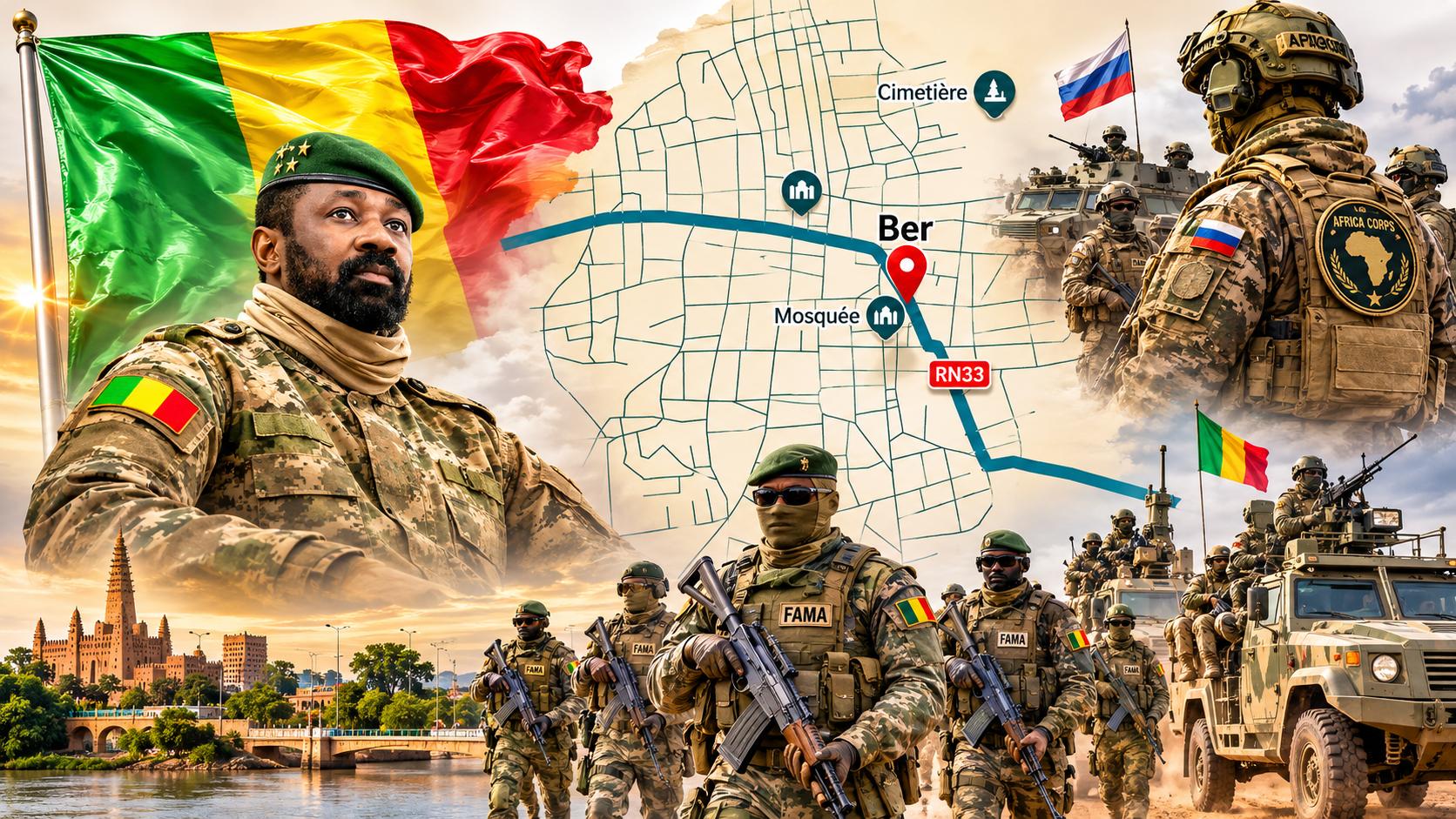
Tombouctou — Northern Mali is once again blazing under the flames of conflict. A military convoy belonging to the Malian Armed Forces (FAMa), accompanied by Russian fighters from the Africa Corps, was ambushed on Wednesday near Ber, in the Tombouctou region. Initial reports indicate that attackers opened fire on the column and deployed improvised explosive devices (IEDs), a tactic commonly used by armed groups operating in the country.
At this stage, no verified and consolidated casualty or damage assessments have been released regarding the attack. Caution is therefore advised when evaluating the number of victims or the identity of the assailants.
Ber, a key battleground under relentless pressure
The town of Ber in the Tombouctou region is no stranger to the violence plaguing Mali. The area has been a recurring flashpoint for clashes between government forces, jihadist groups, and armed movements from the North.
In 2023, the outskirts of Ber were the site of intense fighting involving the FAMa and their Russian allies, a period marked by the gradual withdrawal of the United Nations Multidimensional Integrated Stabilization Mission in Mali (MINUSMA) and the Malian army’s resumption of control over several former international bases.
Three years later, the challenge remains unchanged: securing a city does not equate to controlling the roads leading to it. In a country as vast as Mali, military convoys must traverse long distances along exposed routes, where mines, IEDs, small arms fire, and coordinated ambushes pose constant threats.
The Ber ambush underscores the ongoing struggle faced by the FAMa: not only reclaiming territory held by armed groups but also ensuring lasting security while preventing these factions from regaining influence in rural and desert regions.
JNIM and armed groups adapt their tactics
Mali continues to grapple with multiple overlapping threats. The Group for the Support of Islam and Muslims (JNIM), affiliated with Al-Qaeda, remains one of the primary adversaries of Malian forces. In the North, authorities also face the resurgence of separatist movements and shifting alliances among armed factions.
Recent analyses suggest a tactical convergence between the JNIM and the Azawad Liberation Front (FLA), despite their ideological differences. This cooperation has specifically targeted Malian forces and their Russian partners, with reports indicating a surge in fatalities from armed group attacks in early 2026.
This evolving landscape complicates Bamako’s military strategy. Government forces are no longer confronting a single enemy but a fragmented security environment where jihadists, separatists, and community militias pursue divergent goals, often through temporary alliances.
Russia’s gamble tested by harsh realities
Following the breakdown of partnerships with several Western allies, including France, Mali has significantly realigned its defense policy. Cooperation with Russia now forms a cornerstone of its security strategy.
The Wagner Group has gradually been replaced by the Africa Corps, a Russian structure operating under the authority of the Russian Ministry of Defense. These fighters now collaborate with the FAMa in multiple zones across the country.
For Malian authorities, this partnership reflects a commitment to defending national sovereignty and reducing reliance on Western powers. However, recent military setbacks highlight the limitations of this approach. In 2026, Malian forces and their Russian allies faced intense pressure in key sectors, particularly around Kidal and Anéfis. The scale and simultaneous nature of these attacks demonstrate that armed groups retain significant planning and mobility capabilities.
The Ber ambush should not be viewed as an isolated incident but as yet another episode in a conflict far from over.
An economy held hostage by insecurity
The security crisis extends far beyond the battlefield, directly impacting Mali’s economy.
Mali boasts substantial mineral resources, including gold and an emerging lithium sector. Yet, its economy remains heavily dependent on rain-fed agriculture and raw material exports, making it particularly vulnerable to conflict, climate shocks, and global price fluctuations.
In 2025, the fragility of this system became starkly evident. Attacks on supply corridors disrupted fuel deliveries, crippling transportation, industry, agriculture, and electricity production. According to the World Bank, Mali’s economic growth slowed in 2025, with fuel-related disruptions weighing heavily on activity. The institution nonetheless forecasts a rebound in 2026, projecting growth of around 5%, driven primarily by the mining sector.
The International Monetary Fund is also optimistic about 2026 prospects, estimating growth of approximately 5.5%, contingent on an improvement in security conditions and a recovery in gold production.
Mali’s paradox is striking: while the economy possesses significant growth drivers, insecurity constantly threatens to stifle them.
The dual role of gold: pillar and vulnerability
Gold plays a central role in this equation.
The resolution, at the end of 2025, of a conflict between Malian authorities and a major gold producer is expected to revive production. The IMF estimates that the normalization of mining activities, combined with high gold prices, could bolster public revenue, exports, and banking system liquidity in 2026.
However, mines and their supply corridors remain exposed to armed groups. Instability in mining areas can quickly escalate into a macroeconomic threat.
For Bamako, security is no longer just a military concern; it directly conditions tax revenues, investments, exports, and the state’s ability to fund essential services.
A population enduring a decade of crisis
Behind the economic figures and military communiqués lies a population grappling with over a decade of conflict.
Population displacements, disrupted economic activity, limited access to healthcare and education, food insecurity, and youth unemployment compound the challenges posed by the security crisis. Demographic pressure exacerbates the problem. The World Bank estimates that approximately 235,000 young Malians enter the labor market annually, yet job opportunities remain insufficient.
In this context, insecurity becomes a social crisis. When a road is cut off, it is not just soldiers who suffer; traders cannot move freely, farmers struggle to sell their produce, and rural communities face worsening access to essential services.
The political challenge behind the military one
The security situation unfolds within a unique political landscape. Mali remains under the leadership of authorities installed following the 2020 and 2021 military coups, navigating a transition whose timeline and modalities have sparked significant tensions.
Concurrently, Bamako is pursuing regional autonomy through the Alliance of Sahel States (AES), a coalition with Burkina Faso and Niger. The three nations have launched joint initiatives in security, investment, and development financing.
This push for sovereignty is a cornerstone of Malian authorities’ rhetoric. Yet, it carries significant responsibility: demonstrating that the withdrawal of former foreign forces and the new security partnership can indeed deliver greater stability.
Ber: a warning rather than a mere incident
The ambush near Ber arrives at a critical juncture.
It serves as a stark reminder that, despite military operations and the presence of the Africa Corps, armed threats remain capable of striking government forces on their own supply routes.
The true challenge for Bamako is no longer merely retaking positions or launching offensive operations. It is now about translating potential military gains into sustainable territorial control—one that ensures the safe movement of people and goods, the functioning of public services, and the security of civilians.
In Mali, the battle for security is also an economic and social one.
Until roads remain vulnerable to ambushes and IEDs, until rural areas fall outside effective state control, and until thousands of young people enter a job market unable to absorb them, the country’s stabilization will remain incomplete.
The Ber ambush is more than a new military episode: it is a reminder that peace in Mali will not be achieved solely in the desert or within barracks. It will be won on the roads, in villages, schools, mines, and markets.