
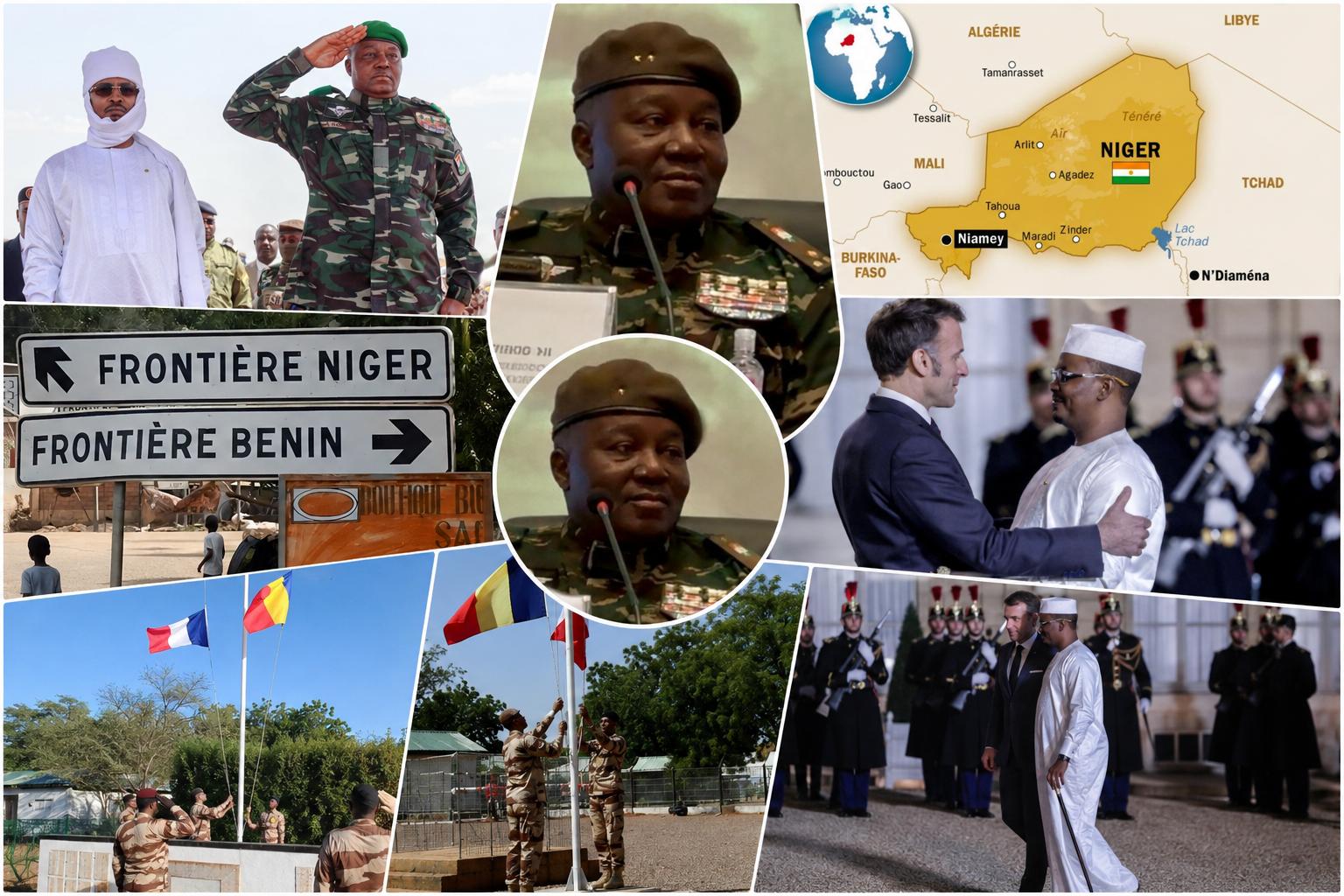
Niger maintains closed border with Benin despite diplomatic thaw
Nearly three years after the July 2023 coup, the border between Niger and Benin remains firmly shut. Despite months of diplomatic engagement and technical discussions between Niamey and Cotonou, no concrete progress has been made toward reopening this critical trade and transit corridor.
While both countries have restored dialogue and established working groups to address security, economic, and legal concerns, Niger continues to uphold its stringent preconditions for reopening the border. In a recent public address, General Abdourahamane Tiani emphasized that any reopening must be preceded by ironclad guarantees—particularly regarding security and the absence of hostile foreign forces operating near the border.
This stance reflects Niger’s long-standing position: Benin’s territory must not serve as a staging ground for operations that could threaten Niger’s sovereignty or stability.
Paris and Cotonou deny military base allegations
Benin has consistently rejected claims that foreign military bases operate within its borders, particularly in the northern regions. In January 2025, Foreign Minister Olushegun Adjadi Bakari reiterated this position, dismissing rumors of a French military presence in the area.
France, too, has publicly denied establishing a permanent military base in northern Benin. In March 2026, French Chief of Defense Staff General Fabien Mandon clarified that no such facility exists, labeling the accusations as unfounded.
However, the reality is more nuanced. While France does not maintain a fixed base in Benin, it provides ad hoc security support, including training and operational assistance to Benin’s armed forces. Reports from April 2026 referenced the discreet deployment of French special forces alongside Benin’s troops in counterterrorism operations. Paris officially frames this cooperation as training missions rather than a permanent military footprint.
Chad’s rapprochement with France exposes Niamey’s dilemma
The situation takes a new turn as Chad—another neighbor of Niger—has begun to restore military ties with France. After severing defense cooperation in late 2024 in a bid to assert full sovereignty, N’Djamena has since welcomed French military personnel back in a scaled-down, low-profile arrangement.
This shift aligns with Chad’s pragmatic response to pressing security challenges: spillover from the Sudan conflict, the persistent threat of Boko Haram in the Lake Chad Basin, and urgent needs for intelligence, surveillance, and logistical support. For Chad, the decision reflects sovereign autonomy—one that Niger may find difficult to challenge.
Yet, for Niger, this development raises a critical question: If the presence of French forces near Benin’s border is deemed a security risk sufficient to keep the border closed, why does Niger not apply the same logic to Chad? The paradox lies in the geographical reality: Niger shares extensive borders with both countries, making the distinction between “acceptable” and “unacceptable” foreign military cooperation appear arbitrary.
Sovereignty vs. consistency: the core of the debate
The Niger–Benin border crisis has evolved into a broader discussion about the application of sovereignty in regional diplomacy. Mali, Burkina Faso, and Niger have made sovereignty and the rejection of former colonial powers a cornerstone of their foreign policy, culminating in their withdrawal from ECOWAS and the formation of the Alliance of Sahel States.
Chad, however, has pursued a divergent path, opting to re-engage with France while maintaining other international partnerships. This choice, though sovereign in nature, challenges Niger’s position: Can a principle like sovereignty be selectively applied when it comes to neighboring countries’ military alliances?
The crux of the issue is not whether Niger should close its border with Chad. It is whether Niger can reconcile its rhetoric on sovereignty with its actions toward Benin. If military cooperation with France is considered a threat when it occurs west of Niger, why is it not perceived as such when it happens to the east?
Toward a resolution—or deeper contradictions?
There are signs that both Niger and Benin recognize the economic and security costs of their prolonged border closure. Cross-border communities, traders, and transporters have borne the brunt of a political dispute that transcends local interests. Additionally, rising violence in the shared border regions with Nigeria underscores the urgent need for coordinated security efforts.
A potential breakthrough could emerge if both nations shift the focus from geopolitical tensions to practical cooperation. Niger may legitimately seek security assurances from Benin, but these must be based on verifiable actions, transparent mechanisms, and mutual commitments—not on blanket opposition to French involvement.
Ultimately, Niger faces a pivotal choice: uphold a doctrine that treats all neighbors equally in matters of military cooperation, or risk being seen as applying double standards. The return of French forces to Chad has transformed this border dispute from a bilateral issue into a test of regional consistency. The question now is whether Niger will prioritize principle over contradiction—or whether the contradictions themselves will define the next phase of Sahel diplomacy.