
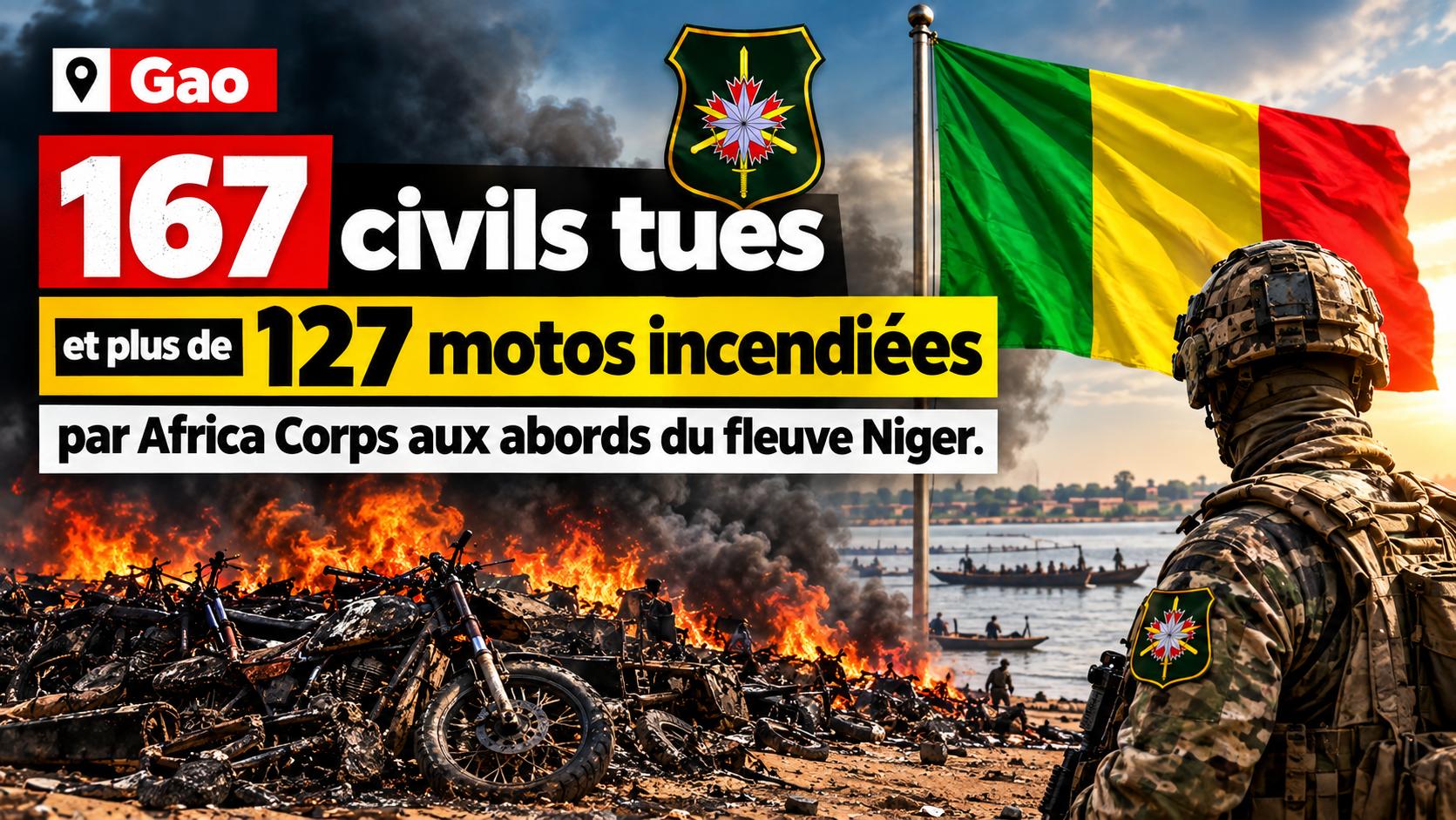
A deadly dawn raid on the banks of the Niger river
As the first light crept over the outskirts of Gao on the morning of Tuesday, 15 September 2026, the quiet of the riverside was shattered by automatic gunfire and thick columns of black smoke rising above the Niger river. In this vital area that sustains local livelihoods, a patrol of Russian mercenaries from Africa Corps — the outfit that has replaced the Wagner group on the continent — launched an operation of extraordinary brutality against unarmed civilians.
The toll is devastating: 167 civilians summarily executed and more than 127 motorcycles deliberately gathered and set ablaze by the foreign fighters. Market gardeners, fishermen and traders were targeted just as they were starting their working day. The attack left behind a scene of utter desolation, plunging the local community into mourning, bewilderment and a climate of absolute terror.
A human massacre compounded by economic strangulation
Beyond the horror of the loss of life, the targeted destruction of transport equipment deals a fatal blow to the entire informal economy of the area. In Gao, a motorcycle is not a luxury: it is the fundamental working tool of young people, the only way to move goods from the river to the markets, and the financial backbone of remarkable family support networks.
“They fired without warning before rounding up our vehicles to set them on fire. My brother is among the victims. Without my motorcycle and without him, we have nothing left to live on or to feed our children tonight,” a survivor recounts under condition of anonymity, his voice broken by grief.
By destroying more than a hundred means of transport and killing those who ride them, the mercenaries are not trying to secure the area: they are deliberately suffocating the civilian population. The burning of the vehicles immediately paralyses the supply of fresh produce, threatening the city with a serious food crisis and pushing hundreds of families into absolute destitution.
The bloody failure of the alliance with the junta
These tragic abuses in Gao highlight the dramatic drift of the security alliances sealed by the military regimes of the region. In Niamey as in Bamako, the rapprochement orchestrated by the junta of General Abdourahamane Tiani and its allies in the Alliance of Sahel States (AES) with Moscow was touted as a sovereign solution to restore order.
On the ground, reality brutally contradicts the official propaganda. The deployment of Africa Corps has not neutralised terrorist groups; it has simply introduced a predatory and uncontrollable force that massacres local populations. Acting with total impunity, the Russian mercenaries behave as occupying troops of blind violence rather than as protectors of the nations they claim to assist.
This absolute dependence on private fighters severely undermines social cohesion and the authority of states. By remaining silent in the face of this carnage of 167 civilians, the junta and its partners become complicit in abuses that definitively discredit their rhetoric of emancipation and security.
A traumatised population facing arbitrary rule
In Gao, shock has now given way to a deep sense of abandonment and injustice. Residents see daily that promises of order and stability translate into the brutality of armed men who answer to no national command and flout international humanitarian law with impunity.
The fear of another attack now paralyses all life along the Niger river. Survivors are afraid to return to their workplaces, deserting the riverbanks for fear of once again crossing paths with the death patrols.
Faced with this unprecedented carnage, the transitional authorities cannot content themselves with their usual silence. The people of Gao are not asking for geopolitical slogans, but for the most basic right to life and dignity — a right that Africa Corps continues to trample in blood.