
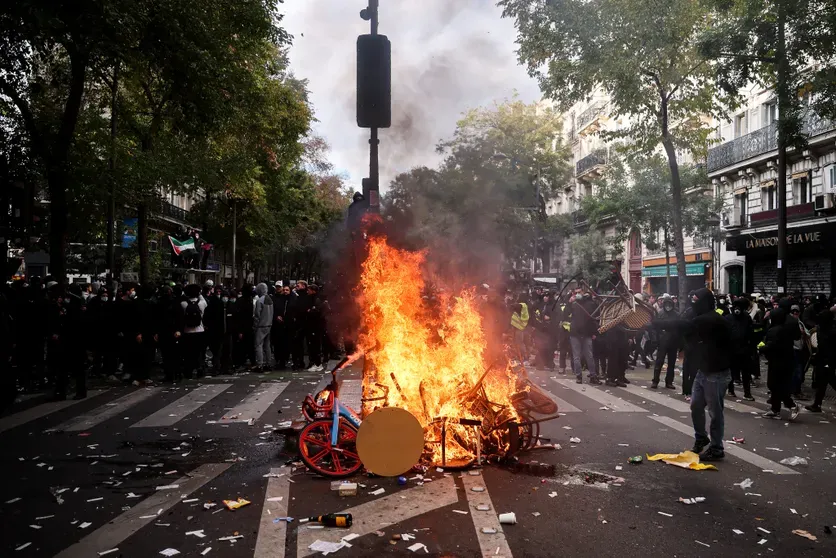
The recent waves of protests and riots in France—marked by burning vehicles, violent clashes with police, and dense tear gas fumes—are not just local disturbances. They have become a powerful propaganda tool in the Sahel, where military regimes in Bamako, Ouagadougou, and Niamey are twisting these images to serve their anti-Western agendas. But does this urban chaos truly strengthen their position, or does it reveal cracks in their own arguments?
From French streets to Sahelian narratives: the propaganda engine
In the capitals of the Alliance of Sahel States (AES), social media is no longer just a platform for discourse—it’s a battlefield. What international observers interpret as domestic unrest, pro-junta influencers reframe as proof of Western decline. The sight of French cities in turmoil is no longer confined to national debates; it’s repurposed as evidence of hypocrisy, a reckoning with colonial history, and a justification for authoritarian governance.
Since the rise of leaders like Assimi Goïta in Mali, Ibrahim Traoré in Burkina Faso, and Abdourahamane Tiani in Niger, these regimes have waged a relentless information war against France. Their strategy hinges on exploiting France’s internal vulnerabilities to bolster their own legitimacy. After years of conditioning foreign aid on democratic principles and human rights, Paris now faces its own contradictions being weaponized against it.
How Sahel juntas weaponize France’s instability: a three-pronged approach
Undermining the myth of Western democracy
For Sahel juntas, the unrest in France is more than a domestic crisis—it’s a visual argument against liberal democracy. By highlighting scenes of police brutality and mass protests, they position their authoritarian rule as the only viable alternative. The same tools once championed by Western governments—free press, multiparty systems, and civil liberties—are now framed as weaknesses. In this narrative, order and sovereignty take precedence over democratic ideals, and France’s struggles become proof that their model is superior.
Distracting from local failures
The dominance of French unrest in global media provides a convenient smokescreen for Sahel juntas. While international attention is fixated on Paris, pressing issues in the Sahel—escalating insecurity, economic hardship, and energy shortages—fade into the background. This media distraction allows regimes to delay elections, suppress opposition, and justify prolonged rule under the pretext of ‘national urgency.’ The more France’s image falters, the easier it becomes for juntas to consolidate power without accountability.
Accelerating the narrative of Western decline
The anti-French propaganda in the Sahel is amplified by global networks aligned with Moscow, turning local unrest into a broader story of European decline. As France’s stability wavers, Sahelian leaders argue that clinging to Western partnerships is futile. Their pivot toward Russia, Turkey, and Iran is framed not as a strategic gamble but as an inevitable shift in global power dynamics. The message is clear: the West is no longer the future, and resisting this change is a losing battle.
The inconvenient truth Sahel juntas ignore
While the propaganda is potent, it rests on a flawed foundation. The very freedoms that French citizens exercise—the right to protest, strike, and openly criticize their government—are systematically denied in Sahel capitals like Bamako, Ouagadougou, and Niamey. In France, dissent is protected by law; in these regimes, it often leads to arrest, censorship, or worse. Yet this contradiction is overlooked in the junta narrative, which thrives on simplifying complex realities into a single, seductive message: the West is failing, we are rising, and our way is the only path forward.
Independent analysts warn that France’s domestic struggles are eroding its diplomatic credibility in the Sahel—not because of junta lies, but because of the visible gap between its ideals and its actions. The irony? The more France grapples with internal chaos, the more its global image weakens, not due to foreign manipulation, but because its own contradictions are laid bare for all to see.
Does the propaganda actually work? The long-term impact
Assessing the success of this narrative warfare is complex. Polls indicate dwindling support for France in Sahel capitals, but they also reflect deep societal fractures—youth unemployment, systemic corruption, and widespread distrust in both local and foreign powers. The junta narrative succeeds not because it reflects absolute truth, but because it offers a compelling, simplified story: abandon the West, embrace our vision, and stability will follow.
For now, the unrest in France fuels the anti-Western engine of Sahel juntas. But like all narratives built on shaky ground, this one may eventually face the test of reality. Will Sahel populations, weary of instability, continue to trade freedom for security—or will they begin to demand both? The answer could redefine the future of the region.