
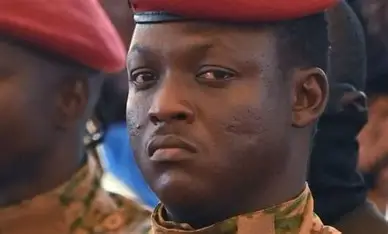
In Burkina Faso, each statement by Captain Ibrahim Traoré fuels further debate regarding the nature of his leadership and the trajectory of the country since the September 2022 coup. Recent remarks by the transitional leader leave little room for ambiguity: they reflect a clear intention to fully embrace an acquisition of power outside any constitutional framework, presenting this rupture as a new political standard.
From coup to mandate: the erosion of democratic foundations
Captain Ibrahim Traoré did not ascend to the highest office through universal suffrage. His rise followed a military takeover that ousted Lieutenant-Colonel Paul-Henri Sandaogo Damiba, who himself had seized power in a prior coup against President Roch Marc Christian Kaboré. This succession of military overthrows underscores a profound departure from the democratic principles that traditionally underpin a head of state’s legitimacy.
Beyond the circumstances of his arrival, the discourse surrounding his ascent raises significant concerns. By publicly embracing this break with constitutional order, Traoré, according to critics, implies that force could become an acceptable means of gaining power—as long as it garners temporary popular support. Such a premise carries grave risks. If political legitimacy no longer stems from institutions, elections, or the rule of law but from the ability of an armed faction to impose itself, future grievances could similarly justify further military interventions. This cycle deepens institutional fragility and fosters chronic instability where the barrel of a gun gradually eclipses the ballot box.
The limits of sovereignty and patriotism as governance benchmarks
Proponents of the transitional regime often highlight restored sovereignty, a break with certain foreign powers, and a resurgence of national pride as key achievements. While these themes resonate with the public, they cannot alone constitute a governance record. History demonstrates that nationalist slogans—however popular—do not replace tangible outcomes in economic stability, security, or institutional functionality.
Instead, political communication appears to dominate governance. Rhetoric flows freely, patriotic symbols proliferate, and displays of support are amplified across social media. Yet critical questions persist about concrete progress on the very challenges cited to justify the coup: combating terrorism, reclaiming territory, and improving living conditions for the population.
Security: the unmet expectation
The most pressing test of the transitional leadership remains security. Despite announced reforms and military restructuring, numerous regions continue to face deadly attacks, mass displacements, and a humanitarian crisis affecting hundreds of thousands of Burkinabè. In several localities, civilians live under perpetual threat from armed groups, while access to healthcare, education, and public services remains severely disrupted.
Economic strain: unfulfilled promises
The economic landscape remains equally troubling. Insecurity continues to hamper agriculture, domestic trade, and investment. Citizens anticipate tangible improvements in daily life: stable employment, higher purchasing power, reliable access to essential services, and a climate conducive to rebuilding futures. Thus far, these aspirations have not translated into commensurate progress since 2022.
The dangers of unchecked power
Critics also warn of an increasing concentration of authority. Dissenting voices—journalists, civil society actors, and opposition figures—operate within an environment where criticism of the regime is often conflated with disloyalty to the nation. This conflation of patriotism with unconditional support for the leadership represents a troubling deviation. In a democracy, loving one’s country does not equate to endorsing its rulers without question.
The adage “Jupiter renders mad those he wishes to destroy” gains particular resonance here. It is not a personal indictment but a universal reflection on the corrosive effects of power. History is replete with leaders who, convinced of their indispensability, gradually dismiss criticism, sideline opponents, and confuse their personal fate with that of the nation. Such hubris often leads to the rejection of institutional checks and balances.
This is the precise risk observers highlight. The more a leader centralizes power and portrays their authority as unassailable, the greater the likelihood of losing touch with the realities faced by the populace. Applause at rallies, orchestrated communications, and curated displays of loyalty are no substitute for measurable progress on the ground.
The true measure of leadership
Ultimately, a head of state’s legitimacy is not forged through force, rhetoric, or defiance—it is built on the bedrock of institutional integrity, citizen protection, the safeguarding of fundamental freedoms, and sustainable improvements in quality of life. It also requires an understanding that power is a means, not an end. It is against these standards that Ibrahim Traoré’s tenure will be judged. Until tangible solutions emerge for the security, economic, and social crises gripping Burkina Faso, debates over his legitimacy and the durability of his rule will persist.