
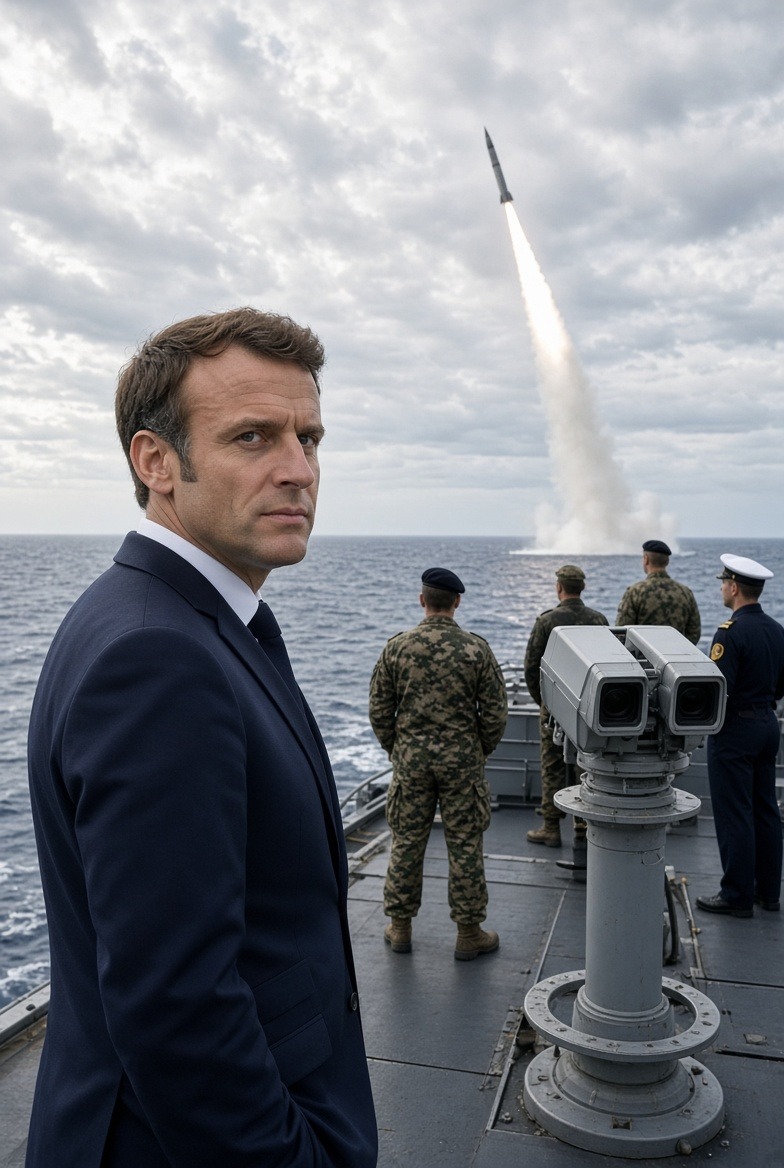
The maiden acceptance firing of the M51.3 ballistic missile from the nuclear-powered submarine Le Vigilant has thrust France into the heart of a pivotal strategic dilemma across Europe. Conducted on October 6, 2026, off the coast of Brittany, this test was more than a technical validation—it was a geopolitical statement as President Emmanuel Macron personally observed the launch aboard the multi-mission frigate Auvergne.
With its enhanced range, precision, and penetration capabilities, the M51.3 represents the latest evolution in France’s sea-based nuclear deterrent. Yet this demonstration comes at a time when European skies are increasingly contested—drones swarm sensitive airspace, Russian fighter jets probe Baltic frontiers, and NATO scrambles interceptors over Poland and Romania. The message from Paris is unambiguous: credibility in deterrence requires not only advanced technology but also visible commitment.
Why the M51.3 test matters now
While the missile was unarmed and its flight monitored by the armed forces’ trials vessel Monge, the political symbolism of the launch was undeniable. Since entering operational service in October 2025, the M51.3 has been designed to overcome increasingly sophisticated missile defenses—a critical upgrade as adversaries expand their anti-access/area-denial capabilities.
France’s nuclear deterrent rests on two pillars: airborne and submarine-launched systems. The Le Triomphant-class submarines, including Le Vigilant, provide a survivable sea-based strike force, their stealth enabling them to remain undetected even under intensified surveillance. The M51.3’s improved maneuverability and accuracy ensure that this second-strike capability remains credible, even as global missile defense networks evolve.
From Ukraine to the Baltic: A continent on edge
The backdrop to this test could hardly be more volatile. Since Russia’s full-scale invasion of Ukraine in 2022, Europe’s strategic landscape has shifted irrevocably. Incidents now span multiple domains:
- Airspace violations over Poland and Romania, attributed to Russian aircraft;
- Drone incursions in Lithuania, intercepted by NATO fighters;
- Maritime attacks in the Black Sea, including the suspected Russian drone strike on a Togolese-flagged merchant vessel off Bulgaria;
- Electronic warfare and cyber operations targeting critical infrastructure across the EU.
While NATO Secretary General Mark Rutte has cautioned that no immediate attack on Alliance territory is expected, the cumulative effect of these provocations has forced Europe to recalibrate its defense posture. Operation Eastern Sentry, launched in 2025 and expanded in 2026, integrates aerial combat assets, missile defense systems, and maritime surveillance into a unified air-defense architecture designed to counter drones, cruise missiles, and ballistic threats alike.
The French doctrine: Power as a condition of freedom
President Macron’s framing of the M51.3 test reflects a deeply held French strategic principle: to remain free, one must be feared; to be feared, one must be powerful. This is not mere rhetoric. Over the past decade, France has doubled its defense budget, accelerated construction of next-generation ballistic missile submarines, and launched development of a hypersonic glide vehicle for its airborne component.
The M51.3 is therefore more than a missile—it is a statement of strategic autonomy. In a continent increasingly exposed to hybrid warfare and gray-zone aggression, Paris argues that nuclear deterrence remains an ultimate insurance policy for vital national interests. Unlike conventional or alliance-based security guarantees, a sovereign nuclear capability ensures France retains decision-making authority in crises.
Beyond missiles: Adapting to a hybrid battlefield
Yet deterrence today is not solely about megatonnage or megawatts. It encompasses electronic warfare, satellite disruption, and swarming drone tactics. The synchronized nature of modern conflict—cyberattacks on power grids coinciding with missile tests, sabotage of pipelines paralleling airspace violations—demands a holistic approach.
France’s response integrates nuclear modernization with broader conventional upgrades, intelligence-sharing with European partners, and investments in space-based surveillance. The M51.3, in this context, symbolizes France’s determination to keep pace with both technological change and geopolitical volatility.
What’s next for European security?
As the M51.3 redefines France’s undersea deterrent, the broader question remains: Can Europe balance escalation control with credible defense? The continent’s eastern flank is now fortified, but deterrence is not a static equation. It demands constant adaptation—technologically, doctrinally, and politically.
For France, the message is clear: the line between preparation and escalation is thin, but crossing it must carry unacceptable costs. In doing so, Paris is not calling for confrontation—it is asserting the sobering reality that in today’s Europe, the greatest risk may not be the war that breaks out, but the peace that never secured its guarantees.