
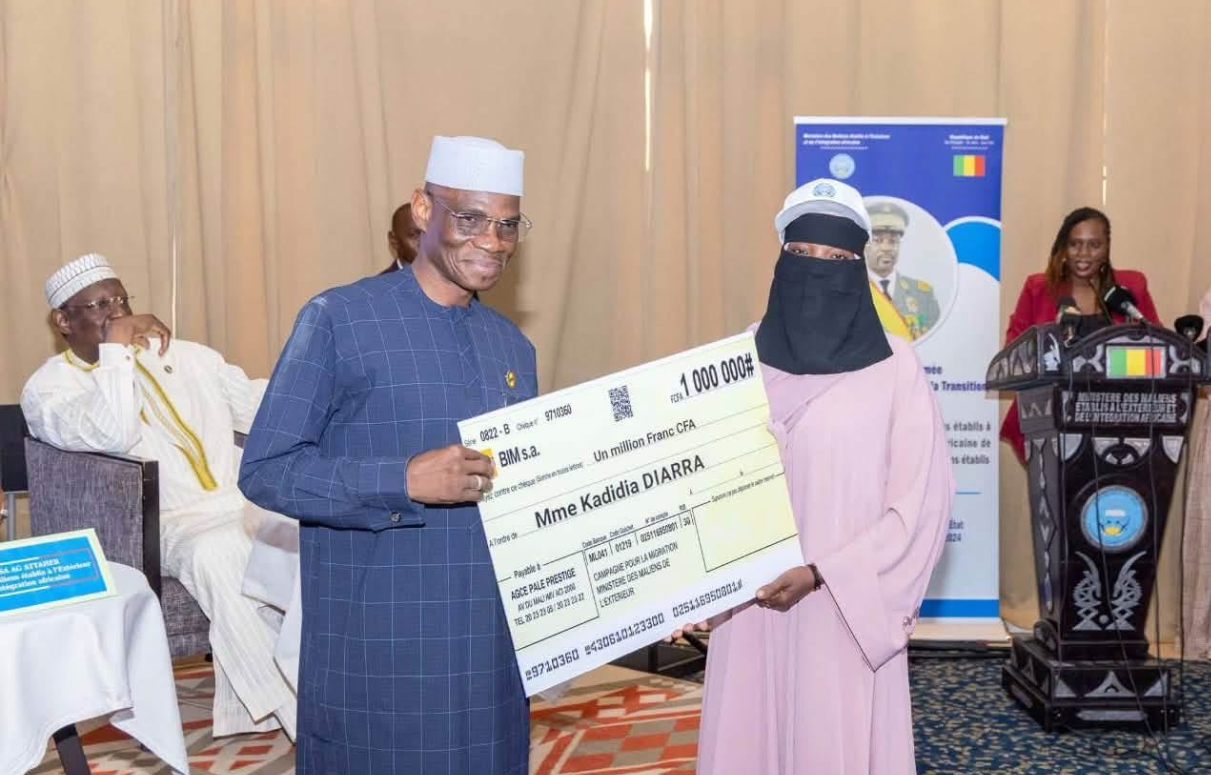
Mali’s latest pledge to reintegrate returned migrants has raised more questions than answers. On October 12, Mossa Ag Attaher, Minister of Malians Abroad and African Integration, distributed financing to 90 socio-economic projects aimed at supporting returnees. The total allocation: 121 million FCFA—roughly 1.3 to 2.7 million per project. Out of 206 applications, only 90 were selected, with funding entirely covered by the Special Investment Budget. Sectors highlighted include livestock, market gardening, agriculture, trade, handicrafts, and services. Beneficiaries are scattered across Bamako and a handful of regions, including Gao, Tombouctou, Nioro, Kita, and San.
At first glance, the initiative appears structured, nationally coordinated, and aligned with current efforts to leverage diaspora contributions. The minister emphasized rigorous management, exemplary governance, and territorial follow-up, even singling out returnees from Saudi Arabia—often overlooked in mainstream reintegration programs. Yet beneath the polished announcement, significant uncertainties cloud the initiative’s credibility and long-term potential.
How were the winners chosen — and who really benefits?
The selection process remains shrouded in secrecy. No public criteria have been disclosed, leaving observers to wonder: what criteria guided the 90 selections out of 206 applications? Was priority given to economic viability, vulnerability levels, return timelines, or possibly less transparent factors such as political connections or personal networks? Past funding rounds—75 projects for 100 million FCFA in 2025 and 40 projects through civil society organizations in 2024—also lacked transparent evaluation frameworks. The absence of clear, published guidelines fuels speculation about favoritism, patronage, or uneven access, undermining public trust in a system meant to support those rebuilding their lives after migration.
Even more troubling is the lack of public beneficiary details. No names. No exact funding amounts per project. No breakdown of project types. In a country where skepticism toward public fund management is deeply rooted, this opacity isn’t just concerning—it’s a red flag. Without transparency, how can anyone verify that funds reach their intended recipients? That disbursements aren’t diverted? That grassroots entrepreneurs aren’t sidelined in favor of connected elites?
Follow-up promised, but impact remains unseen
The minister pledged territorial monitoring to ensure the sustainability of funded projects. But here’s the catch: no public evaluation has ever been released for earlier rounds. How many of the 2024 and 2025 projects are still operational? How many generate stable income or create jobs? How many collapsed once the subsidies ran out? Without performance metrics, independent audits, or public reporting, this initiative risks remaining a series of ad-hoc gestures rather than a measurable public policy. It’s one thing to announce funding—it’s another to prove it delivers lasting change.
A drop in the ocean, or a symbolic gesture?
Since 2022, the MPRR-SSA program—largely funded by the European Union and implemented with support from international agencies—has facilitated the return of over 27,800 Malians and supported more than 14,000 reintegration projects. Against this scale, 90 projects funded with 121 million FCFA feel more like a symbolic nod than a substantive investment. The risk? Framing a limited, short-term initiative as a major “commitment to development” creates a dangerous illusion of progress—while the vast majority of returned migrants remain without structured support, left to navigate reintegration alone.
Unanswered questions and unspoken realities
Funding for this initiative comes from the Special Investment Budget—a finite pool in a fiscally strained environment. But where exactly do these 121 million FCFA come from? Have they been redirected from other urgent priorities? Additionally, the beneficiary list raises questions: are these exclusively recent returnees, or do they include individuals who returned years ago? Most critically, how does this government-led initiative align—or clash—with existing programs run by international partners such as the IOM? The absence of clarity risks duplication of efforts, missed opportunities, or worse: leaving critical gaps unfilled.
Is transparency just a word in Bamako?
The stated goal—helping compatriots rebuild sustainable livelihoods after often harrowing migration experiences—is undeniably important. But a public policy worthy of the name is measured not by announcements, but by transparency, traceability, and measurable outcomes. Today, this initiative remains a black box: applications submitted, projects selected, funds disbursed… and silence on everything that follows.
Without public disclosure of beneficiary lists, selection criteria, or impact reports from prior years, skepticism isn’t just justified—it’s inevitable. And in a field as sensitive as reintegrating returned migrants, uncertainty is never neutral. It erodes trust, sows doubt, and risks turning a well-intentioned program into yet another missed opportunity for real, lasting change.
What needs to happen next?
To restore credibility, the Malian government must take immediate steps toward transparency: publish the full list of beneficiaries, disclose the exact allocation per project, and release third-party audits of past rounds. Only then can the 121 million FCFA allocation shift from a headline-driven initiative to a tangible investment in Mali’s future—and the futures of those who have returned.