
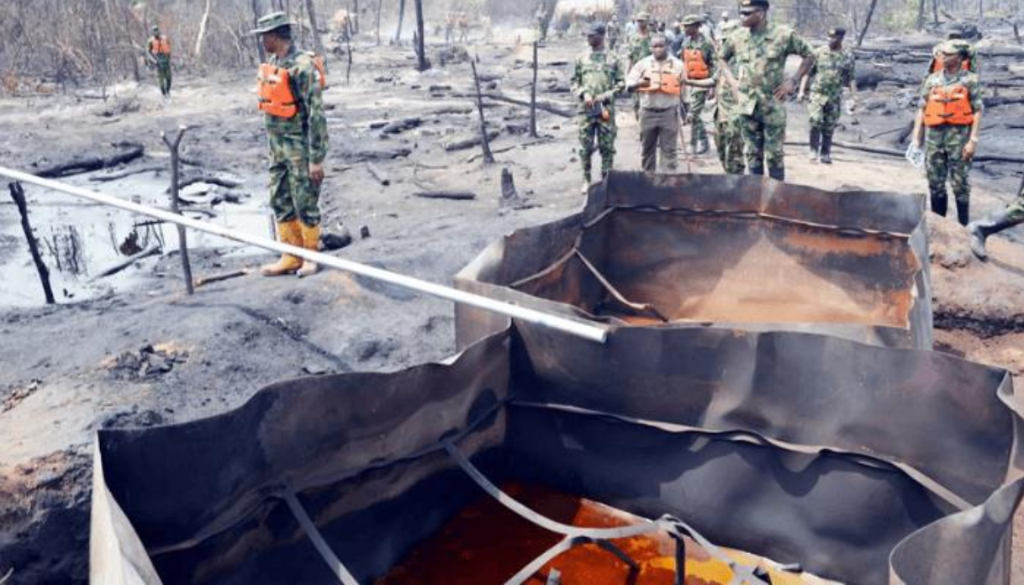
The unearthing of a massive underground oil refining operation in Ogun State has thrown Nigeria’s economic security into sharp focus. Authorities uncovered what appears to be a clandestine facility operated by foreign nationals, raising urgent questions about the exploitation of Africa’s largest oil reserves and the integrity of Nigeria’s regulatory framework. This development comes as officials scramble to determine how such an operation could thrive outside official oversight.
What exactly was discovered in Ogun State?
Investigators from the Nigerian Economic and Financial Crimes Commission (EFCC) raided a hidden industrial site in Ogere, located in Ogun State’s southwest region. The facility spanned over three hectares and contained extensive infrastructure designed to process crude oil residues into marketable fuels. Key components included underground storage tanks, heating systems, separation devices, and cooling units. One notably large tank held an estimated 90,000 liters of processed material.
According to initial assessments, the facility used so-called “black sludge” — viscous petroleum byproducts — sourced from major southern hubs such as Warri (Delta State) and Port Harcourt (Rivers State). These raw materials were subjected to rudimentary refining processes, producing a diesel-like fuel known locally as AGO. Crucially, the operation functioned without any regulatory approvals or oversight.
How did this illegal refinery operate for so long?
The scale and persistence of this operation suggest a sophisticated supply chain. Authorities are now probing how raw materials were transported hundreds of kilometers, stored securely, and processed consistently — all while evading detection. Key inquiries include:
- Who supplied the crude residues and funded the equipment?
- How were the finished products transported and sold?
- Were local authorities or transport officials involved in facilitating the trade?
- Who benefited financially from the operation?
Without arrests on site, investigators must piece together financial trails, logistical routes, and potential local collaborators. This raises concerns about institutional complicity — though no evidence has yet emerged implicating government agencies.
The environmental and economic toll of illegal refining
This unauthorized facility poses severe risks on multiple fronts. Environmentally, the primitive refining process releases toxic fumes, contaminates soil, and threatens groundwater supplies. Without proper containment, spilled residues can seep into farmland and waterways, harming ecosystems and public health.
Economically, the operation undermines Nigeria’s formal sector. By avoiding taxes, licensing fees, and quality controls, illegal refiners undercut legitimate businesses that operate within the law. Consumers, too, face danger: uncertified fuels can damage vehicle engines and industrial equipment, while improper storage increases fire and explosion hazards.
Foreign operators and Nigeria’s regulatory challenge
The discovery of a foreign-backed illegal refinery comes amid growing scrutiny of non-Nigerian involvement in the country’s strategic sectors. While Chinese enterprises operate across mining, infrastructure, and trade, this case raises specific concerns about oversight of foreign economic actors.
It remains unclear whether this operation reflects coordinated foreign policy or isolated criminal activity by individuals. However, the incident exposes systemic gaps in Nigeria’s ability to monitor and regulate resource extraction within its borders.
What comes next for Nigeria’s oil sovereignty?
This is more than a law enforcement issue — it is a test of Nigeria’s capacity to secure its natural wealth. Authorities face critical tasks ahead:
- Identifying and prosecuting those responsible for establishing and operating the refinery
- Tracing financial flows to uncover profit recipients and potential money laundering
- Reviewing supply chains and transport routes to dismantle smuggling networks
- Strengthening inter-agency coordination to prevent future breaches
Ultimately, Nigeria’s oil wealth offers immense potential — but only if it is extracted, processed, and sold under legitimate governance. The discovery in Ogun State is a stark reminder: a nation rich in resources must also be vigilant in protecting them.