
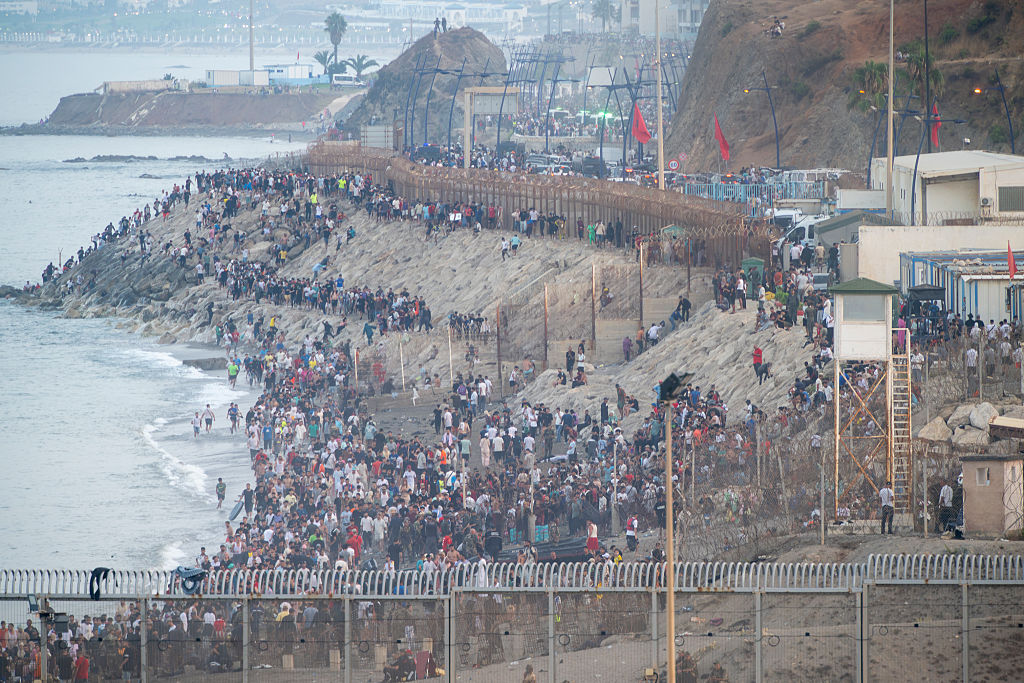
The Moroccan government has reiterated that it will not abandon its long-standing territorial claims over the Spanish enclaves of Ceuta and Melilla, according to insights from a former Spanish ambassador to Rabat. The declaration comes at a time when Spain faces its most severe migration crisis in decades, with over 72,000 irregular entries recorded in Ceuta during late July.
Jorge Dezcallar, who previously served as Spain’s ambassador to Morocco and director of the Spanish intelligence agency CNI, emphasized that unresolved border disputes between the two nations have played a critical role in exacerbating the recent surge of migrants. He noted that Morocco appears to be testing Spain’s resolve, particularly as Madrid grapples with political instability and a perceived weakening government.
The left-wing administration led by Prime Minister Pedro Sánchez has faced mounting criticism over corruption scandals involving high-ranking officials and close associates. Additionally, its progressive immigration policies and vocal opposition to certain U.S. policies have strained relations with key European allies, further complicating diplomatic engagements with Rabat.
Diplomatic friction and historical grievances
Relations between Spain and Morocco have long been marked by volatility, swinging between cooperation and confrontation. Despite robust economic ties and vital collaboration on security, migration control, and counterterrorism, the issue of Ceuta and Melilla remains a persistent sore point. Morocco’s monarchy and government officials have increasingly amplified their calls for sovereignty over these territories, which have been under Spanish control for centuries—long before modern Morocco existed as a state.
Abdellatif Ouahbi, Morocco’s Justice Minister, reaffirmed this stance in recent remarks, stating, « This question remains unresolved. Every time we meet with Spanish counterparts, we raise it. We are firmly committed to our territories… It is a matter we will address through dialogue and patience. »
Madrid has responded firmly. Margarita Robles, Spain’s Defense Minister, declared unequivocally, « Ceuta and Melilla are Spanish, and they are non-negotiable. » Her statement followed a high-profile visit to Ceuta, a rare occurrence in recent diplomatic history. Notably, King Felipe VI has never traveled to either enclave, and a Spanish foreign minister only made such a visit for the first time this week—an apparent effort to avoid provoking Morocco.
Unresolved tensions fuel migration challenges
Both countries cite human trafficking networks as the immediate trigger for the latest crisis. In July, Spain’s Supreme Court ruled against the immediate repatriation of migrants arriving by sea in Ceuta and Melilla, a decision that smugglers swiftly exploited. Dezcallar cautioned that Moroccan authorities may have shown either negligence or deliberate permissiveness in allowing the influx.
He further warned that Spain lacks the necessary capacity to curb such crossings, particularly given their recurrence. A previous diplomatic rupture in 2021 occurred after Spain permitted the hospitalization of a Sahrawi leader, Brahim Ghali. In retaliation, Morocco facilitated the arrival of nearly 10,000 migrants in Ceuta—a move widely condemned by Spanish officials as « blackmail. »
Dezcallar criticized the Spanish government for failing to heed early warnings from Ceuta’s authorities about rising irregular arrivals in the days leading up to the crisis. Intelligence sources recently alerted of a potential new surge on August 15, coinciding with calls on social media for an organized assault on the city. Police and Guardia Civil unions have also confirmed these threats.
The former ambassador concluded with a stark warning: « Anyone who believes Morocco will abandon its claims on Ceuta and Melilla is mistaken. » The territorial dispute remains a defining, unresolved challenge in Spain-Morocco relations.