
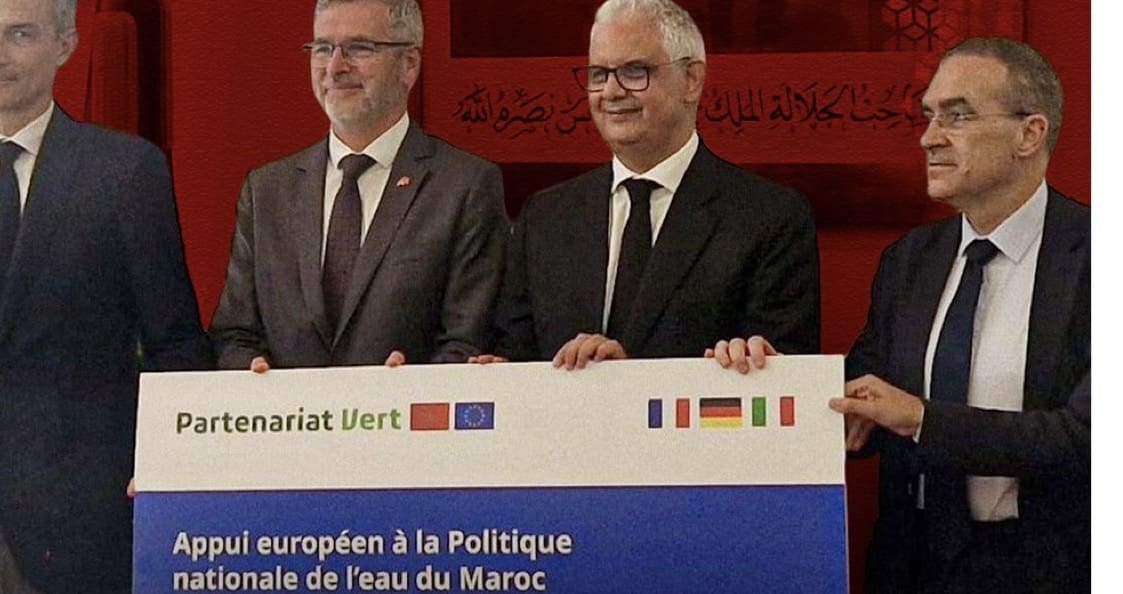
Morocco has taken a major step toward securing its water future with a landmark financial agreement signed alongside the European Union (EU) delegation and the embassies of Germany, Italy, and France. The initiative, backed by a total investment of 3.7 billion Moroccan dirhams (equivalent to 402.2 million US dollars), aligns with the country’s National Water Policy (PNE), reinforcing efforts to enhance water governance across three critical dimensions: resource assessment, extreme event management, and institutional capacity building.
The funding structure includes a direct grant of 514.4 million dirhams from the EU, complemented by three loans totaling 3.2 billion dirhams secured from European financial institutions. The program also incorporates technical support and knowledge exchange frameworks to strengthen collaboration between Moroccan authorities and their European counterparts.
Morocco faces severe water stress, exacerbated by prolonged drought conditions, declining rainfall, and a sharp rise in water demand. Over the past seven years, the Kingdom has endured consecutive years of below-average precipitation, intensifying pressure on an already fragile resource.
In response, Rabat has launched a series of large-scale water infrastructure projects designed to secure long-term supply. These include the expansion of dam networks, the development of cross-regional water interconnections, and the implementation of wastewater recycling initiatives. Urban and agricultural water distribution systems are also undergoing modernization to minimize losses and improve efficiency.
Anchoring the strategy is Morocco’s bold push toward seawater desalination, positioning the technology as a cornerstone of its water security agenda. The initiative aims to meet over 50% of drinking water needs by 2030 while extending irrigation coverage to support agricultural productivity and bolster national food sovereignty.