
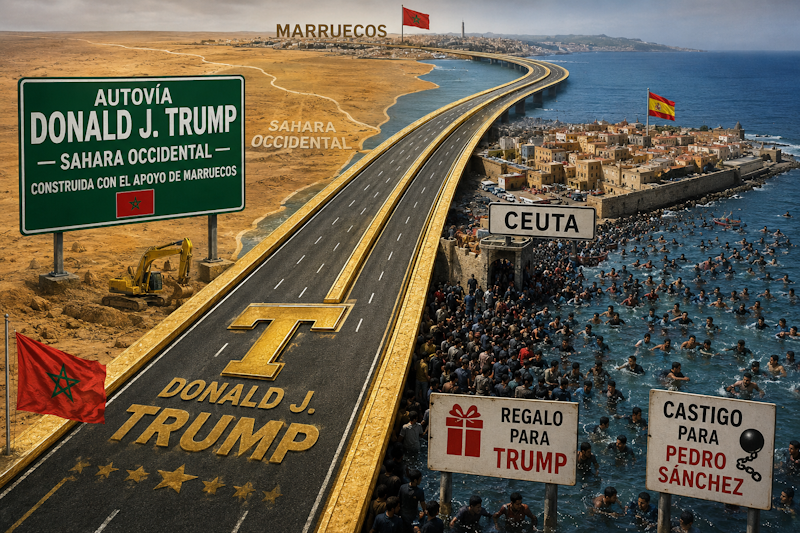
As summer 2026 unfolds, Morocco is orchestrating a high-stakes diplomatic play involving Washington and Madrid, with the disputed Western Sahara territory at its core. While the North African kingdom seeks to solidify American backing, it’s deploying an unexpected pressure point: the Spanish enclave of Ceuta.
The Moroccan government has pulled out all the stops, most notably through the symbolic renaming of the Tiznit-Dakhla highway—the continent’s longest road infrastructure—to honor former US President Donald Trump. This gesture, personally approved by King Mohammed VI, serves as a tangible thank-you for the 2020 US recognition of Morocco’s sovereignty over Western Sahara, a move that reshaped the geopolitical landscape of North Africa.
The monarch emphasized the highway’s strategic importance, stating it “binds Morocco’s northern and southern regions while connecting Europe to Africa.” Trump responded swiftly on Truth Social: “What an incredible honor! Can’t wait to drive this magnificent highway soon!”
Ceuta crisis becomes a bargaining chip
Yet the highway is merely one piece of Morocco’s strategy. The real leverage lies in the humanitarian disaster unfolding at Ceuta, one of Europe’s two land borders with Africa. In late July, nearly 60,000 migrants surged across the border in a matter of hours, leaving at least 57 dead—mostly from drowning or trampling—according to Spanish authorities. Rabat officially acknowledged 11 fatalities, though the actual toll may be higher.
This wasn’t Morocco’s first use of migration as a diplomatic tool. In May 2021, a similar crisis involving 8,000 crossings forced Spain to abandon its neutral stance on Western Sahara, particularly after Madrid treated Brahim Ghali, leader of the Polisario Front, for medical care—a move that strained relations. Analysts suggest this latest surge is no coincidence: it followed Spanish Prime Minister Pedro Sánchez’s visit to Algiers, where he sought to strengthen ties with Morocco’s regional rival.
Washington’s pivotal role
Morocco’s chessboard extends to the United States, where President Trump’s administration has repeatedly backed Rabat’s position. Secretary of State Marco Rubio reaffirmed Washington’s stance: “The US recognizes Morocco’s sovereignty over Western Sahara.” Trump himself dismissed alternative solutions, calling them “unacceptable” and endorsing Morocco’s autonomy proposal as the only viable path forward.
The White House has also criticized Spain’s migration policies, with a spokesperson warning Madrid that its approach could “jeopardize its own stability.”
Europe’s fragile unity
The Ceuta crisis has sent ripples through the European Union. Italy suspended Schengen agreements with Spain temporarily, joined by Finland and Denmark. Belgian MR party leader Georges-Louis Bouchez even called for Spain’s partial suspension from the Schengen Zone. Experts warn this reflects a broader shift: Morocco’s willingness to weaponize migration as a retaliatory tactic against Spain, particularly due to its two North African enclaves.
Three-pronged strategy
Analysts break down Morocco’s approach into three key components:
- Symbolic diplomacy: The Trump-named highway reinforces US backing for Morocco’s territorial claims.
- Migration pressure: The Ceuta surge underscores Spain’s vulnerability and dependence on Moroccan cooperation.
- UN negotiations: Rabat aims to secure Washington’s support as stalled talks on Western Sahara’s future drag on.
A clear message to Madrid
Morocco’s message is unmistakable: it holds the keys to Europe’s southern border. By combining symbolic gestures for Washington with migration pressure on Madrid, Rabat is weaving a diplomatic web where every thread strengthens its position on Western Sahara. European negotiators are taking note—this is a lesson they won’t soon forget.