
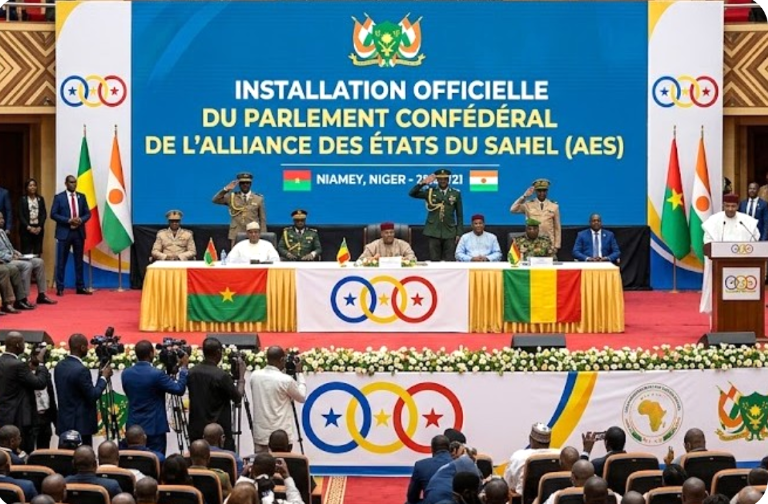
The Alliance of Sahel States (AES) has taken a significant step forward with the inauguration of its new Parliament in Niamey. Yet beneath the carefully orchestrated ceremonies lies a pressing question: can regional integration thrive without democracy, political pluralism, or genuine popular legitimacy?
Building Institutions Without Popular Roots
In late August 2026, representatives from Burkina Faso, Mali, and Niger gathered in Niamey to officially launch the AES’s confederal Parliament. With 45 members—15 from each country—this new body is tasked with shaping the future of the regional alliance. Already, the Parliament has adopted its internal regulations and established three key committees focused on defense, diplomacy, and development.
On the surface, this marks a bold move by three nations that have distanced themselves from the Economic Community of West African States (ECOWAS) to forge their own path. Official statements frame the Parliament as a symbol of regained sovereignty and heightened Sahelian unity. But the deeper issue remains unaddressed: who do these parliamentarians truly represent?
A Mirror Image of ECOWAS
The irony is hard to miss. After criticizing ECOWAS for being distant from its people and lacking sovereignty, the AES has replicated much of its institutional framework—including a confederal structure, shared political bodies, and now a Parliament meant to address regional concerns. The resemblance is striking.
ECOWAS’s Parliament has 115 seats, designed to represent the communities of its member states. While its members are currently chosen from national assemblies, the long-term goal is direct universal suffrage. The AES, by contrast, has a smaller assembly of 45 members, selected in the same way. The difference in scale doesn’t change the fundamental principle: creating a regional body to drive integration.
The real divide lies not in structure, but in legitimacy. And that’s where the problems begin.
Legitimacy in Question
The AES Parliament was born in three countries led by military juntas: Mali since 2020–2021, Burkina Faso since 2022, and Niger since 2023. Promised transitions have stalled, and elections remain indefinitely postponed. In Burkina Faso, the military leadership has gone so far as to declare that democracy is not suited to the nation, urging citizens to “forget” it entirely. Opposition parties have been dissolved, and public freedoms have eroded.
In Mali, military rule has tightened its grip since the 2020 and 2021 coups, with elections repeatedly delayed. Niger’s junta, too, has maintained power despite promises of a quick return to civilian rule. In such an environment, how can a confederal Parliament claim to represent the will of the people?
Democracy on Paper, Autocracy in Practice
The risk is clear: an institution that appears democratic in form but lacks real popular accountability. Seats, committees, and regulations can create the illusion of progress, but they do little to ensure that ordinary citizens have a voice in decisions that shape their lives.
Sovereignty, as framed by AES leaders, is now a central theme in regional discourse. But sovereignty must mean more than breaking ties with former colonial powers. It must also mean empowering citizens to hold their governments accountable. A Parliament without elections, a political system without parties, and a society without free expression cannot claim to serve the people it claims to represent.
The Silent Citizenry
The people of the Sahel face urgent challenges: insecurity, poverty, displacement, unemployment, crumbling public services, and rising living costs. Militant groups continue to destabilize vast areas, displacing millions. Against this backdrop, institutional construction feels hollow if it doesn’t address these daily realities.
A Parliament cannot feed a family. A regional commission cannot rebuild a school. A set of rules cannot heal a sick child in a village without a doctor. True sovereignty begins with meeting the needs of the people—not the other way around.
The Paradox of Rejection Becoming Replication
The AES was founded partly in opposition to ECOWAS, which its members accused of overreach and serving foreign interests. Yet today, the AES is replicating ECOWAS’s institutional forms while stripping away its democratic safeguards. Where is the innovation in that?
Why not go further? Why not create a Parliament directly elected by the people? Why not enshrine strong protections for civil liberties, press freedom, judicial independence, and peaceful political alternation? That would have been a true institutional revolution.
Instead, the AES risks building a facsimile of ECOWAS—without its democratic ambition.
The Role of Togo in the Regional Shift
While Togo is not part of the AES, its political trajectory warrants attention. Under President Faure Gnassingbé, Lomé has grown closer to the Sahelian juntas, despite its own democratic shortcomings.
Since a 2024 constitutional reform, Togo has shifted to a parliamentary system where the prime minister holds executive power. Faure Gnassingbé, in office since 2005, assumed this role in May 2025—a move critics call a ploy to extend his rule. In June 2025, protests against the reform turned deadly. Social media restrictions and arrests followed. By July 2026, demonstrators were still demanding a return to the old Constitution, denouncing the concentration of power in the presidency.
Recent arrests of French journalists have further raised concerns about media freedom, especially as international outlets like RFI and France 24 remain blocked in the country since 2025. Togo is not just observing the region’s political shifts—it is becoming part of them, with a model that raises serious questions.
The People Will Decide
The AES Parliament may be historic, but history will judge it not by its opening ceremonies, but by its ability to truly represent the people it claims to serve.
Having a Parliament doesn’t mean having democracy. Having deputies doesn’t mean having representation. Invoking the people’s name isn’t the same as asking for their consent. The AES still has a choice: it can build a Confederation rooted in popular sovereignty, political freedom, and accountable leadership—or it can become an institutional shell designed to entrench military rule under the guise of security and sovereignty.
That is the true ambiguity of this parliamentary birth.
The AES has created its Parliament. Now it must create its democracy. Because in the Sahel, as elsewhere, sovereignty is not the privilege of juntas against the outside world. It belongs to the people—and it must be defended against all who seek to seize it.