
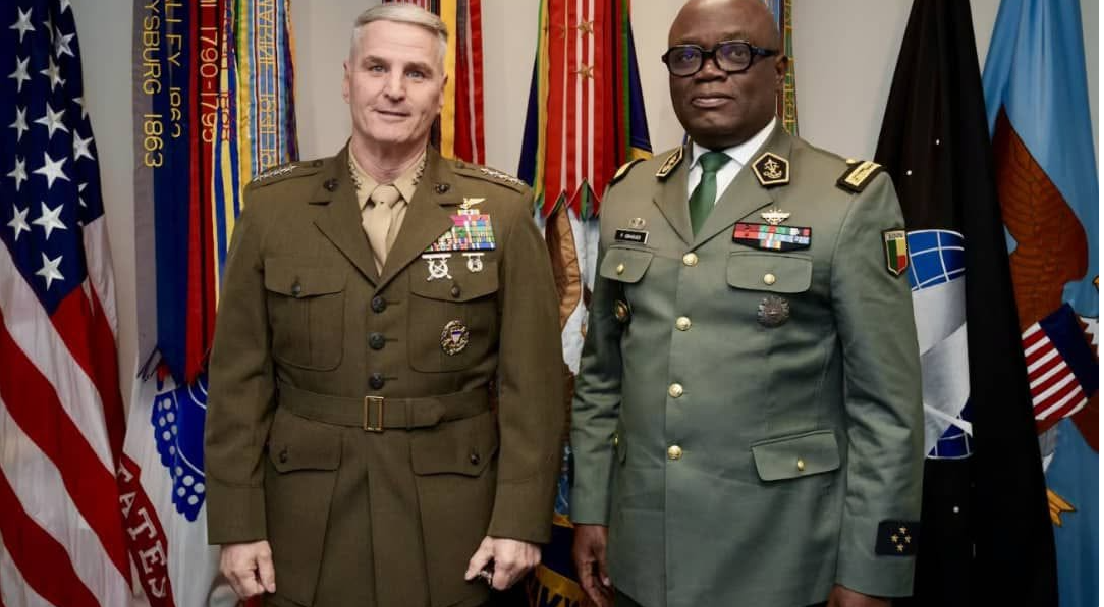
Washington reception highlights Benin’s multi-faceted security approach
The visit of Benin’s Chief of the General Staff, Lieutenant General Fructueux Gbaguidi, to the Pentagon on August 25, 2026, was more than a diplomatic gesture—it symbolized the depth of a strategic security partnership between Cotonou and Washington. Meeting with U.S. Joint Chiefs of Staff Vice Chairman General Christopher J. Mahoney, Gbaguidi underscored a shared vision: reinforcing national defense capabilities while maintaining democratic stability as a cornerstone of regional peace.
In an official statement, U.S. military leadership described the Benin-United States security cooperation as “strong and enduring,” emphasizing discussions on regional threats, joint initiatives, and AFRICOM-backed security assistance. The U.S. reaffirmed that a “secure, stable, and democratic Benin” plays a critical role in West African stability.
This endorsement reflects the credibility Benin has built in regional security, particularly as it navigates complex threats spreading from the Sahel toward coastal nations.
From Sahel threats to Benin’s proactive defense strategy
As armed groups extend their reach across borders, Benin has adopted a proactive stance—strengthening military readiness, intelligence networks, territorial presence, and international alliances. The logic is clear: in a landscape of asymmetric and transnational warfare, no nation can rely solely on domestic resources. Effective counterterrorism demands intelligence sharing, border surveillance, troop mobility, training, equipment, and operational collaboration.
U.S.-Benin military ties are not new; they span over six decades. However, they have intensified in response to rising terrorist activity in northern Benin. In September 2025, AFRICOM’s commander visited Cotonou and designated Benin a “strategic security partner,” stressing the need for enhanced cooperation amid evolving terrorism trends.
The August 2026 Pentagon meeting marks another milestone in this ongoing collaboration, reinforcing a partnership built on shared objectives rather than temporary alliances.
Why diversification is Benin’s strongest asset
Benin’s security diplomacy shines in its diversity. While Washington remains a key ally, Cotonou is not limiting itself to one partner. The country is actively engaging with multiple African and international actors, participating in regional conflict prevention mechanisms, and fostering dialogue with neighboring nations.This approach is vital in a West Africa where traditional security alliances are shifting. For instance, in May 2025, a joint military commission with South Africa focused on sharing best practices in asymmetric warfare. Similarly, Benin has strengthened cross-border cooperation with Nigeria to enhance community resilience against insecurity and transnational crime.This diversification isn’t merely diplomatic—it’s a practical necessity. Terrorism ignores borders, and so must the response. By building multiple alliances, Benin ensures it is not overly dependent on any single partner, thereby safeguarding its national interests.Democracy as a strategic advantage in West Africa’s security landscape
Beyond military cooperation, Benin’s political stability sets it apart in a region plagued by institutional ruptures and military takeovers. While neighboring countries face political instability, Benin has consistently upheld democratic transitions and institutional continuity. This stability is a key confidence-building factor for Western partners, including the United States.Washington’s communication explicitly links security, stability, and democracy—indicating that Benin is seen not just as a military ally but as a stabilizing force in the region. This positioning gives Cotonou diplomatic leverage, allowing it to engage with both Western partners and African regional bodies without sacrificing its principles.The persistent challenge: fractured cooperation with the Sahel Alliance
A glaring paradox persists: despite overlapping threats, Benin’s security cooperation with the Alliance of Sahel States—Burkina Faso, Mali, and Niger—remains limited. Communities, trade routes, and border regions are deeply interconnected, yet political distrust hinders joint action against terrorism and cross-border crime.Benin has repeatedly expressed openness to dialogue. In June 2026, a state visit by President Romuald Wadagni to Ouagadougou aimed to revitalize bilateral ties and seek collaborative solutions. Burkinabè authorities at the time emphasized the urgency of consolidating security cooperation. Yet, the persistent political rift overshadows these efforts.The cost of this divide is high. While the Sahel states have developed their own unified security architecture—such as the April 2025 announcement of a joint AES force—this internal cohesion should not exclude neighboring countries. Effective counterterrorism requires intelligence sharing, coordinated patrols, joint command communication, early warning systems, and, where possible, cross-border operations.The absence of closer Benin-AES cooperation is a collective vulnerability. Despite Benin’s repeated overtures, the political hesitancy from Sahel authorities continues to undermine regional security efforts.
Beyond diplomacy: the urgent need for collective action
The stakes are clear. Northern Benin remains exposed to incursions from Sahel-based armed groups. International observers, including French and Dutch authorities, maintain heightened vigilance along Benin’s northern borders, particularly with Burkina Faso and Niger.No nation can succeed alone. Benin has embraced this reality by diversifying its partnerships. The U.S. recognizes Benin’s strategic importance. The Sahel states, through the AES, have reinforced their internal military coordination. The next step is to bridge these efforts rather than let them diverge.What comes after the Pentagon visit?
General Gbaguidi’s Washington visit underscores a broader strategy: strengthening Benin’s armed forces while maintaining multiple cooperation channels. The message from the Pentagon is unambiguous: the U.S. is committed to working with a Benin that is secure, stable, and democratic, and to deepening AFRICOM-led initiatives.For Cotonou, the challenge now is translating these partnerships into tangible capabilities—more intelligence, surveillance, mobility, training, and coordination. Yet, the ultimate diplomatic success will come when Sahel neighbors rejoin the security equation.Terrorism does not recognize borders. Benin’s growing partnerships are a step forward, but regional security will only be sustainable when political divisions give way to cooperation. The Pentagon meeting serves as a reminder: in a rapidly changing threat landscape, the most effective strategy combines sovereignty, partnership, diversification, and institutional stability.
Benin appears to have made this choice. The question remains: will its neighbors do the same, or will their divisions continue to create collective vulnerabilities?