
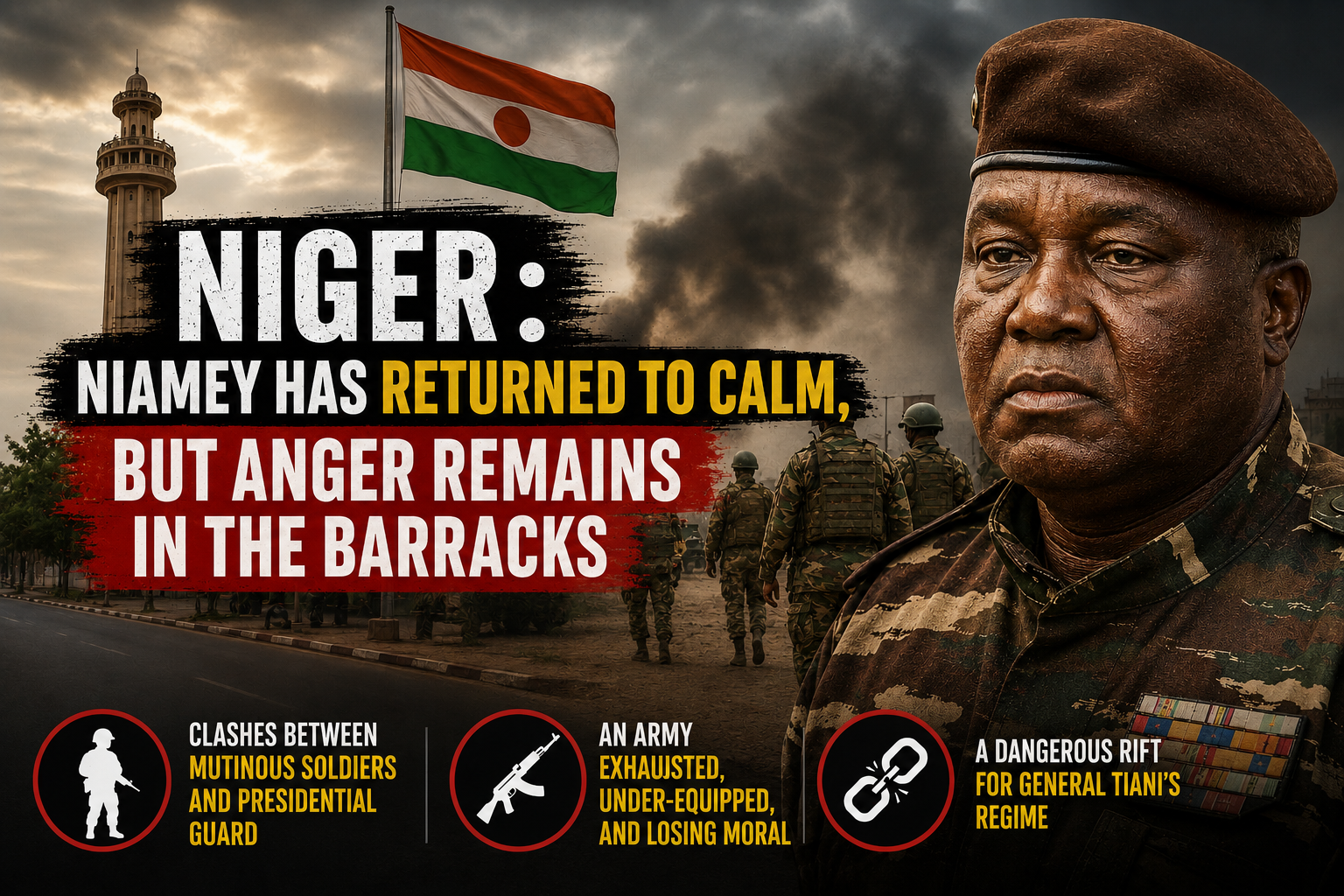
Calm has returned to the streets of Niamey, but beneath the surface, tensions remain palpable in Niger’s capital following a weekend of unprecedented violence. The unrest, which erupted in the early hours of Friday and continued through Saturday, pitted mutinous soldiers against the presidential guard, supported by Russian Wagner Group operatives operating under the Africa Corps banner.
The incident has left the leadership of the National Council for the Safeguarding of the Homeland (CNSP) in a precarious position. General Abdourahamane Tiani, the CNSP’s president, has maintained a deliberate silence, while official statements downplay the severity of the clashes as mere “mood swings” among troops. However, the absence of a detailed official assessment leaves critical questions unanswered.
Underlying grievances fuel military discontent
The junta’s sanitized narrative risks obscuring the deeper issues at play. When soldiers tasked with defending a regime turn against their own command, the implications extend far beyond a localized barracks incident. It raises fundamental concerns about the army’s internal cohesion, operational conditions, and the trust or lack thereof between troops and their superiors.
A pattern of neglect and exhaustion
The simmering discontent did not emerge overnight. For years, soldiers deployed in Niger’s most volatile regions have faced relentless attacks from jihadist factions, enduring mounting casualties, operational fatigue, and logistical shortfalls. Many endure grueling rotations, inadequate supplies, and the stark realization that the resources at their disposal fall far short of the government’s stated ambitions.
A soldier may accept the risks of combat, but enduring those risks without proper equipment, support, or prospects of success erodes morale over time. The frustration stems not from a single incident but from systemic failures that leave frontline units feeling abandoned by the very institutions they are sworn to defend.
The sovereignty paradox: rhetoric vs. reality
Since seizing power, the CNSP has championed a sovereignist agenda, emphasizing military autonomy and the termination of traditional partnerships. The integration of Russian forces into Niger’s security apparatus was framed as a strategic pivot one that promised greater self-reliance and reduced dependency on Western allies.
Yet for the troops on the ground, sovereignty is a hollow concept if it does not translate into tangible support. Outdated weaponry, insufficient armored vehicles, erratic supply chains, and weak operational backstopping leave them vulnerable in asymmetrical warfare. When jihadist groups exploit these gaps with precision strikes, the disparity between political promises and battlefield realities becomes glaringly evident.
Fatigue and disillusionment: the human cost of prolonged conflict
The strain of prolonged counterinsurgency operations is taking a toll. Repeated losses, unrelenting attacks, and the absence of meaningful progress despite official pledges of territorial recovery have sapped morale. When soldiers perceive their sacrifices as unrecognized or their safety as an afterthought, resentment festers and trust in leadership erodes.
Discontent in the barracks is not merely a logistical issue; it is a barometer of the army’s overall health. An institution that loses faith in its command structure becomes harder to mobilize, particularly when it is asked to sustain operations indefinitely without adequate compensation or recognition.
A widening rift between command and combat units
The mutiny may also signal a growing divide between the military’s strategic leadership and its operational units. While the CNSP touts sovereignty and resistance to external pressures, frontline soldiers face an immediate reality: the absence of the tools needed to survive, let alone prevail, against a determined enemy.
When the highest echelons of power prioritize political messaging over the material and psychological needs of the rank and file, the disconnect undermines military effectiveness. The consequences are not confined to the battlefield; they threaten the very foundation of a regime that derives its legitimacy from the armed forces.
The role of foreign forces: a double-edged sword
The involvement of Russian Wagner Group elements alongside the presidential guard during the clashes introduces another layer of complexity. The deployment of foreign troops was justified as a means to bolster Niger’s security sovereignty and reduce reliance on Western partners. Yet their presence in an internal military standoff underscores an uncomfortable truth: can external reinforcements compensate for structural weaknesses within the national army?
Foreign partners can provide temporary reinforcements, equipment, or expertise, but they cannot instill long-term cohesion, restore morale, or resolve systemic deficiencies. The episode in Niamey highlights the limitations of outsourcing security when the root causes of discontent remain unaddressed.
The cost of silence: why downplaying the crisis is risky
General Tiani’s reticence to address the mutiny in detail may be strategic, but it also risks fuelling speculation. In an environment where information is tightly controlled, the lack of transparency only amplifies doubts about the true scale and nature of the unrest. When a government minimizes a crisis of this magnitude, it inadvertently invites scrutiny of its own handling of the situation and its ability to manage the military’s grievances.
The return of calm to Niamey’s streets does not guarantee harmony within the barracks. The cessation of gunfire may silence immediate threats, but the underlying frustrations unresolved grievances, unmet needs, and a widening trust deficit persist. For the junta, this should serve as a stark warning: the greatest threat to its stability may not come from external enemies, but from the fractures forming within the institution tasked with defending it.
If the malaise is left unaddressed, the mutiny may prove to be less an anomaly than a symptom of a deeper crisis one that questions not only the CNSP’s leadership but the very sustainability of its military strategy.