
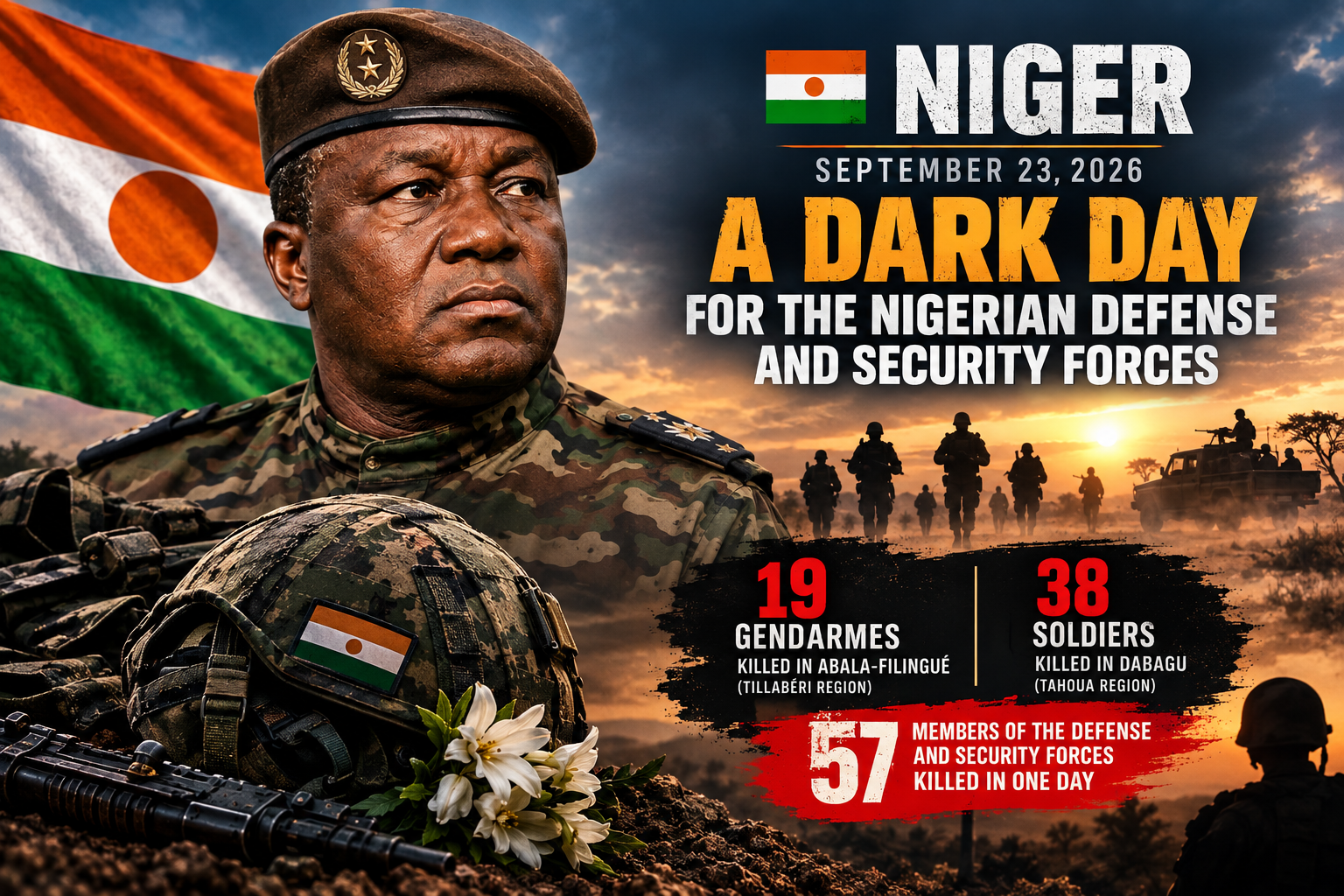
Niger faces a decisive moment after simultaneous attacks leave 57 security personnel dead
The 23rd of September 2026 will be remembered as a day of profound tragedy for Niger’s defense and security forces. In a matter of hours, the country witnessed two devastating assaults that not only claimed dozens of lives but also exposed glaring vulnerabilities in the national security apparatus. These coordinated attacks have forced a reckoning with the strategies currently in place to protect Niger’s sovereignty and its citizens.
The first assault struck in the Abala-Filingué area, within the Tillabéri region, where 19 gendarmerie personnel were killed. Hours later, a second attack targeted a military outpost in Dabagu, located in the Konni department of the Tahoua region, resulting in at least 38 soldiers losing their lives. Reports also indicate a number of military personnel remain unaccounted for following the second strike. While these figures remain provisional pending official confirmation by the Nigerien authorities, the sheer scale of the losses has sent shockwaves through the nation.
These attacks collectively mark the deadliest single day for Niger’s defense and security forces in recent memory. The provisional death toll stands at 57 personnel, though this number may rise as further assessments are conducted. The incidents have raised urgent questions about the effectiveness of the security strategy implemented under the leadership of General Abdourahamane Tiani, particularly in protecting military personnel from highly mobile, well-armed armed groups operating across multiple fronts.
Unanswered questions and discrepancies in official reports
The disparity between official statements and reports from local and security sources has only deepened concerns. How many soldiers and gendarmes were truly killed, injured, or remain missing? What equipment has been lost in these devastating encounters? Most critically, why do units deployed in high-risk areas continue to suffer such catastrophic losses, despite repeated assurances from the Tiani regime regarding the strengthening of Niger’s military capabilities?
The challenges facing the Nigerien armed forces are not merely a matter of bravery or resolve. The groups opposing them are increasingly adept at rapid, coordinated strikes using motorized units, concentrating forces against isolated military positions, and vanishing before reinforcements can arrive. In such a high-stakes environment, the roles of intelligence, mobility, aerial surveillance, communications, and advanced equipment for forward-deployed units cannot be overstated.
A crisis of strategy and accountability
The events of September 23rd also demand a closer examination of the political and strategic dimensions of Niger’s security crisis. Since the CNSP’s ascent to power in July 2023, the government has consistently identified security as a cornerstone of its agenda. Yet, the staggering losses incurred on that single day cast serious doubt on the tangible results of these efforts.
While authorities assert that military capabilities have been enhanced and territorial control is gradually being reclaimed, the repeated attacks on defense forces paint a different picture. The Tillabéri region, in particular, remains a hotspot for armed group activity, highlighting persistent vulnerabilities in the nation’s security framework.
The human cost of these failures is devastating. Behind the provisional numbers and official statements lie 57 families plunged into grief, uncertainty lingering for those still missing, and a nation forced to confront the stark realities of its security challenges. The events of September 23rd are not merely another date in Niger’s conflict calendar they represent a turning point that demands urgent action and accountability.
Rethinking intelligence, equipment, and deployment
To address these critical shortcomings, a multi-faceted approach is essential. First, intelligence gathering must be prioritized to anticipate and disrupt armed group movements. Second, the mobility and equipment of forward-deployed units need to be significantly upgraded to match the agility of opposing forces. Finally, communication systems must be reinforced to ensure rapid coordination between units in the field.
However, beyond tactical adjustments, the events of September 23rd underscore the need for a broader strategic review. The Nigerien government must not only focus on the resources mobilized but also on the tangible outcomes achieved. When dozens of defense personnel are killed in a single day, the question shifts from how many enemies were neutralized to why so many defenders of the nation continue to pay the ultimate price. After more than three years under the current regime, certain regions remain as vulnerable as ever, raising difficult questions about the long-term viability of current security policies.
What lies ahead for Niger’s security framework?
The path forward is fraught with challenges, but it is also an opportunity for decisive action. The government must demonstrate a clear commitment to addressing the root causes of these vulnerabilities, from enhancing intelligence capabilities to ensuring that military personnel are equipped to meet the evolving threats posed by armed groups. Failure to act decisively risks further erosion of public trust and the continued destabilization of regions already under immense pressure.
The 23rd of September 2026 has served as a stark reminder of the fragility of security in Niger. It is a day that will be etched into the nation’s memory, not just for the lives lost but for the urgent call to action it has sounded. The time for reflection is over; the time for meaningful, measurable change is now.
By Yvette Tchuente — State political analyst