
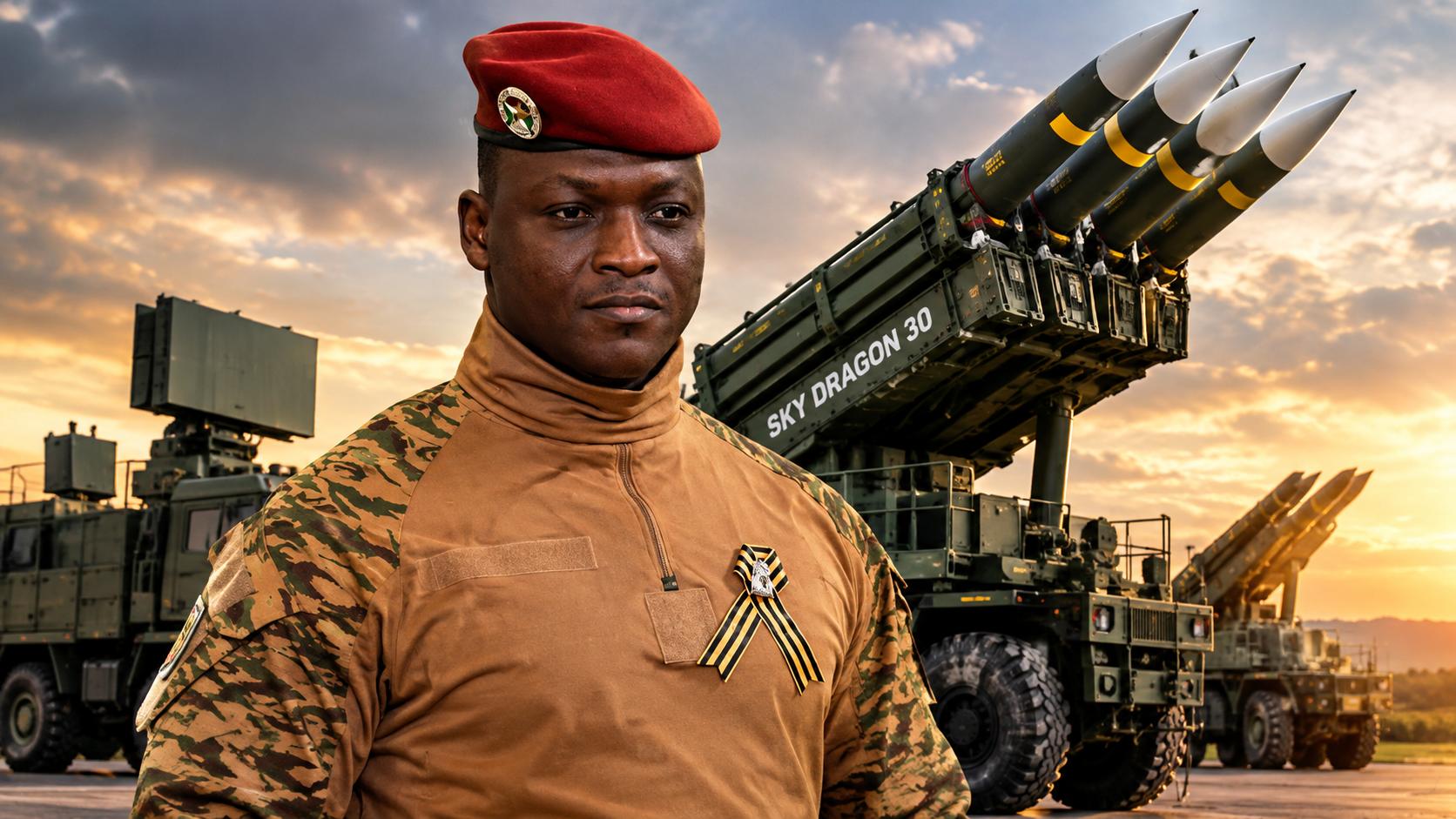
The Regime’s Strategic Mirage: Sky Dragon 30’s Debut in the Burkina Faso Crisis
In a carefully staged display of military might, Burkina Faso’s transitional leadership rolled out its newest strategic acquisition: the Chinese-made Sky Dragon 30 air defense system. Amid the red-carpet treatment for cameras and state media, the spectacle of armored trucks and missile launchers painted a picture of an invincible army. Yet, the timing of this showcase could not have been more out of sync with reality. While the system was presented as a leap toward national defense, the country’s villages continue to empty under relentless attacks by men on motorcycles—armed groups moving faster than any air defense radar can detect.
Why a $15 Million Air Defense System is the Wrong Answer to Burkina Faso’s Real Threats
Acquired from China’s NORINCO, the Sky Dragon 30 (DK-10A) is a long-range surface-to-air missile system built for a different kind of war. Designed to intercept conventional aerial threats such as fighter jets, attack helicopters, and cruise missiles, it operates at altitudes up to 18,000 meters and within a 30-kilometer radius. Its 3D radar (IBIS 80) can detect aircraft more than 130 kilometers away—capabilities that bear no relevance to the actual security challenges unfolding on the ground.
Burkina Faso’s conflict is not fought in the skies. Armed groups, moving in groups of three or four on motorcycles, lay improvised explosive devices (IEDs) along rural roads, ambush convoys, and terrorize villages like Djibo and Boussouma. There is no air force, no helicopters, no drones—just silent, agile killers on two wheels. A Sky Dragon 30 cannot see them. It cannot lock onto them. And it cannot stop them. Deploying such a system against these threats is like trying to catch a swarm of bees with a fishing net.
The Propaganda of Power: How a Missile System Became a Political Shield
Beyond its military incompetence, the Sky Dragon 30 serves a far more calculated purpose: it is a propaganda tool. In a nation where the state’s control is shrinking and rural communities are fleeing en masse, the regime needs symbols—not solutions. A missile launcher mounted on an armored truck makes for dramatic footage on national television and viral social media clips. It allows the government to project an image of modernization and invincibility, while diverting attention from the growing security vacuum in the countryside.
The narrative is simple: “We are under siege from invisible external enemies.” This myth justifies increased militarization, curtails public debate, and sustains the illusion of strength. Meanwhile, the soldiers at the front lines face critical shortages—no mine-clearing equipment, no real-time intelligence, and often no fuel to patrol key roads. The Sky Dragon 30 is not a shield. It is a distraction. And the Burkinabè people are paying the price in both security and lost resources.
A Call for Strategic Accountability: Ending the Cycle of Irrelevant Spending
The acquisition of the Sky Dragon 30 is more than a misjudgment—it is a failure of strategic vision. In a country where every dollar counts, spending millions on an air defense system that cannot engage the actual enemy is not just wasteful—it is morally indefensible. The regime’s reliance on symbolic firepower over practical defense reveals a dangerous disconnect between leadership and reality.
As the country grapples with insurgency, displacement, and economic strain, the priorities must shift from theatrics to tangible support. Soldiers need better equipment to counter ground threats. Communities need protection, not parades. The Sky Dragon 30 is not a turning point—it is a dead end. True security will not come from missiles that miss their real targets, but from policies that confront the ground war being waged every day across Burkina Faso.