
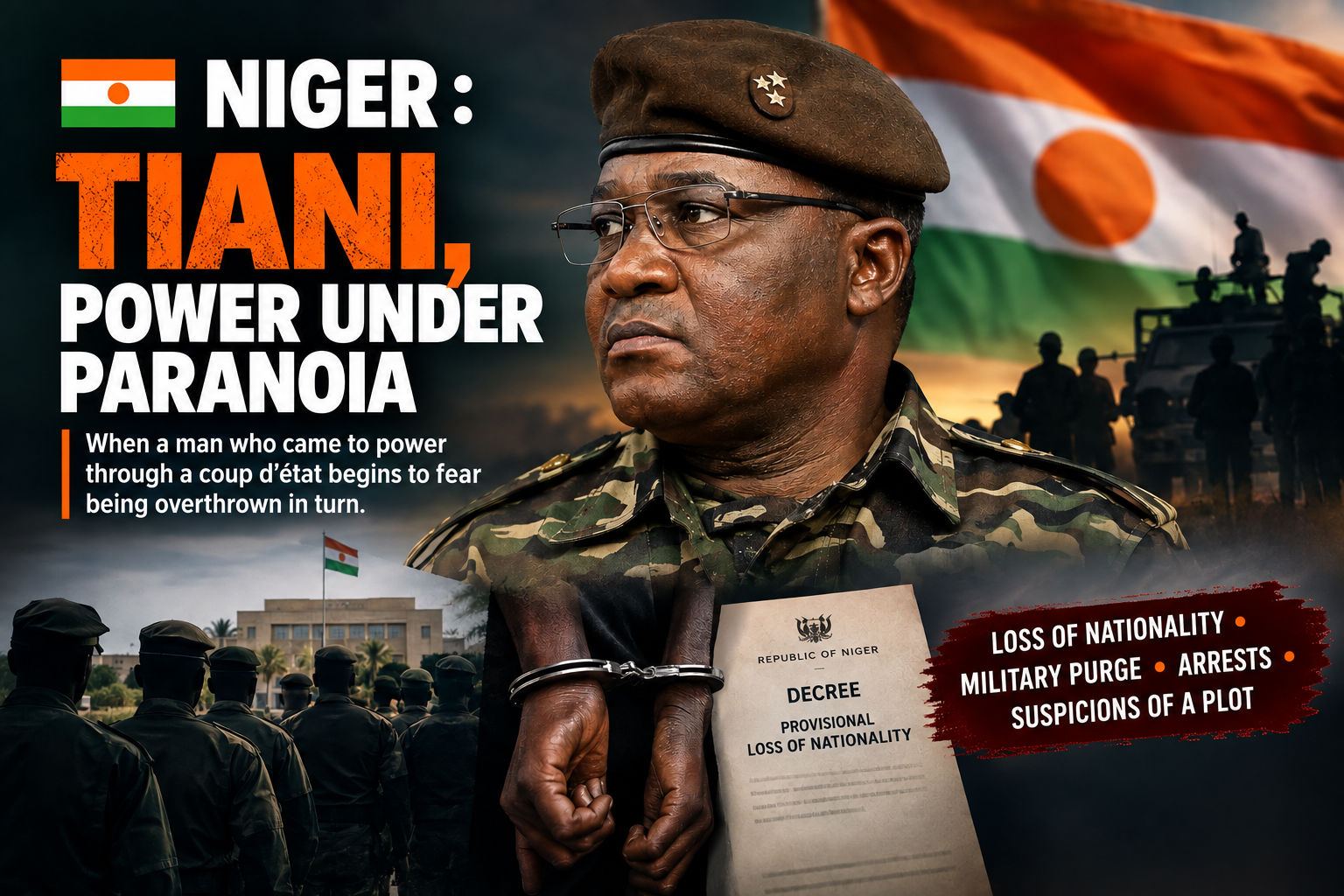
From coup-maker to coup-fearing: Tiani’s dramatic power consolidation
When a leader who seized power through a military takeover begins to fear being overthrown in turn, a dangerous cycle begins. In Niger, General Abdourahamane Tiani’s regime is grappling with the very scenario he once wielded against Mohamed Bazoum. The August 29 coup attempt launched from within the military itself has forced Tiani to confront an uncomfortable truth: the methods he used to gain power could now be used against him.
A failed uprising that changed everything
The attack on the presidential palace, the assault on Air Base 101, and the storming of national television were not the work of external forces. They originated from within Niger’s military apparatus, exposing deep internal fractures. Reports indicate that mutineers actively sought to sway other officers, while key commanders reportedly hesitated to take sides. For a ruler who rose to power through force, this was a sobering realization the very system he inherited could now turn against him.
In the aftermath, the regime’s response has been swift and sweeping. Hundreds of military personnel have been detained, with special forces bearing the brunt of arrests. The dismissal of the army chief of staff, General Moussa Salaou Barmou, on September 11 signaled a dramatic reorganization. Four ministers followed soon after. Official explanations cite command chain dysfunctions and security reforms, but the timing reveals a deeper strategy: after surviving the putsch, Tiani is tightening control around those he deems most reliable.
The September 17 decree: stripping citizenship as a tool of control
The most dramatic escalation came on September 17, when Tiani signed a decree revoking the Nigerian nationality of five individuals, including former Prime Minister Ouhoumoudou Mahamadou. The charges ranging from alleged collaboration with foreign powers to undermining public order and state security are outlined in the decree, though no judicial verdict has been reached.
The symbolism is unmistakable. Mahamadou was not merely an opposition figure; he held a key position in Bazoum’s administration, the very regime Tiani overthrew. By targeting him, the regime is sending a clear message: loyalty to the previous government is now tantamount to political treason. With 25 individuals now facing provisional nationality revocations since 2024, the question arises: when does national security end and political purging begin?
Paranoia or strategy? The regime’s widening crackdown
The August 29 events have fundamentally altered Niger’s power dynamics. The threat is no longer confined to armed groups or foreign actors it now emanates from within the military itself. For a regime born from a coup, this is a critical vulnerability. The response has been a systematic purge: military leaders replaced, ministers dismissed, soldiers arrested, and former Bazoum administration figures systematically targeted.
Officially, each action is justified by institutional reforms or security concerns. However, taken together, they paint a picture of a leadership that, having narrowly escaped a coup, is now attempting to eliminate every potential source of uncertainty. The risk? A governance model where suspicion becomes policy, and dissent is automatically equated with subversion.
The paradox of power: a regime that fears its own shadow
Tiani’s predicament encapsulates the irony of Niger’s political landscape. He came to power through a coup, only to face a counter-coup from within his own ranks. Now, his regime is trapped in a cycle where every crisis sparks further purges, every suspicion leads to sanctions, and each challenge reinforces the concentration of power. The September 17 decree is more than a legal measure it is the latest chapter in a broader struggle to eliminate uncertainty.
The critical question is whether this approach is reinforcing stability or eroding it. By framing dissent as a threat to the state, the regime risks transforming every political disagreement into an existential crisis. The line between protecting the nation and protecting the regime is becoming dangerously blurred. For a leader who once exploited instability to seize power, the greatest challenge now may be overcoming the very fears his methods have instilled.
Where does this path lead?
As Niger’s power structure continues to tighten, the regime’s reliance on coercive measures raises concerns about its long-term viability. Can a system built on exclusion and suspicion ever foster genuine stability? With each purge, Tiani may be securing his position in the short term, but at what cost to the nation’s cohesion and democratic potential?
The answer may well determine whether Niger’s current leadership can break free from the cycle of coups or whether it will become its next victim.

By Yvette Tchuente — State political analyst