
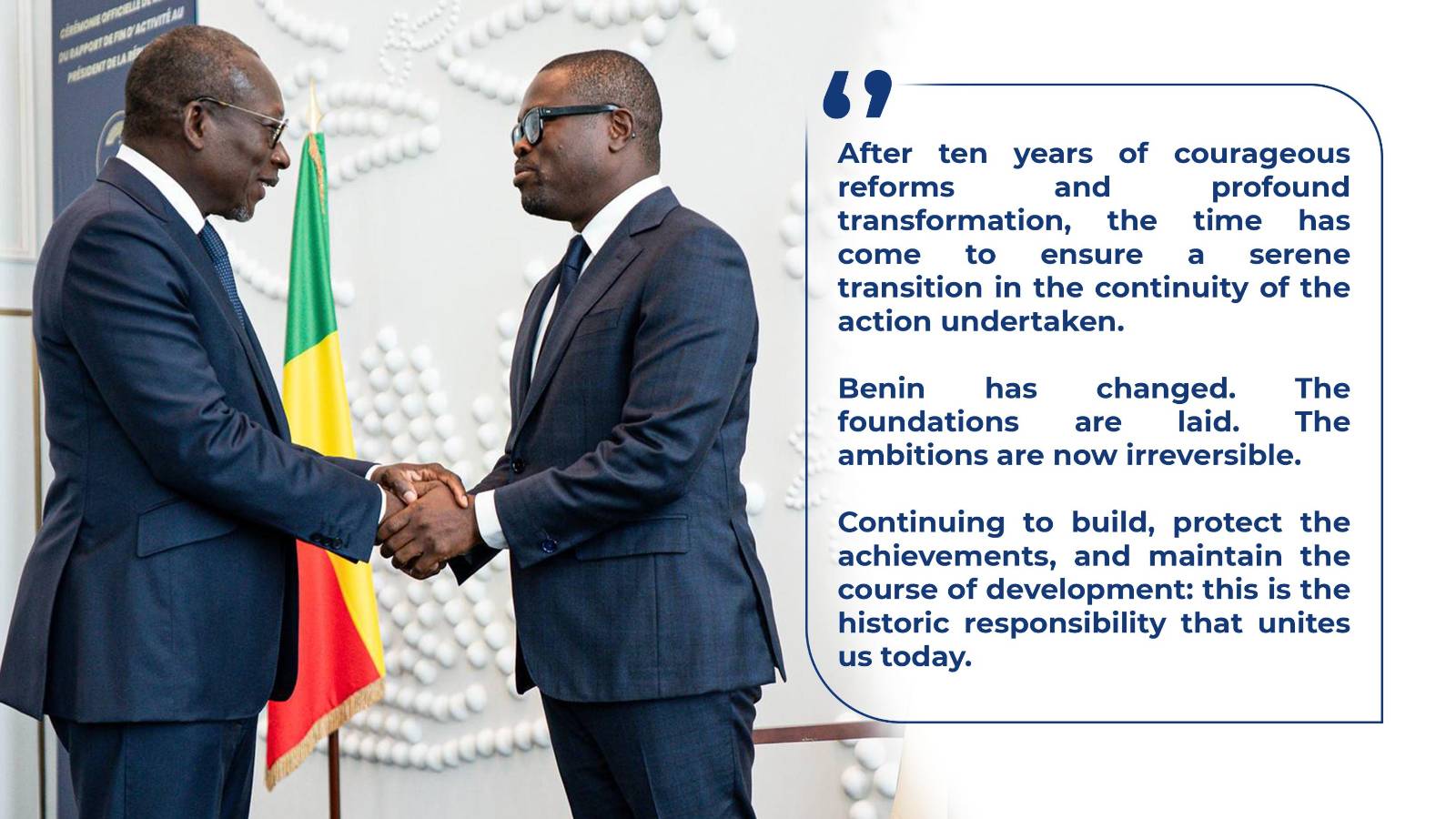
After ten years of decisive leadership, President Patrice Talon delivered a solemn farewell address to the nation of Benin, marking the end of an era defined by sweeping reforms and economic restructuring. With his successor, Romuald Wadagni, set to be inaugurated in the coming days, Talon reflected on a presidency that reshaped the country’s institutional, economic, and social landscape under the banner of the ‘Rupture.’
a balanced farewell: pride and accountability
In a nationally televised address, the outgoing president presented a candid assessment of his time in office, acknowledging both the achievements and the sacrifices demanded of the Béninois people. From the outset in 2016, his administration prioritized fiscal discipline, public sector reform, and rapid infrastructure development—measures intended to break the cycle of underdevelopment and restore Benin’s standing on the global stage.
While defending the necessity of these sometimes unpopular decisions, Talon extended his gratitude to the citizens, praising their endurance and collective commitment to the nation’s transformation. ‘The path forward was not easy,’ he emphasized, ‘but every step taken was guided by the conviction that a stronger, more credible Benin was within reach.’
a seamless handover rooted in continuity
The president’s address took a forward-looking turn as he formally endorsed Romuald Wadagni, his former Minister of Economy and Finance, as his successor. Wadagni, widely recognized as the architect of the administration’s macroeconomic policies, embodies the continuity of a technocratic governance model designed to preserve the momentum of national recovery while transitioning into a new phase of consolidation.
For Talon, the selection of Wadagni signals more than a personal endorsement—it represents a commitment to safeguarding the strategic projects that have defined his presidency, from urban renewal to industrial expansion.
key achievements of the talon era
- Economic stabilization: The restoration of fiscal health and improved sovereign credit ratings stand as hallmarks of this decade.
- Urban transformation: A sweeping program of road paving and infrastructure upgrades has visibly modernized major cities.
- Industrial growth: The Glo-Djigbé Industrial Zone (GDIZ) has emerged as a cornerstone of Benin’s push toward economic diversification and job creation.
the challenges ahead under wadagni
Though Benin enters this new chapter with stronger economic foundations, the road ahead remains demanding. Romuald Wadagni inherits a nation reshaped by progress, yet one still grappling with pressing social and security concerns.
The incoming president’s immediate priorities include:
- Revitalizing purchasing power: Ensuring that growth translates into tangible benefits for households remains a top priority.
- Easing political tensions: Fostering national cohesion and reducing polarization will be essential to maintaining stability.
- Bolstering border security: Strengthening defenses against regional terrorism, particularly along the northern frontier, demands urgent attention.
a democratic milestone
By adhering strictly to the constitutional two-term limit, Patrice Talon has reinforced Benin’s democratic credentials at a time when neighboring nations in West Africa face political instability and constitutional revisions. His decision to step aside voluntarily underscores a commitment to institutional rule and peaceful transition—an increasingly rare practice in the region.
As official inauguration preparations gather pace in Cotonou, Benin stands poised to close one chapter—the ‘Rupture’—and begin another, guided by pragmatism and the lessons of the past decade.