
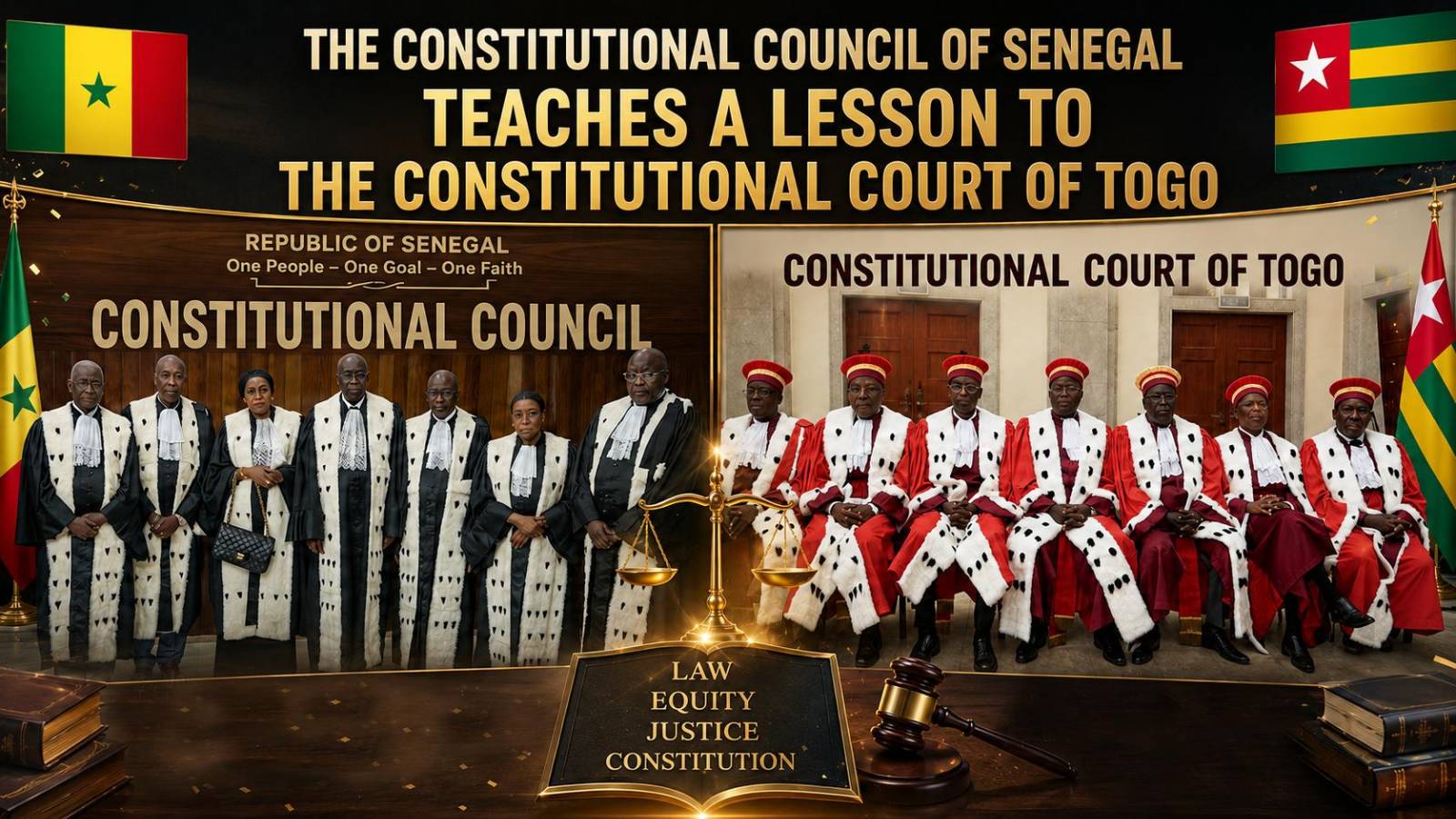
Two West African capitals, Dakar and Lomé, are currently showcasing sharply divergent interpretations of constitutional governance. Recent judicial decisions in both countries underscore fundamentally opposing views on the role of state institutions in upholding the rule of law.
Judicial independence versus institutional alignment
In Dakar, the Constitutional Council has reaffirmed its role as an impartial guardian of constitutional principles. The body struck down a proposed constitutional amendment pushed by the government of Prime Minister Ousmane Sonko and backed by the parliamentary majority. The decision sent a clear message: electoral victory does not grant unlimited power. In a functioning democracy, political legitimacy must always defer to constitutional boundaries.
In Lomé, however, the Constitutional Court took a markedly different stance. It validated a sweeping overhaul of the country’s fundamental charter despite widespread objections from opposition groups, civil society organizations, and legal scholars. Critics argue the reform lacked broad national consultation and was implemented more as a political maneuver than a genuine exercise in constitutional renewal. When constitutional changes appear driven by short-term political calculations rather than collective agreement, their legitimacy erodes—undermining the very foundation of democratic governance.
The stakes of institutional credibility
The contrast between these two approaches highlights a critical truth: the strength of a democracy depends not on the elegance of its constitutional text, but on the willingness of its oversight institutions to enforce it fearlessly. A constitution is only as strong as the institutions charged with protecting it.
In Senegal, the Constitutional Council’s decision to block the government’s reform demonstrates how judicial independence can serve as a bulwark against political crisis. By setting clear constitutional limits, the Council not only preserves legal principles but also shields institutions from instability. It signals to citizens that no actor—regardless of electoral mandate—stands above the law. This predictability fosters public trust, attracts investment, and enhances the country’s international standing.
Togo’s experience offers a cautionary tale. When a constitutional court appears to rubber-stamp executive decisions, it risks losing moral authority. Over time, citizens may conclude that domestic legal avenues are ineffective, pushing disputes toward regional courts like the ECOWAS Court of Justice. Such reliance on external jurisdictions often reflects a deep-seated lack of confidence in national institutions and their ability to deliver fair, impartial justice.
The dangers of constitutional reform as political tool
Beyond legal technicalities, the process of constitutional revision reveals much about a nation’s democratic health. In mature democracies, such reforms are typically preceded by extensive debate, public consultation, and efforts to build consensus. The goal is not merely to adapt laws for the moment, but to ensure they endure across future political transitions.
When constitutional changes are perceived as serving narrow political interests, they create dangerous precedents. Each new administration may feel empowered to reshape institutions to its advantage, leading to chronic instability and the concentration of power in the hands of the executive. Such an environment fosters division, weakens institutions, and turns the constitution itself into a source of conflict rather than a unifying contract.
Lessons from contrasting models
As Togo explores a shift toward a parliamentary system, officials have conducted comparative studies abroad, including in India, to examine alternative governance models. While learning from international experiences can be valuable, it cannot replace the insights gained from African democracies facing similar challenges. The continent offers numerous examples of how institutional credibility is built—not through imported templates, but through consistent respect for constitutional principles.
Senegal’s experience stands as a testament to this truth. Its Constitutional Council has earned credibility not through rhetoric, but by exercising rigorous oversight—even when it clashes with the government. This commitment to impartial enforcement sends a powerful signal: the rules of democracy apply equally to all.
The implications are far-reaching. They shape governance quality, citizen confidence, international perception, and economic attractiveness. Countries whose institutions appear stable and predictable attract greater trust from investors, development partners, and global organizations. In contrast, systems where institutions seem to bend to political expediency undermine confidence and deter engagement.
Ultimately, the divide between Dakar and Lomé reflects more than constitutional differences. It reveals fundamentally opposing philosophies about the role of state institutions. In one capital, the constitution is seen as a constraint on power. In the other, critics argue, it risks becoming a tool for political adaptation. A resilient democracy, however, is measured not by the frequency of its constitutional reforms, but by the enduring capacity of its institutions to protect citizens from all forms of excess—whether from the executive, legislature, or any other source of authority.