
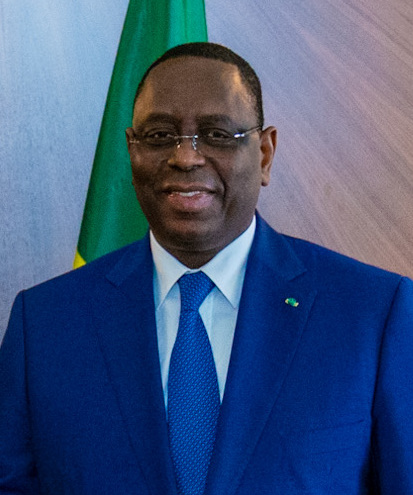
The decision came just days after a historic meeting at the Palais de la République: Senegal will fully support Macky Sall’s candidacy for United Nations Secretary-General. President Bassirou Diomaye Faye’s endorsement marks a surprising yet strategic pivot in regional diplomacy, one that transcends personal grievances in favor of national interests.
A calculated move beyond political divisions
At first glance, the move appears paradoxical. Bassirou Diomaye Faye rose to power after a dramatic political journey—imprisoned in April 2023 during a crackdown targeting opposition leader Ousmane Sonko, he was released on March 14, 2024, just days before the election, following a presidential pardon secured in a tense pre-election climate. His victory marked an unprecedented transition from prison to the presidency in weeks, a narrative rooted in resistance against authoritarian tendencies under Macky Sall’s administration.
Yet, the decision to support Sall’s UN bid reflects a broader state logic. Dakar’s presidency emphasized a dialogue beyond political alternations, framing the move as a contribution to Africa’s collective voice and multilateral governance. The government has since instructed the entire diplomatic network to mobilize in support of this candidacy—a clear signal that national interests now outweigh past political fractures.
The internal rupture that unlocked new possibilities
This strategic shift became feasible only after a decisive political fracture: the rupture between Bassirou Diomaye Faye and his former ally Ousmane Sonko, who was dismissed as Prime Minister in May. As long as the Faye-Sonko alliance held, the government maintained a hardline stance against the previous regime, driven largely by Sonko’s personal antagonism toward Macky Sall—stemming from his imprisonment and exclusion from the 2024 presidential race.
Sonko’s removal removed a major constraint, allowing President Faye to adopt a more statesmanlike posture. The move reframed Sall’s candidacy not as a partisan issue, but as a national diplomatic priority—one aligned with Senegal’s broader ambitions on the global stage.
Moreover, this decision aligns with Bassirou Diomaye Faye’s long-term political strategy. With plans to launch his own political party and consolidate power ahead of the 2029 election, he is rebuilding an electoral coalition that may include former networks tied to both Macky Sall and Abdoulaye Wade. The warmth of Sall’s reception during his recent visit to Dakar underscored his enduring influence—a factor not lost on the current president.
A candidacy strengthened, but the race remains open
For Macky Sall, the Senegalese backing is transformative. His candidacy, submitted in March by Burundi under the African Union’s rotating presidency, had long suffered from a structural weakness: the absence of explicit support from Senegal undermined its legitimacy.
In the complex calculus of UN leadership elections, the silence—or worse, opposition—of a candidate’s home country is often interpreted as a rejection. It weakens a bid before it even faces the veto power of the five permanent Security Council members. With Dakar’s formal support now secured, Sall’s campaign gains crucial credibility, depriving rivals of a powerful argument against him.
Yet, this endorsement does not guarantee victory. The race to succeed António Guterres follows an unwritten continental rotation system—and this time, Latin America holds the turn. Four of the five declared candidates hail from the region: Argentina’s Rafael Grossi, former Chilean leader Michelle Bachelet (whose government withdrew support in March), Costa Rica’s Rebeca Grynspan, and Ecuador’s María Fernanda Espinosa. This regional alignment reflects a widely held expectation within the General Assembly.
As the sole non-Latin American and the only former head of state in the race, Macky Sall faces an uphill battle. Africa has not held the UN top post since Boutros Boutros-Ghali in the 1990s, yet this representational gap alone may not suffice to override regional customs. While Senegal’s support solidifies his bid, the final outcome will hinge on Security Council negotiations—where veto-wielding permanent members hold decisive sway.
Sall’s diplomatic positioning offers cautious optimism. Close to France—where he campaigned for the presidency—and maintaining constructive ties with Russia, he has avoided outright antagonism in key global forums. Notably, Senegal abstained during the March 2022 UN vote on Russia’s invasion of Ukraine, a balanced stance that resonates in Moscow. His recent meeting with Russian Foreign Minister Sergei Lavrov in the Russian capital signals continued diplomatic outreach as he presses forward. The verdict is expected this autumn.