
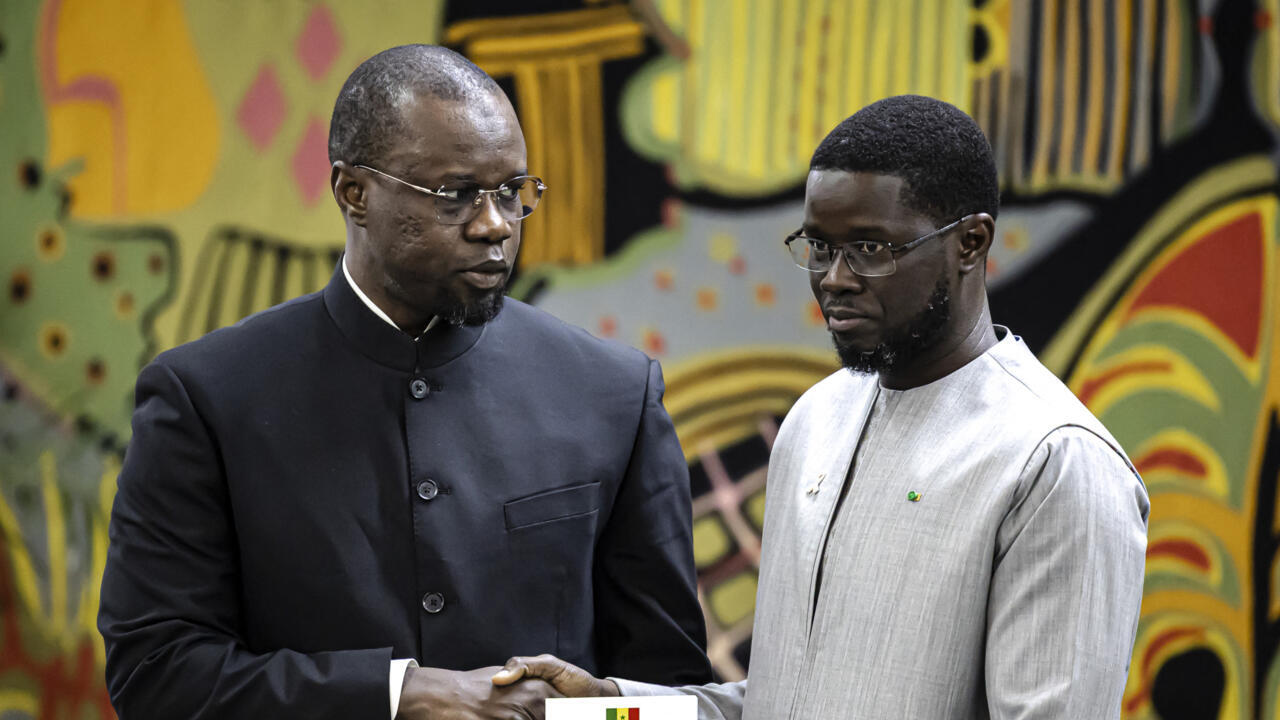
After just two years together, the Diomaye Faye-Ousmane Sonko partnership has come to an abrupt end. President Bassirou Diomaye Faye has removed Sonko from the prime ministership, a position he had occupied until recently. Now serving as President of the National Assembly, Sonko has been overwhelmingly re-elected as leader of the Pastef, the majority party in Parliament that remains excluded from the government. What led to this unprecedented break? Can these two political figures coexist under a tense cohabitation? And will these internal conflicts overshadow the pressing priorities of Senegalese citizens?
From allies to adversaries: the breakdown of a political tandem
The sudden rupture between President Bassirou Diomaye Faye and former Prime Minister Ousmane Sonko marks a turning point in Senegalese politics. Once united by a shared vision, the two leaders now find themselves on opposing sides of a deepening divide. Sonko’s removal from the government and his elevation to the presidency of the National Assembly—while retaining leadership of the Pastef—has created a complex power dynamic that raises critical questions about the future of governance in the country.
Key players in the unfolding crisis
- Abdoulaye Tine, Presidential advisor and spokesperson.
- Amadou Ba, former Minister of Culture, current deputy, and national secretary in charge of Communication for the Pastef.
- Babacar Ndiaye, political analyst and research director at the Wathi think tank.
A cohabitation fraught with uncertainty
The political landscape in Dakar is now defined by uncertainty. With Sonko at the helm of the National Assembly and leading the opposition-aligned Pastef, and Faye consolidating power within the executive, the stage is set for a delicate cohabitation. Will this arrangement endure, or will it collapse under the weight of irreconcilable differences? The stakes are high, and the consequences could redefine Senegal’s political trajectory for years to come.
Beyond the personal and ideological rifts, the broader implications for Senegal’s development cannot be ignored. As these two influential figures navigate their strained relationship, the nation’s urgent socioeconomic challenges—such as youth unemployment, infrastructure deficits, and regional security concerns—risk taking a backseat. Can the political elite refocus their energy on addressing the needs of the Senegalese people, or will rivalry eclipse progress?
The future of Senegal’s governance under scrutiny
The coming months will be decisive in determining whether Senegal can maintain stability amid this political turbulence. With the Pastef holding a parliamentary majority but sidelined from the government, and Sonko’s leadership unchallenged within the party, the pressure on Faye to reconcile—or confront—his former ally grows by the day. Meanwhile, Senegalese citizens watch with bated breath, hoping for leadership that prioritizes their well-being over partisan strife.