
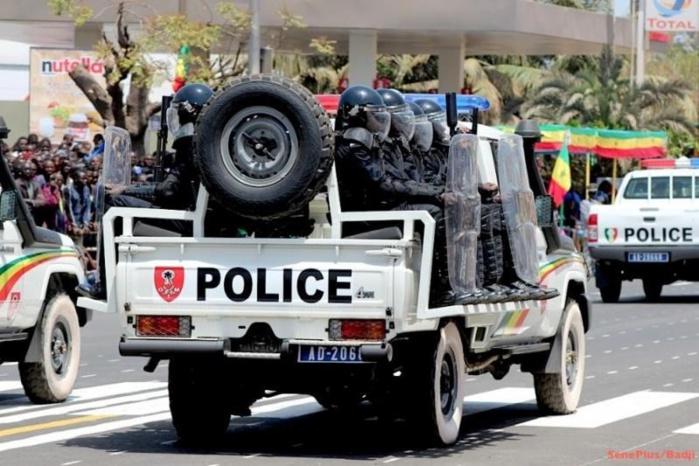
Dakar has witnessed a sharp rise in police checks targeting foreigners over the past two weeks, with authorities reporting 490 individuals verified and 36 referred to prosecutors for irregular stay within just eight days. While authorities frame these operations as routine administrative verifications, civil society groups and foreign residents express mounting unease over a perceived shift toward systemic suspicion.
Anxiety in the capital’s streets
For Amadou Bangoura, a 30-year-old Beninese student pursuing advanced studies in Dakar, the experience was both shocking and revealing. Having lived in Senegal for five years without prior issues, he found himself abruptly stopped by police officers late one evening as he left a gym in the Liberté 6 district. When asked for identification, he explained he had left his documents at home—a statement that triggered immediate tension. “Return to your country,” one officer reportedly warned him, while another threatened detention pending prosecution.
Bangoura’s ordeal only ended when officers accompanied him to his residence, where he produced his valid passport and residency documents. Though no legal action followed, the episode left him deeply unsettled. “I never imagined this could happen here,” he shared with local journalists. His case, however, is far from isolated.
Numbers reveal escalating enforcement
Between June 30 and July 8, 2026, the Directorate of Foreign Police and Travel Documents (DPETV) conducted sweeping verification campaigns in multiple neighborhoods across Dakar and its outskirts. According to official figures, nearly 490 foreigners of various nationalities were inspected during this period, with 36 detained for irregular stay—an uptick that coincides with broader regional migration debates.
Civil society warns against creeping suspicion
A coalition of five prominent organizations—Legs Africa, Frapp, Nawle, Afrikajom Center, and Diwan Citoyen—issued a joint statement on July 13, raising the alarm over what they describe as a dangerous normalization of administrative harassment against foreign residents in Senegal. While acknowledging the state’s sovereign right to regulate borders and combat irregular migration, they cautioned: “Sovereignty cannot be conflated with arbitrariness.”
Their primary concern lies not in the existence of migration policies, but in the gradual erosion of Senegal’s traditionally welcoming posture. “What troubles us today is not the policy itself,” the statement read, “but the normalization of a climate where foreigners are increasingly viewed not as rights-bearing individuals, but as administrative risks—even when their stay is entirely legal.”
Balancing security and hospitality
Elimane Kane, President of Legs Africa, emphasized that security and openness are not mutually exclusive. “Security does not exclude otherness,” he asserted, urging authorities to avoid framing these operations as rejections of foreigners. Instead, he called for better coordination among security forces to prevent controls from being perceived as persecution rather than protection.
Kane also highlighted the global nature of professional mobility: “Just as Senegalese travel abroad for work, foreigners have the right to come here and contribute,” he noted. The solution, he argued, lies not in blaming migrants, but in creating opportunities for young Senegalese to access local employment—thereby addressing root causes of irregular migration without undermining hospitality.