
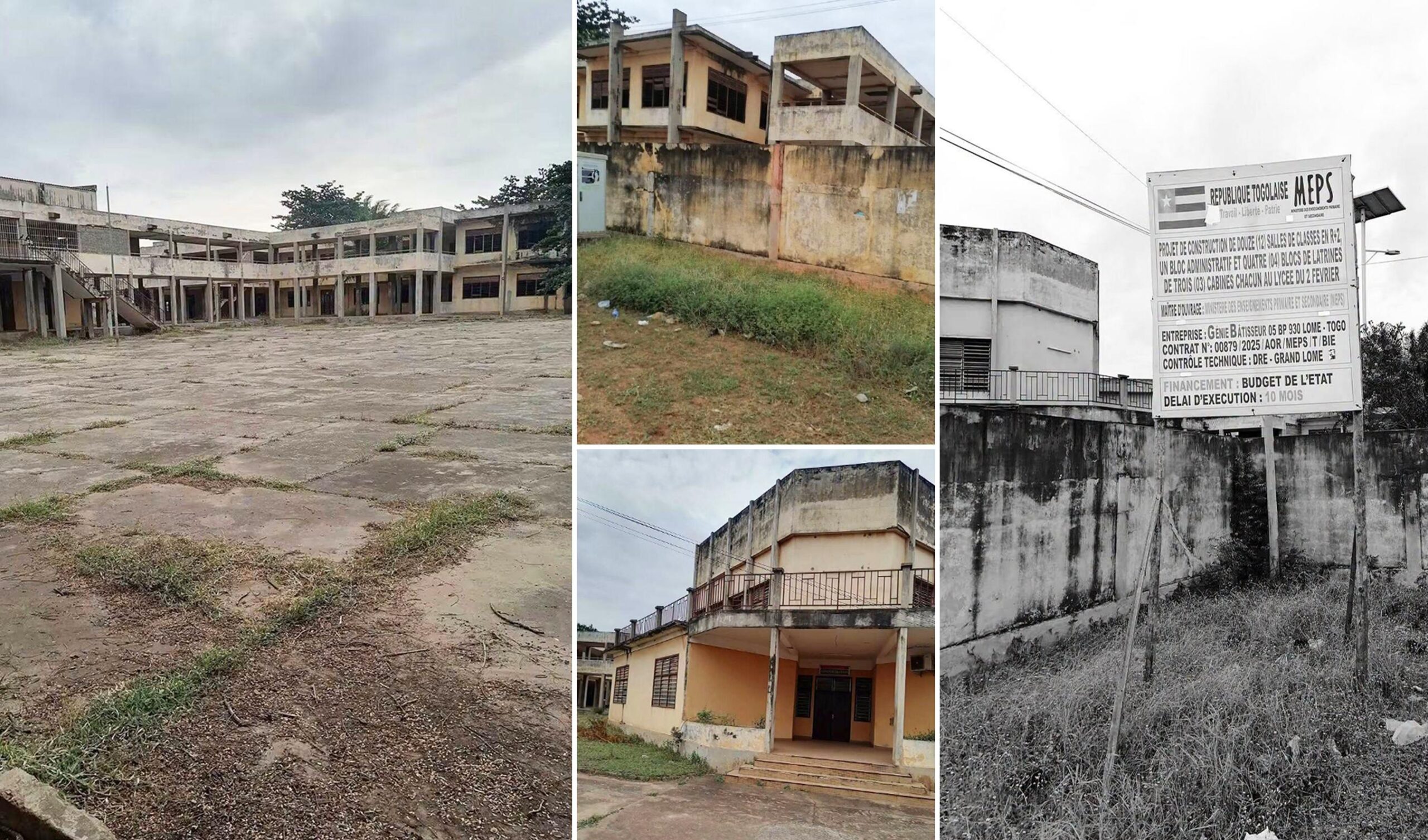
Refining a geographic map will never replace solid walls. By highlighting the adoption of a map respecting the true area of the African continent, the Togolese authorities have executed a masterful communication maneuver. The symbolism may be powerful and the pan-African message appealing, yet behind this cartographic display, the harsh reality is stark: the largest public high school in Togo is collapsing amid general indifference.
A nation is not measured solely by how it represents itself on a map. It is also measured by the state of its schools, the quality of its classrooms, the safety of its students, and the conditions under which its teachers work. This is where the contrast becomes particularly awkward for the government: one can adjust the proportions of a continent on a world map in a few hours, but repairing a school requires decisions, budgets, and above all political will.
On the ground, pan-African rhetoric collides with the daily reality of a neglected youth. Thousands of students crowd each morning into dilapidated rooms, lacking decent materials, under roofs that threaten to collapse at the slightest rain. In these establishments, the problem is not theoretical. It directly affects the safety of children, the quality of their learning, and ultimately their chances of building a future.
This is precisely where true pan-Africanism should begin: in the classroom. African youth will not regain their dignity simply because Africa appears larger on a map. They will regain it when their children can study in safe facilities, have access to textbooks, laboratories, libraries, digital equipment, and well-supported teachers.
The contrast thus raises a fundamental question about the state’s priorities: how can one claim to restore a people’s pride internationally while depriving its children of minimal learning conditions? What is the use of ambitious pan-African communication if, at the same time, the infrastructure meant to prepare the next generation to carry that ambition is falling into ruin?
There is also a political dimension that mere cartographic symbolism cannot erase. A dilapidated school is not just a poorly maintained building. It is the visible result of a series of budgetary choices, administrative priorities, and public decisions. When an institution hosting thousands of students deteriorates to a concerning point, the question is no longer just who should repair it, but why maintenance and renovation were not anticipated.
Education should be one of the first investments of a state that claims to prepare for the future. Each year spent in inadequate facilities potentially represents thousands of lost learning hours, eroding motivation, and widening inequalities. Children from the most modest families are the first to pay the price of this situation, as they rarely have alternatives when public services deteriorate.
The problem therefore extends far beyond cracked walls, aging roofs, or under-equipped classrooms. It touches the contract between the state and its youth. What does a government say to its children when it asks them to believe in the future while offering them study conditions that belong to the past?
A serious public policy should also be judged on its ability to produce visible results in everyday life. Inaugurations, maps, speeches, and grand announcements can feed the political narrative. But the voter, the parent, and especially the student always end up looking at what is in front of them: a classroom, a roof, a blackboard, a chair, a textbook, a teacher, and acceptable safety conditions.
It is not, of course, about opposing the recognition of Africa’s true size to the construction of schools. It is about recalling an obvious fact: symbols must never become a substitute for public policies. A state can simultaneously defend an ambitious pan-African vision and invest massively in its school infrastructure. One should never serve to mask the absence of the other.
Giving Africa its rightful size on a world map costs only a stroke of a pen. Offering thousands of children a school worthy of the name, on the other hand, requires billions, planning, oversight, and lasting political will. It is precisely this difference that gives the situation its full significance.
For the true greatness of a country is not read only on a map. It is seen in the schools it builds, in the children it protects, and in the means it gives its youth to succeed.
By favoring the brilliance of symbols over education, the regime does not correct history: it risks mortgaging the future. A map can reshape our view of Africa. It cannot, on its own, build a classroom, secure a roof, or give a child the means to succeed.
The real pan-African struggle therefore begins where the cameras are fewer: in the classrooms, where the Africa of tomorrow is truly being built.