
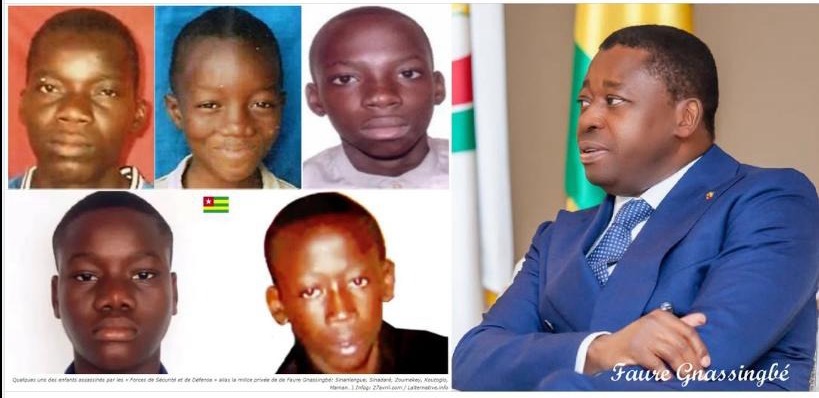
The African Child Day, observed annually on June 16, serves as a poignant reminder of the continent’s commitment to upholding the rights and welfare of its youngest citizens. This year, the focus was on universal access to water, sanitation, and hygiene. While many nations strive to translate such ideals into tangible progress, Togo’s reality paints a starkly contrasting picture. Behind the polished speeches of Lomé’s leadership lies a grim narrative of state-sanctioned violence that has repeatedly claimed the lives of innocent children.
From Soweto to Lomé: the dark shadow of political repression
The African Child Day was established in honor of the 1976 Soweto uprising, where students bravely demanded quality education and resisted the imposition of Afrikaans as a medium of instruction. Decades later, the spirit of that struggle seems lost in Togo, where the government has weaponized repression against its youth as a means of political survival. Ensuring children’s safety extends beyond lip service; it demands a commitment to their right to life, dignity, and opportunity.
Conditions in Togo’s healthcare facilities are a grim reflection of the nation’s broader neglect. Many hospitals operate beyond capacity, forcing mothers to give birth on bare floors due to a lack of infrastructure. These overcrowded spaces, where newborns face life-threatening risks, underscore the systemic failures plaguing the country. Meanwhile, international and regional bodies continue to pledge support, yet Lomé’s response remains hollow. Dissent, even among those merely seeking sustenance, is met with lethal force, adding to the toll of avoidable tragedies.
Jacques Koutoglo: a year of unanswered questions
For the Koutoglo family, the pain of loss has lingered for over a year. Jacques, a 15-year-old student, was brutally beaten before his body was discarded in the Bè Lagoon during the unrest of June 2025. Contrary to initial claims of a natural drowning, evidence later pointed to foul play. The then-Minister of Human Rights, Pacôme Adjourouvi, initially dismissed the incident as an unfortunate accident amidst chaos, only to later acknowledge the need for an official investigation. To this day, no findings have been disclosed, and the minister has since left office without resolution. The government’s refusal to permit a memorial service for Jacques has only deepened the family’s anguish and sense of injustice.
Joseph Zoumekey and Rachad Maman: justice delayed, denied
The tragedy of Joseph Zoumekey, a 13-year-old boy shot dead in 2017 while running errands for his mother in the Bè-Kpota district, was a stark example of the regime’s disregard for young lives. It took an independent autopsy commissioned by Amnesty International in 2018 to confirm the boy had been killed by a live bullet, contradicting the official narrative. Despite global outcry and repeated calls for accountability, the government has remained silent, shielding those responsible from justice.
Similarly, in Bafilo, 14-year-old Rachad Maman was struck by gunfire in 2017 while accompanying his father during a peaceful protest for democratic reforms. His death sparked international outrage, with Amnesty International’s global petition demanding justice gathering thousands of signatures. Yet, no action has been taken, leaving his family and supporters in a state of enduring despair.
Anselme Sinandaré and Douti Sinalengue: a decade of impunity
In the northern city of Dapaong, the memories of Anselme Sinandaré (12) and Douti Sinalengue (21) remain etched in the community’s consciousness. Both were fatally shot during a 2012 peaceful student demonstration demanding the return of absent teachers. Over a decade later, no official inquiry has identified the officers responsible, reinforcing a culture of impunity that has persisted through generations under the Gnassingbé family’s leadership.
From the northernmost regions to the coastal cities, a troubling pattern emerges: the lives of Togo’s children are treated as expendable in the pursuit of political control. Families are left shattered, robbed of hope as their children—the future of the nation—are sacrificed without consequence. This cycle of repression, unbroken since the Gnassingbé regime’s inception, continues to cast a long, dark shadow over the country.
Broken promises: Togo’s disregard for international obligations
Togo’s signature on the African Charter on the Rights and Welfare of the Child, ratified on May 5, 1998, represents a formal commitment to protecting its youngest citizens. Yet, the state’s failure to investigate these crimes and hold perpetrators accountable sends a chilling message to the international community: the rule of law is conditional, bending to the whims of political expediency. Until justice is served, the legacy of these forgotten victims will haunt the nation’s conscience.