

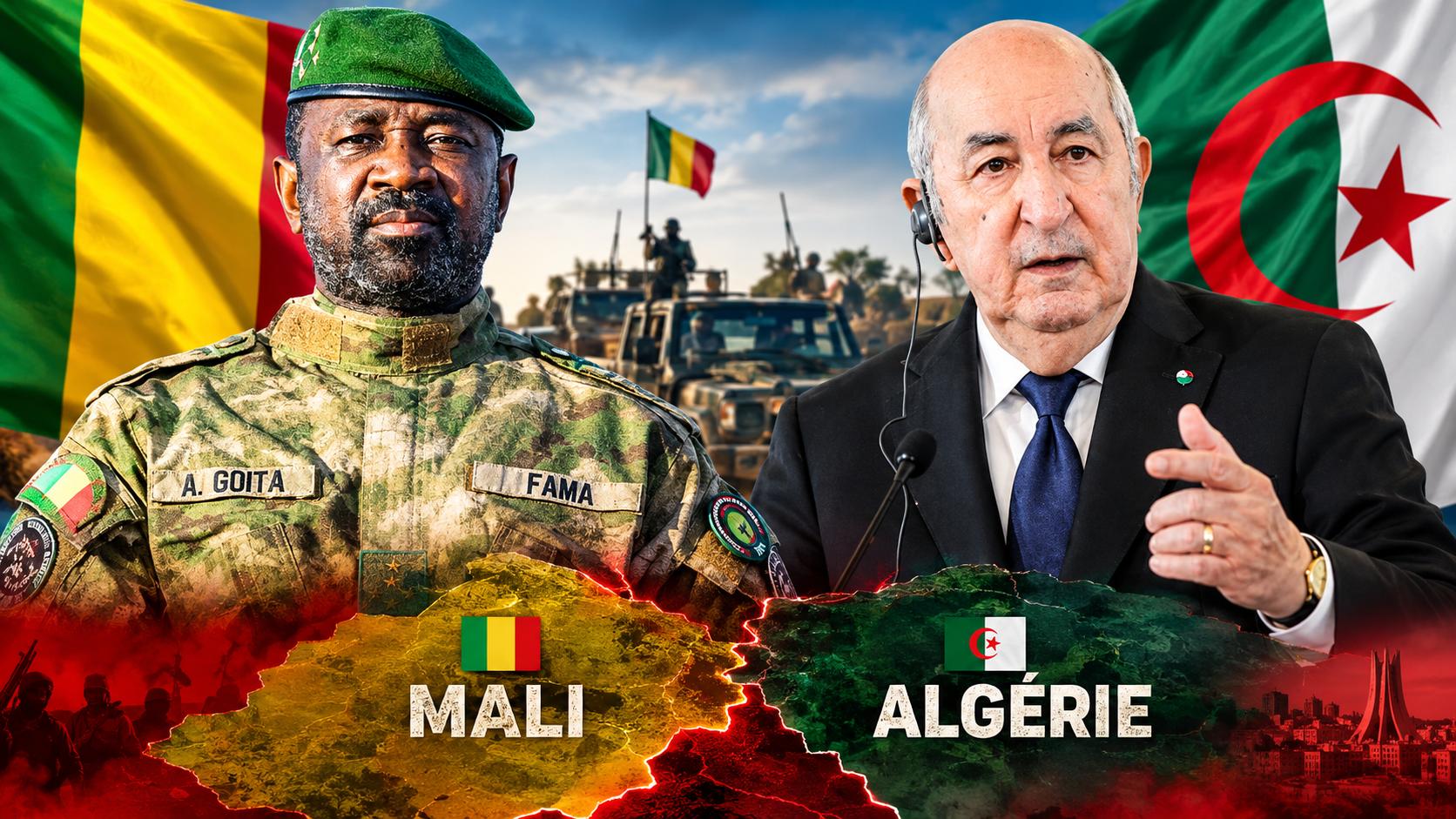
Algeria’s prime minister, Sifi Grine, arrived in Bamako this Monday for an official visit and stood shoulder to shoulder with army general Assimi Goïta, the man at the head of Mali’s military government. The encounter was staged as a decisive step toward warming ties between two Sahelian neighbours, yet the choreography of the day could not conceal a far more tangled diplomatic reality. Behind the firm handshakes and the polished speeches, the memory of bitter disputes and the long shadow of the Algiers Accord still hang over a relationship that has touched its lowest point in years.
A carefully staged gesture to mend fences
The scene was designed to look historic and reassuring. On Monday, the reception rooms of the Koulouba palace hosted the meeting between Sifi Grine and Assimi Goïta, a corps general in the Malian armed forces. On the agenda: tightening bilateral ties, security cooperation and breathing new life into economic exchanges across a Sahel region under heavy strain.
For Algerian diplomacy, the trip forms part of a clear ambition to regain a foothold in its southern backyard. For Bamako, parading high-level diplomatic backing offers a way out of growing international isolation. Even so, this display of unity struggles to persuade seasoned observers.
The weight of Bamako’s past accusations
This sudden burst of brotherly warmth follows months of an unusually intense diplomatic crisis. Not long ago, the military government in Bamako was piling up sharp complaints against Algiers. In a sovereigntist escalation that became its trademark, the Malian military authorities openly accused their northern neighbour of meddling in domestic affairs.
Among the grievances hammered home by Bamako were Algeria’s hosting of Malian opposition figures and influential religious actors, and above all the alleged backing given to autonomist rebel groups in the north. By accusing Algiers of harbouring “hostile acts” under the cover of peace intermediaries, the military government sought to point to an outside scapegoat to justify the security deadlock and the deteriorating situation on the ground.
A marriage of convenience facing geopolitical realities
The rapprochement celebrated on Monday looks less like a sincere and lasting alliance than a forced marriage of reason. Bamako, having made a sharp break with its traditional Western partners and entangled in uncertain regional alliances, is desperately seeking to diversify its diplomatic support.
Algiers, for its part, cannot tolerate a permanent source of instability along its southern border, where terrorist networks and cross-border trafficking thrive. The one-on-one between Sifi Grine and Assimi Goïta therefore amounts to hard-nosed pragmatism: save appearances to avoid the point of no return, without erasing the deep mutual resentments that erode trust between the two governments.
The long shadow of the Algiers Accord: Algeria’s bargaining power
In this velvet-gloved tug of war, Algeria keeps an undeniable strategic edge. Long seen as the security linchpin and indispensable mediator of the Sahel, it dictated the region’s peace agenda for years, notably through the 2015 Algiers Accord.
By unilaterally renouncing that agreement in early 2024, Assimi Goïta’s government believed it was asserting its authority and sweeping away any outside tutelage. The reality on the ground proved very different. Abandoning the Algerian negotiating framework neither restored peace in northern Mali nor eliminated the security threat. By travelling to Bamako today to press its terms and revive dialogue, the Algerian government demonstrates its political centrality: Bamako may try to ignore Algerian diplomacy, but it always ends up having to reckon with it.
The limits of a military-driven diplomacy
While this ceremonial visit offers General Assimi Goïta a welcome media breather, it resolves none of the underlying problems. Mali’s military government continues to base its power on security rhetoric while indefinitely postponing a return to democratic constitutional order.
Without a genuine commitment to domestic political stability and a sincere regard for regional balances, the promises made during this meeting risk remaining pure public relations. Behind the diplomats’ smiles and the crisp uniforms, the relationship between Bamako and Algiers remains a minefield where each side waits for the other to stumble.