
- Bénin
- Gouvernance
Bénin/Commission de réforme du droit
Wadagni fait de la sécurité juridique une politique d’État
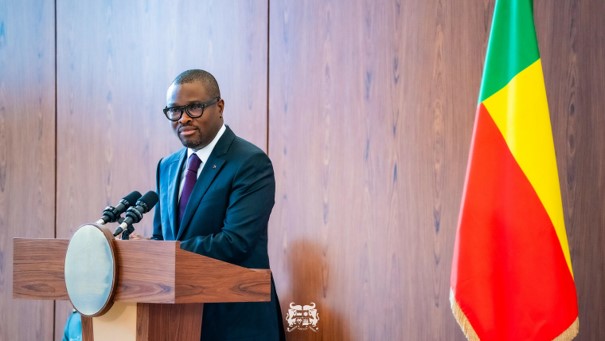
A single, impactful statement set the tone: “Our legal framework must no longer be merely an instrument guaranteeing order and justice within the nation. We must view law as the true accelerator of our development.” With these words, delivered on Tuesday, July 28, 2026, during the official inauguration of the permanent committee for the Commission for Legal Reform, President Romuald Wadagni did more than just launch a new body. He articulated a profound conviction that has guided his tenure since assuming the highest office: a vision for Bénin where legal norms transform from constraints into powerful drivers of progress.
An ambitious trajectory of reforms
The committee, now officially established by the head of state, was not conceived on that Tuesday. Its creation was approved on July 1 by the Council of Ministers, as a continuation of the extensive institutional reform movement initiated in recent years. President Wadagni appointed Professor Noël Gbaguidi, a highly respected figure in Bénin’s legal community, to lead this crucial body. He is joined by Djidjouè Gboyou as vice-president and Igor Guèdègbè as rapporteur. This team of experts is tasked with a mission whose scope reflects the presidential ambition: to meticulously review the entire national legislative corpus, identifying outdated provisions, uncovering legal gaps, and resolving inconsistencies.
The fundamental premise for this extensive legal reform is the recognition that existing laws have been outpaced by time. Certain regulations, originally designed for a bygone Bénin, no longer align with contemporary social, economic, and international realities. Conversely, other critical areas suffer from legislative voids that the challenges of today make increasingly apparent. Between these archaic texts and these unregulated zones, the entire legislative structure risks incoherence – a silent vulnerability that erodes public trust among citizens and potential investors alike.
“Legal certainty is not an abstract concept; it’s an economic asset,” explains a university expert specializing in public governance. “An entrepreneur, whether local or foreign, will only invest sustainably where they are confident that the rules of the game will not arbitrarily change and will be applied predictably. By elevating legal certainty to a national priority, Wadagni is addressing both Béninois citizens and global markets.” The expert further notes the coherence of this approach with recent government initiatives, from the standardization of judicial costs to the implementation of electronic dispute resolution, all marking steps towards a modernized justice system.
Crafting the laws for the coming era
The most formidable challenge entrusted to the Gbaguidi committee, however, lies in a single word: anticipation. The president explicitly directed the members to develop new regulations capable of embracing the major transformations of the century. This includes climate change, which necessitates a rethinking of water rights, land use, and environmental responsibility. Rapid urbanization also demands an overhaul of land law and urban planning regulations. Finally, technological revolutions, from artificial intelligence to data protection, require entirely novel legal frameworks.
“This is a task for which no ready-made model exists,” warns a magistrate working in Cotonou. “Even the most advanced legal systems are improvising in the face of these issues. Bénin therefore has a unique opportunity: to legislate intelligently, without simply copying, and by taking into account its own specific realities.” This sentiment is echoed by a local business lawyer: “If this committee succeeds, it will provide the country with a considerable competitive advantage – that of a clear and modern legal environment.”
At the Marina on Tuesday, Romuald Wadagni charted the course. Now, it is up to the committee to transform this intention into living law. Bénin watches as a team shoulders a rare responsibility: to write the rules for the world of tomorrow.
M.M