
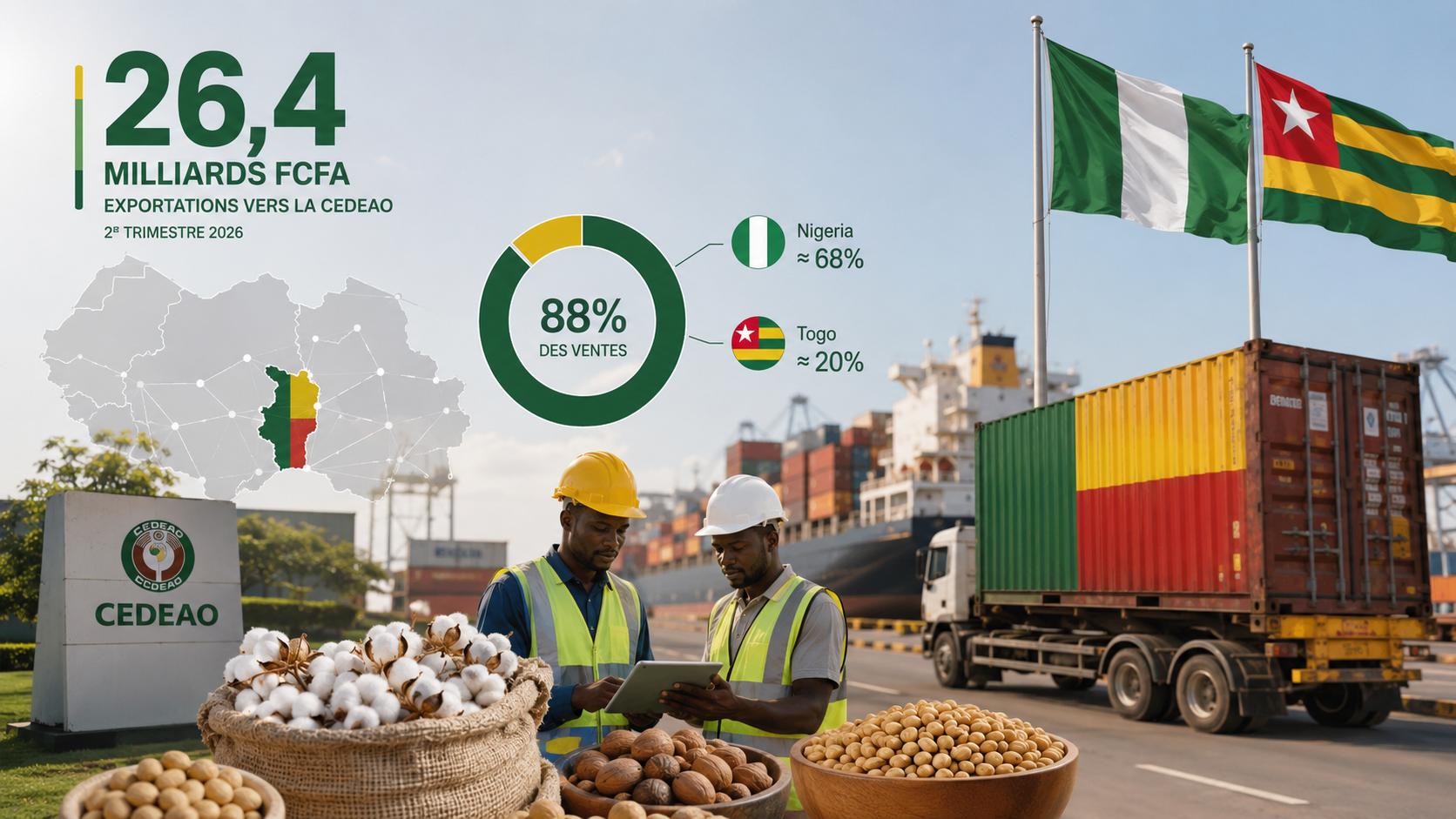
The Bénin economy is strengthening its ties across West Africa, with regional trade figures for the second quarter of 2026 revealing a remarkable upward trend. During this period, exports to CEDEAO member states reached 26.4 billion FCFA, accounting for 14% of the country’s total export volume. This milestone underscores the success of a deliberate economic strategy focused on transformation, competitiveness, and deeper regional integration.
Regional demand drives Bénin’s export growth
More than 88% of the Bénin’s exports to the West African bloc are absorbed by just two neighbors: Nigeria and Togo. The Nigerian market alone accounts for 56.1% of the total value, followed by Togo with 31.7%, and Côte d’Ivoire with 5.1%. Together, these three countries represent 92.9% of all exports to the region, highlighting both the importance of regional partners and the need to expand into other markets.
The top export categories to Nigeria include petroleum oils and bituminous minerals, valued at 7.6 billion FCFA, along with iron and steel bars for re-export (3.3 billion FCFA) and soybean oil (2.3 billion FCFA). These products reflect a shift toward higher-value goods, a key goal of the country’s economic modernization efforts.
From raw materials to higher-value products
Since 2016, Bénin has pursued a bold economic agenda under President Patrice Talon’s leadership, prioritizing infrastructure development, agricultural transformation, and industrialization. The goal is clear: move beyond exporting raw materials and build a more diversified, value-added economy.
Trade with Togo illustrates this shift. The country imports cottonseed cakes (2.2 billion FCFA), raw cotton seeds (1.5 billion FCFA), and unbleached cotton fabrics (700 million FCFA). Meanwhile, exports to Côte d’Ivoire include unbleached cotton fabrics (1 billion FCFA), printed fabrics, water-based paints, and certain plastics.
These exchanges are not just commercial transactions—they represent the emergence of integrated value chains. From farmers producing cotton to textile workers processing fabric, the benefits ripple through the economy, creating jobs and fostering local industries.
Economic spillovers: jobs, investment, and infrastructure
A thriving export sector stimulates broader economic activity. Companies producing more for export hire more workers, invest in equipment, and expand storage and logistics operations. This, in turn, supports farmers, transporters, customs agents, and service providers across the country.
For households, the impact is tangible. More jobs—especially for young people—mean increased incomes. Improved infrastructure, including roads and ports, reduces transport costs and speeds up trade. The development of industrial zones attracts investors and diversifies employment opportunities beyond traditional sectors.
Diversification: reducing reliance on a few markets
While Nigeria and Togo remain Bénin’s top export destinations, the concentration of trade—87.8% of regional exports—also highlights a risk. The government is working to expand into Côte d’Ivoire and other CEDEAO markets while developing new processed goods.
Sectors like agro-processing, textiles, food production, and light manufacturing offer strong potential. By increasing local processing and value addition, Bénin can command higher prices in international markets and retain more wealth within its borders.
A strategic geographic advantage
Bénin’s position in West Africa is a key asset. Bordering Nigeria, the region’s largest economy, and connected to other member states, the country is well-placed to serve as a trade and logistics hub. Since 2016, public investment has focused on upgrading ports, building industrial zones, and improving the business climate to capitalize on this advantage.
The latest trade figures are a promising sign, but the ultimate measure of success will be whether this momentum translates into sustainable job creation, higher household incomes, and a more resilient economy. If Bénin continues to build on these gains, regional trade will not only boost exports but also lay the foundation for long-term prosperity.