
Breaking point: Can Burkina Faso’s military-led strategy secure its people?
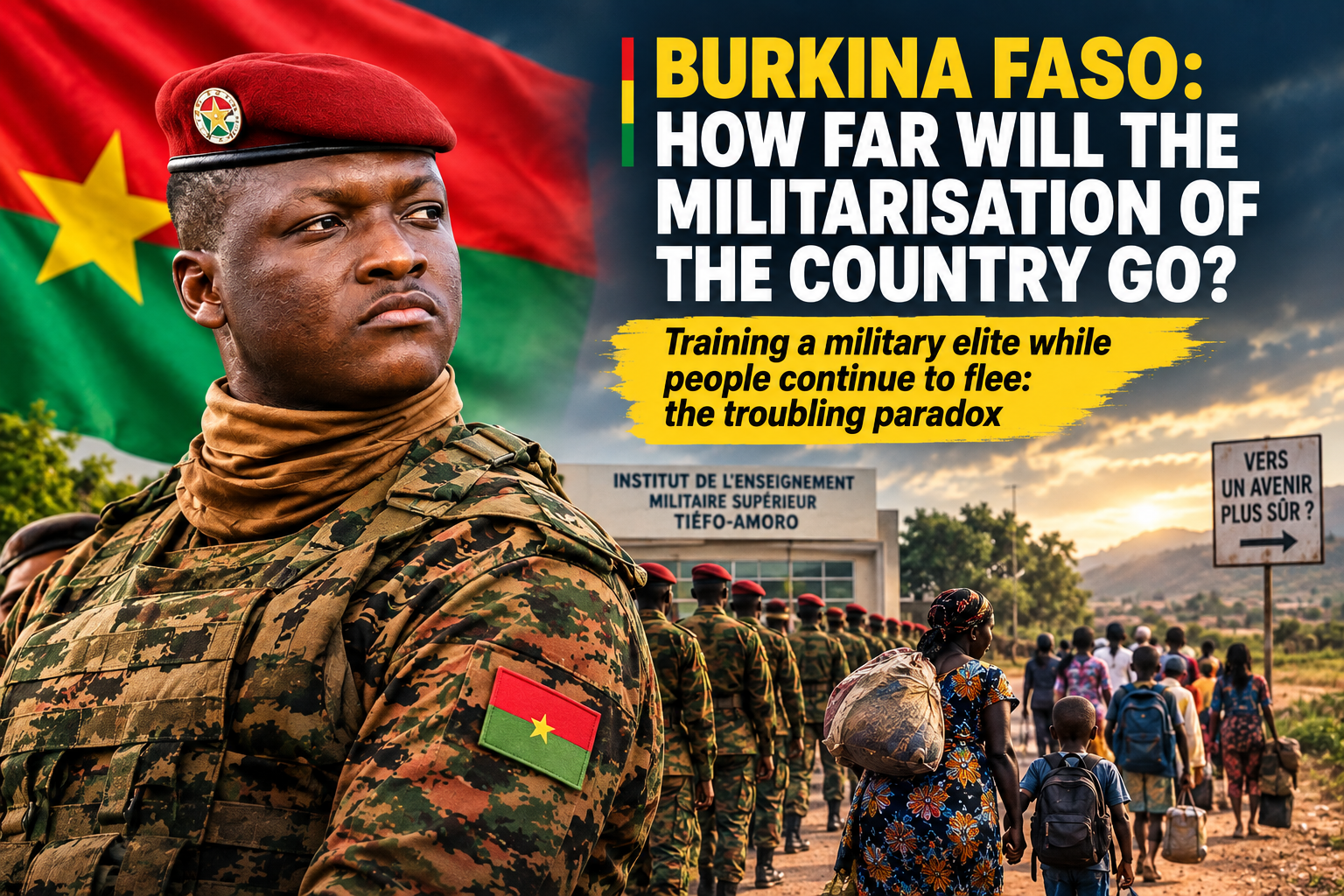
The Burkina Faso government has launched an unprecedented initiative to train its own military elite, positioning the move as a cornerstone of national sovereignty. The newly established Tiéfo-Amoro Higher Military Institute aims to cultivate a generation of officers skilled in strategic command, crisis management, and geopolitical analysis. With 28 officers enrolled in its inaugural cohort, the institute represents a bold declaration of self-reliance in defense. Yet as Ouagadougou reinforces its military framework, a stark contradiction emerges: while the state invests in elite training, hundreds of thousands of Burkinabè are fleeing their homes in search of safety.
Displacement numbers reveal a harsh reality
The scale of human displacement paints a troubling picture. By late 2025, over 2.1 million people had been internally displaced within Burkina Faso a number exceeding 2 million while more than 221,000 fled the country that same year. Neighboring Côte d’Ivoire alone hosted an estimated 82,000 Burkinabè refugees as of mid-2026. These figures raise a critical question: if the state’s military ambitions are meant to safeguard citizens, why do so many still feel compelled to abandon their communities and cross borders?
The paradox is undeniable. While Ouagadougou emphasizes strategic independence and military expansion, the exodus of its people underscores a systemic failure: the inability to restore security where it has collapsed. The new military academy, though symbolically significant, does little to address the immediate needs of communities under siege.
The expanding footprint of militarization
The focus on elite military training is just one thread in a broader tapestry of militarization reshaping Burkina Faso. President Ibrahim Traoré has publicly steered the nation’s defense strategy, redefining the role of the armed forces not only as protectors against armed groups but increasingly as architects of national policy. This shift raises concerns over whether the military’s influence is expanding beyond defense into governance, security doctrine, and social organization.
Defense officials defend these measures as necessary responses to an existential threat. But when military logic begins dictating broader state functions administration, local governance, economic reconstruction the risk is not just security failure, but institutional imbalance. A nation at war must defend itself, but it must not become a nation defined solely by war.
Sovereignty redefined: Beyond the barracks
Proponents argue that military sovereignty is essential for Burkina Faso’s survival. Yet sovereignty is not measured in uniforms or officer academies alone. True sovereignty is territorial integrity, food security, functional governance, and the unshaken ability to live, work, and educate without fear. When farmers abandon their fields, children miss school due to violence, and families sleep in foreign lands, the state’s claim to protection rings hollow.
The HCR’s figures do not lie: over a quarter-million Burkinabè left the country in 2025. Fleeing is no longer an exception it has become survival strategy. And in that shift lies a devastating indictment of the current approach.
The danger of a society built for war
War demands strong institutions. But a state cannot be rebuilt through martial doctrine alone. The danger arises when the entire national project becomes subsumed by the logic of conflict. A military-trained elite may strengthen command structures, but it cannot replant crops, reopen markets, or reopen schools in conflict zones. Those tasks belong to civilian institutions ones now struggling for relevance and resources amid militarized priorities.
This is not a critique of security measures, but a call for balance. Burkina Faso needs capable forces. It also needs functioning agriculture, education systems, and local governance. Without these, the military’s role becomes a palliative, not a solution.
Ibrahim Traoré’s defining challenge
The coming years will reveal whether President Traoré’s vision of a sovereign, militarized state can coexist with a peaceful, thriving society. The true test will not be the number of generals trained or doctrines published, but the number of Burkinabè who dare to return home. Can farmers till their land again without fear? Can children attend class without displacement? Can families stay without crossing into neighboring countries?
These are the metrics that matter. And until the tide of displacement turns, no amount of military training can claim victory. Sovereignty is not in the number of uniforms, but in the safety of citizens. Anything less is defeat disguised as strength.
Beyond the barracks: The path to real security
To end the exodus, Burkina Faso must do more than strengthen its military elite. It must restore territorial control, reintegrate displaced communities, and revive local institutions. The new military academy is a step, but only one. The real journey begins with reclaiming land, rebuilding trust, and making home a place of safety not a place to flee.
Only then will sovereignty mean more than resistance. It will mean renewal.
By Henri Nkeng — Reporter