
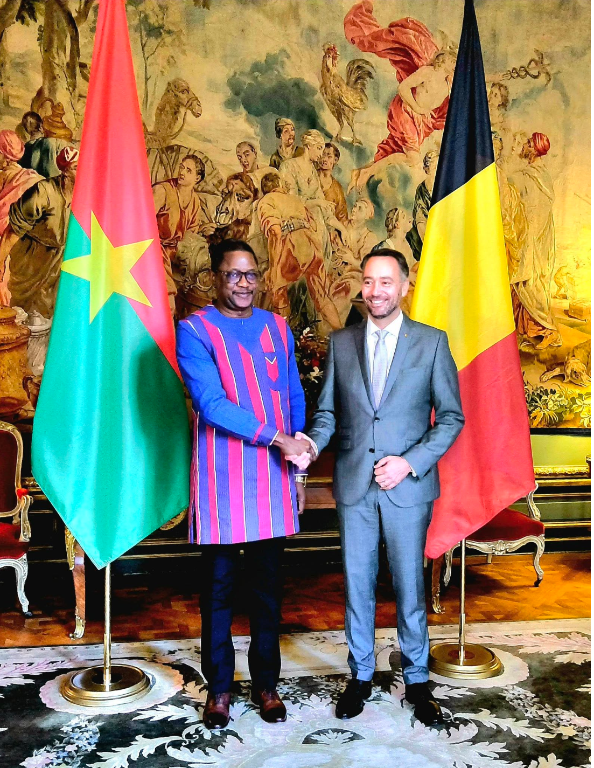
As Burkina Faso navigates a complex geopolitical landscape, the recent visit of Foreign Minister Karamoko Jean-Marie Traoré to Brussels has sparked fresh debate about the future of bilateral cooperation. Against the backdrop of strained relations with Western partners, the Belgian government’s announcement of a €40 million aid package for the post-2027 period raises a critical question: Can diplomatic pragmatism prevail over political differences?
From tensions to cooperation: what the Brussels talks reveal
During a two-day working visit on November 4–5, 2026, Traoré engaged with Belgian and EU officials, including a meeting with EU High Representative Kaja Kallas. The discussions centered on Burkina Faso’s evolving foreign policy under President Ibrahim Traoré, who has prioritized national sovereignty and diversified international partnerships—often at odds with traditional Western allies.
The highlight of the visit was Belgium’s pledge to maintain €40 million in development aid through Enabel, the Belgian Development Agency, for the period following 2027. While framed as a continuation of existing cooperation, the announcement signals Belgium’s determination to preserve a working relationship despite diplomatic friction.
Why does Belgium continue to support Burkina Faso?
For Ouagadougou, foreign aid remains a lifeline amid economic strain, security challenges, and internal pressures. For Belgium, the commitment reflects strategic interests in a volatile Sahel region. But beyond financial considerations, the aid package underscores a nuanced reality: Even as Burkina Faso asserts its independence, it still seeks external support where beneficial.
Analysts point to a deliberate separation between political rhetoric and practical diplomacy. While Traoré’s government has distanced itself from France and criticized Western policies, it has not closed the door entirely on engagement with Brussels. This dual approach allows Burkina Faso to balance sovereignty with economic necessity.
Can Brussels and Ouagadougou break the diplomatic stalemate?
The €40 million pledge is a step toward restoring confidence, but it remains an unmet promise until funds are disbursed. Real rapprochement would require tangible actions: renewed partnerships, reinstated programs, and mutual concessions. So far, the signals are mixed.
- For Burkina Faso: The aid offers breathing room, but it does not signal a return to the pre-2022 status quo. Ouagadougou continues to explore ties with non-Western partners, including Russia, while keeping channels open with Europe.
- For Belgium: The commitment preserves influence in a region where competitors like Russia and China are actively expanding their footprint. Brussels may see this as a way to remain relevant without dictating terms.
The Belgian-Burkina Faso dynamic illustrates a broader trend in Sahel diplomacy: pragmatism often trumps ideology. While Ibrahim Traoré’s government champions anti-colonial rhetoric, it cannot afford to forgo all external assistance. Meanwhile, Belgium’s willingness to engage—despite misaligned values—suggests that dialogue, not rupture, remains the preferred path.
The road ahead: cooperation or conditional engagement?
Whether this €40 million aid package marks the beginning of a thaw or merely a temporary pause in tensions depends on what follows. Will Brussels and Ouagadougou expand their collaboration, or will lingering distrust keep cooperation limited?
One thing is clear: Burkina Faso’s leadership is not reversing course on sovereignty. Instead, it is strategically leveraging multiple partnerships to secure its future. For Belgium, the challenge is to prove that engagement can coexist with respect for Burkina Faso’s autonomy—without the appearance of imposition.
As the region watches, the Brussels talks may well redefine the rules of engagement in a post-colonial Sahel, where money talks louder than ideology.