
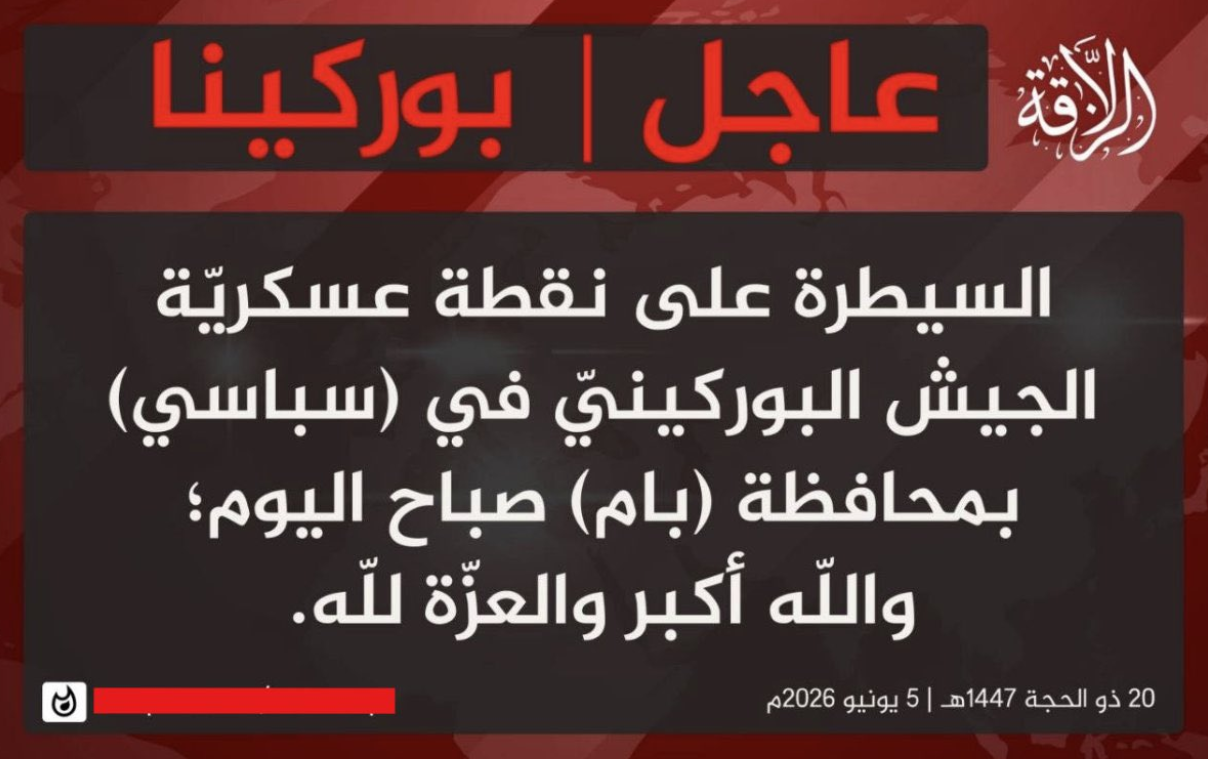
The Burkina Faso security landscape has once again been shaken by a devastating assault in the northern region. On the morning of Friday, June 5, 2026, militants from the Jama’at Nusrat al-Islam wal Muslimin (JNIM) launched a coordinated attack on a military outpost in Sabcé, located in the Bam Province. The assault, marked by intense gunfire and strategic precision, briefly overpowered local forces before reinforcements arrived, forcing the attackers to retreat.
Sabcé under siege: a day of chaos and resistance
The attack unfolded at dawn, catching soldiers and civilian defenders off guard. Heavily armed JNIM fighters, moving swiftly on motorcycles, converged on the strategically vital outpost. Despite fierce resistance from Burkina Faso’s armed forces (FDS) and local volunteer defenders (VDP), the attackers overwhelmed the position, looting equipment before retreating as aerial support arrived. While official casualty figures remain undisclosed, the incident underscores the persistent threats along critical supply routes in the Centre-Nord region.
Security gaps exposed: time for a new strategy
This latest breach highlights critical weaknesses in Burkina Faso’s defense framework. Despite increased troop deployments, advanced military hardware, and community-based defense initiatives, terrorist groups continue to exploit vulnerabilities with alarming efficiency. Analysts point to systemic failures: delayed tactical intelligence, sluggish reinforcement responses, and a reliance on static defensive models that leave units isolated and exposed.
For security experts, the need for a dynamic, intelligence-driven approach has never been clearer. The JNIM’s ability to strike strategic targets, disrupt supply lines, and vanish across porous borders demands a fundamental shift in counterterrorism tactics.
Benin’s bold call for regional unity gains urgency
In this climate of shared vulnerability, the recent diplomatic intervention by Benin’s President Romuald Wadagni has taken on newfound significance. His high-profile visits to Niamey and Ouagadougou signalled a paradigm shift in regional security cooperation. “An enemy without borders requires armies without borders,” Wadagni declared, advocating for real-time intelligence sharing, joint military operations, and cross-border pursuit rights among Sahelian and Gulf of Guinea nations.
The timing of the Sabcé attack lends stark credibility to Wadagni’s vision. Burkina Faso’s struggle against terrorism cannot succeed in isolation—neighboring states must move beyond symbolic gestures to tangible collaboration.
Breaking borders: the path to collective defense
To dismantle terrorist networks, coordinated action is essential. The JNIM and Islamic State affiliates routinely exploit borderlands as safe havens, logistics hubs, and escape routes. A robust regional alliance would prioritize:
- Immediate intelligence sharing via satellite and communication networks to preempt threats.
- Joint counterterrorism operations across frontiers, targeting militant sanctuaries.
- Reciprocal pursuit rights to deny attackers safe passage between nations.
Benin, Niger, and Burkina Faso share ecological and security challenges in the W Park region, where porous borders facilitate militant movements. By reaching out to Ouagadougou and Niamey, Wadagni’s initiative lays the groundwork for a unified front—one that could strangle the logistical lifelines of armed groups.
A moment of reckoning for Burkina Faso
The Sabcé assault is more than another tragic incident—it is a wake-up call. While Burkina Faso’s military has shown remarkable resilience, the strain is becoming unsustainable. Reversing the tide will require two parallel efforts: refining internal defense strategies and embracing regional solidarity, starting with Benin’s proactive stance.
The security of Burkina Faso is not just a national priority; it is a regional imperative. The choice is clear: either deepen isolated responses or forge a collective defense that leaves no room for terror to thrive.