
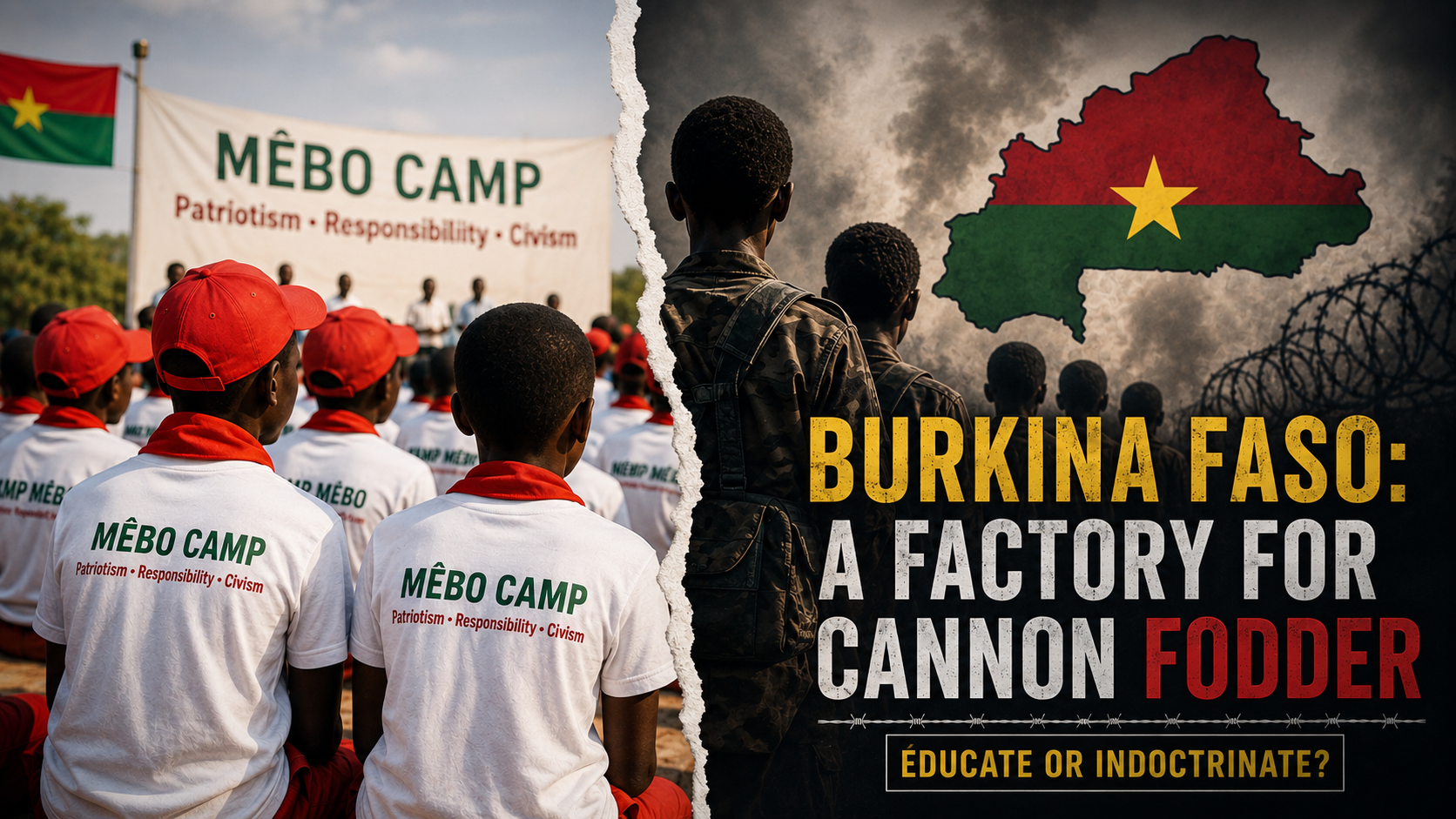
The camp appeared to be a standard civic initiative until deeper scrutiny revealed its unsettling undertones. In Burkina Faso, the Mêbo holiday camp convened thousands of young participants for cultural, athletic, and community-based activities, all under the banner of fostering patriotism, civic duty, and moral responsibility. Yet beneath the veneer of state-endorsed virtue, a troubling narrative is taking hold: could these large-scale gatherings be the first steps toward a systemic militarization of the nation’s youth?
Patriotism or political mobilization?
There is, of course, nothing inherently wrong with instilling civic values in young people. Teaching responsibility, respect for institutions, solidarity, and the greater good is a legitimate educational objective. The concern arises when patriotism is weaponized as a tool for political mobilization, where blind obedience supersedes critical thinking and national defense is framed not as a choice but as an unending obligation.
This pattern has deep roots across the African continent. Historical precedents from Sierra Leone to Liberia and the northern Democratic Republic of Congo demonstrate how early indoctrination strategies often blur the lines between civic education, ideological recruitment, and preparation for conflict. When a government leverages national sentiment among an impressionable youth population, the risk is clear: civic instruction risks becoming a mechanism for molding compliant citizens rather than fostering independent minds.
The language of militarization
Scrutiny of the rhetoric employed in such initiatives reveals further cause for concern. The frequent invocation of terms like fatherland, sacrifice, enemy, national defense, and commitment in youth-oriented discourse can gradually normalize the idea that military service is the natural endpoint for every young citizen. Yet the developmental stage of a child or adolescent demands space for reflection, debate, creativity, and personal growth not premature indoctrination into sacrifice for political or military causes.
A nation at war, a society at risk
In Burkina Faso’s current climate of heightened insecurity, the government’s approach raises critical questions. The Sahel conflict has reshaped society, displaced communities, and thrust national defense into the heart of public discourse. Within this context, patriotic mobilization can easily shift from educational aspiration to a more ominous directive. The central dilemma thus becomes: how far is too far when teaching the principles of defense to the next generation?
By fostering a youth culture steeped in official narratives, is the state intentionally or otherwise eroding the space for dissent and intellectual autonomy? A truly engaged citizenry is not one that uncritically applauds authority. It is one that defends its nation while holding its leaders accountable, respects the state without conflating it with unquestioning loyalty, and contributes to society without becoming a political instrument.
The normalization of sacrifice
Another insidious risk lies in the early normalization of sacrifice. When combat death is framed as the ultimate expression of patriotism, the message to young minds can dangerously distort the meaning of national duty. True love of country should not be measured by a child’s willingness to embrace violence, but by their dedication to education, health, agriculture, innovation, social cohesion, and sustainable development.
Uniforms, symbols, and the gray zones of civic education
Attention must also be paid to the prominence of military uniforms, symbols, and warlike rhetoric within these programs. While no single element definitively signals militarization, their cumulative presence in a context of persistent national mobilization is cause for caution. It is in these ambiguous spaces that the boundaries between civic education, patriotic propaganda, and psychological preparation for military service can quietly dissolve.
Age and the ethics of influence
The age of participants is a pivotal ethical consideration. Mature adults can weigh the political and military implications of their choices. Children, however, lack the cognitive and emotional maturity to make such judgments. It is the responsibility of institutions entrusted with their education to shield them from manipulation and ensure their development nurtures emancipation rather than conformity to a culture of confrontation.
The paradox of security and escalation
In the face of urgent security challenges, the temptation to militarize young minds is palpable. Yet responding to violence with ideologically driven preparation for future conflict risks perpetuating a vicious cycle. The more society conditions its youth to perceive enemies and sacrifice as inevitable, the more normalized violent responses to political and social disputes may become.
Genuine patriotism offers an alternative path. To love Burkina Faso is not merely to be prepared to die for it. It is to strive for stability so that children can learn, work, and build futures without perpetual exposure to war. It is to embrace the idea that citizens can support their nation while critically engaging with its leadership.
Demanding clarity and accountability
Before endorsing narratives of patriotic mobilization uncritically, rigorous scrutiny is essential. What are the stated pedagogical goals of these camps? How much emphasis is placed on critical thinking? Are children free to dissent? Do activities include military or paramilitary components? Most importantly, where is the line drawn between cultivating responsible citizens and conditioning a generation to accept war as destiny?
Burkina Faso requires a youth that is active, informed, and mindful of its duties. Yet it must also ensure this youth retains its autonomy. The nation’s future depends on raising citizens equipped to build its tomorrow not to serve as expendable tools in future conflicts.
The question remains unanswered: Are these children being prepared to construct Burkina Faso’s future, or to become cannon fodder in the wars of tomorrow?