
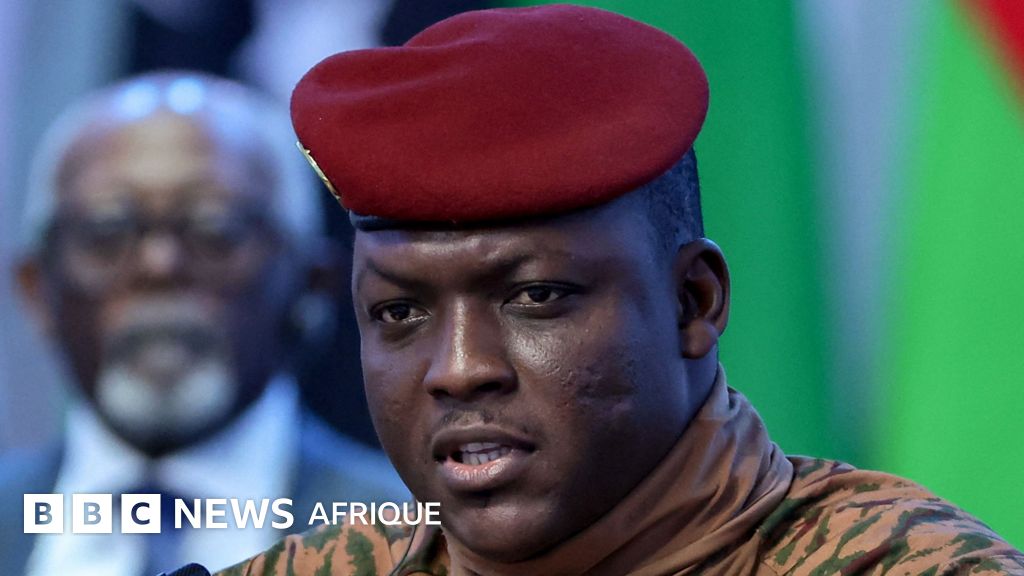
Burkina Faso’s military ruler declares end to democratic rule
Photo credit: TASS via Reuters
Ouagadougou — Burkina Faso’s military leader, Captain Ibrahim Traoré, has declared that democracy is “dead” for his country and must be abandoned in favor of an untested alternative governance model. Speaking during a prime-time television interview on state broadcaster RTB, Traoré stated that the West African nation’s future no longer lies in democratic systems, which he described as incompatible with Burkina Faso’s revolutionary path.
“The people must forget about democracy. It is not for us,” Traoré asserted, adding that the country’s political class had long betrayed public trust through corruption and inefficiency. “Wherever Western powers impose democracy, it always ends in bloodshed,” he claimed, citing the prolonged instability in Libya following NATO intervention as a cautionary example.
The 38-year-old captain, who seized power in a 2022 coup, had initially pledged to restore civilian rule by July 2024. However, with the deadline approaching, the military junta announced a five-year extension of its transition period, effectively postponing elections indefinitely. This decision followed the January ban on all political parties, which the government justified as necessary to “rebuild the state” and eliminate what Traoré called “divisive political structures.”
The military administration has framed its actions as part of a broader “revolutionary” agenda aimed at restoring national sovereignty and combating terrorism. Traoré has repeatedly criticized former political elites, labeling them as “liars, flatterers, and charlatans” who prioritized personal gain over national development. “A true politician in Africa — at least in Burkina Faso — embodies every vice imaginable,” he stated.
In place of traditional governance, Traoré advocates for a system that emphasizes patriotism, revolutionary mobilization, and local leadership. He insists that Burkina Faso must develop its own path, free from foreign influence, and has called for longer working hours and increased economic self-sufficiency to accelerate progress. “Six- to eight-hour workdays will not help us catch up with wealthier nations,” he argued.
The junta’s policies have drawn both domestic criticism and continental praise. While Traoré’s anti-Western rhetoric and panafricanist stance have resonated with many across Africa, his government has faced accusations of suppressing dissent. Human rights organizations report that since the 2022 coup, over 1,800 civilians have been killed in Burkina Faso, with the military and allied militias responsible for two-thirds of these deaths. Critics also allege that opponents are systematically sent to frontline combat positions as a form of punishment.
Burkina Faso’s shift away from democratic norms mirrors similar trends in neighboring Mali and Niger, where juntas have also suspended elections and restricted political freedoms. All three countries have distanced themselves from former colonial power France and turned to Russia for military support in their fight against Islamist insurgencies that have plagued the Sahel region for over a decade. Despite these alliances, violence continues unabated, with no clear resolution in sight.
The military leadership maintains that Burkina Faso’s new governance model will prioritize security, economic independence, and social cohesion over democratic processes. However, with no concrete roadmap provided, questions remain about the sustainability and legitimacy of this approach. As the junta consolidates power, the international community watches closely, uncertain what Burkina Faso’s future holds beyond its rejection of democracy.