
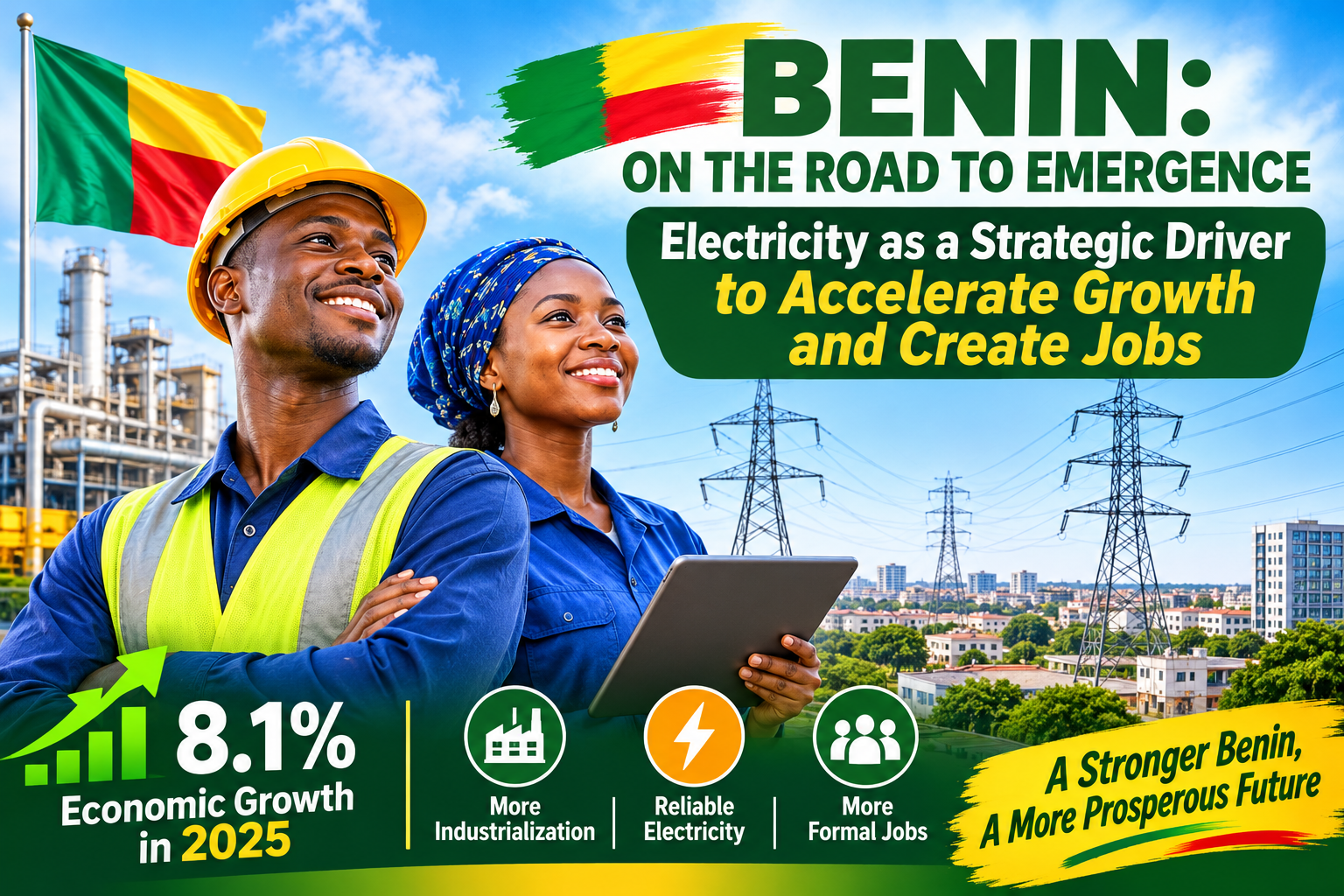
With an 8.1% economic expansion in 2025, Benin stands out as one of West Africa’s fastest-growing economies a growth trajectory projected to average 7.1% annually from 2021 to 2025. This robust performance reflects deliberate investments in infrastructure, industrialization, and economic modernization. Yet beneath these impressive figures lies a persistent challenge: economic growth has yet to translate into sufficient formal, stable, and well-paying employment.
The paradox is clear. While Benin’s macroeconomic indicators shine, the labor market remains dominated by informality. According to the latest economic assessment, 96.3% of workers were engaged in the informal sector in 2022, with eight out of ten new jobs being self-employed activities. By 2024, only 19.8% of workers held salaried positions a figure that drops to just 9% among young adults, highlighting a structural disconnect between growth and inclusive employment.
Why economic growth isn’t creating enough stable jobs
The issue is not a lack of growth, but rather the economy’s limited capacity to convert it into productive employment. A street vendor earning daily income lacks job security, social protections, or the capital needed to expand operations. Similarly, artisans and small-scale producers face constraints in scaling up due to inadequate infrastructure, financial access, and, crucially, reliable access to electricity.
This gap between economic expansion and job quality is especially acute in key sectors. The industrial sector particularly in export-oriented value chains requires consistent power to maintain production, meet delivery schedules, and remain competitive. Without it, businesses risk losing contracts, wasting perishable inputs, and incurring higher operational costs from backup generators.
Electricity shortages: the hidden obstacle to industrial progress
The energy crisis in Benin is not just about capacity it’s about reliability, accessibility, and affordability. Nearly half of Benin’s businesses cite electricity as a major constraint, with 86.1% reporting frequent outages in 2025. Transmission and distribution networks are aging, with over 25% of lines and substations exceeding 25 years of use. Technical and commercial losses reached 24.7% in 2024, further straining the system and driving up costs.
Energy supply diversification is underway. Four solar plants commissioned in Natitingou, Djougou, Bohicon, and Parakou are expected to add 50 MW of renewable capacity, while the Onigbolo thermal plant aims to generate 128 MW. However, most new projects target supply enhancement, not yet addressing the critical need for grid stability and universal access.
For small and medium-sized enterprises (SMEs) and rural processors, the consequences are immediate. Food processors face spoilage during outages. Textile manufacturers delay shipments. Artisans cannot afford backup power. The cumulative effect throttles productivity, limits hiring, and constrains Benin’s ability to compete regionally.
Mission 300: a regional energy plan with local impact
In response, Benin is aligning with the Mission 300 initiative, co-led by the World Bank and the African Development Bank, which aims to connect 300 million additional Africans to electricity by 2030. Benin’s National Energy Pact under this framework seeks to modernize production, upgrade transmission and distribution networks, and mobilize private investment in clean energy.
The vision extends beyond kilowatt-hours. By 2030, the initiative could catalyze the creation or upgrading of nearly 159,000 jobs across Benin provided the plans are executed effectively. This would represent a significant leap from the current trajectory, where industrial hubs like the Glo-Djigbé Industrial Zone (GDIZ) have already created 22,798 jobs since 2024, a 28.8% increase.
But potential is not guaranteed. Success depends on three key factors: reducing technical and commercial losses, improving governance in the energy sector, and accelerating grid expansion and connections especially to rural and peri-urban SMEs and agricultural processors.
From megawatts to meaningful employment: the missing link
Benin has shown it can sustain growth and attract investment. The challenge now is to ensure that energy infrastructure improvements translate into broader economic inclusion. Reliable electricity could empower young entrepreneurs, stabilize small businesses, and enable rural value addition key drivers of formal job creation.
The true measure of success in the coming years will not be GDP growth alone, but the number of quality jobs created, the resilience of supply chains, and the ability of Benin’s youth to access decent work. With the right policies, investments, and execution, the country could turn its energy challenges into a powerful engine for inclusive development.
By Yvette Tchuente — Journalist