
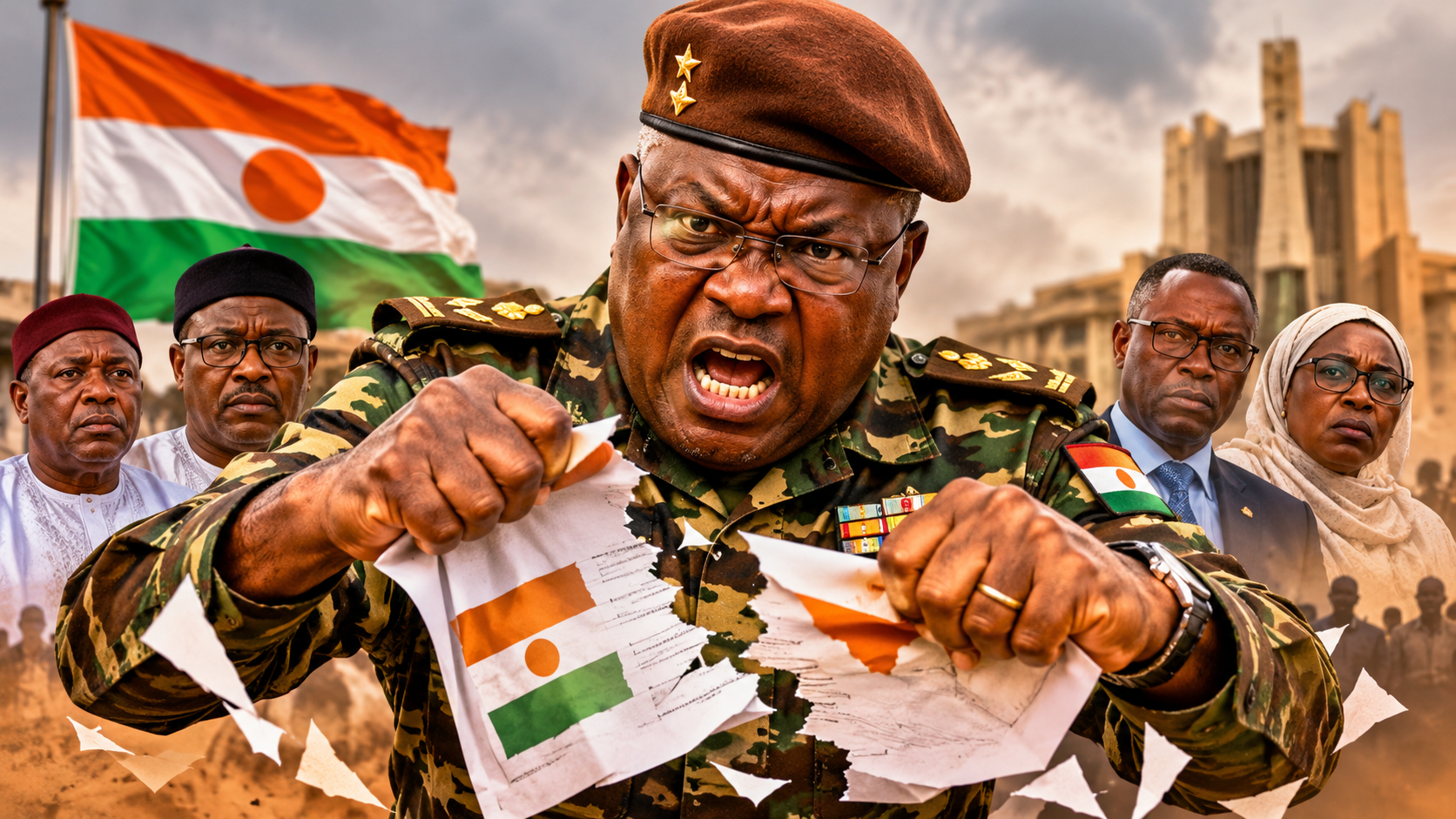
Can national security justify stripping citizenship in Niger?
Since the July 26, 2023 coup d’état, Niger’s military junta under General Abdourahamane Tiani has increasingly used deprivation of nationality as a policy tool. Initially framed as a measure to protect the nation’s core interests, this practice has evolved into a contentious instrument with profound political implications. The latest such decision came on September 17, 2026, when Tiani signed a decree stripping five more individuals including former Prime Minister Ouhoumoudou Mahamadou and several associates of ousted President Mohamed Bazoum of their Nigerien citizenship. This brings the total number of provisional revocations since October 2024 to 25, according to local reports.
At the heart of the controversy lies a critical question: Is the junta using citizenship revocation to uphold national security, or is it weaponizing the law to settle scores with figures from the former regime? The distinction is not merely semantic it challenges the very legitimacy of the state’s actions and the rights of its citizens.
From Security Rhetoric to Political Confrontation
The post-coup relationship between the new military authorities and the remnants of Bazoum’s administration has been defined by deep distrust and escalating confrontation. While the junta has removed former officials from office and pursued legal actions against some, the use of provisional nationality revocation marks a new phase in this power struggle.
The September 2026 decree did not target individuals solely on alleged criminal grounds. It also encompassed prominent political figures who had held significant roles under Bazoum. This pattern especially the inclusion of officials who had already fled the country has fueled perceptions that the revocations are less about justice and more about political subjugation.
The military authorities justify these measures by invoking accusations such as the dissemination of information disrupting public order, collaboration with foreign powers, and threats to state security. While these allegations must be taken seriously, they do not inherently prove guilt. More critically, they do not clarify why nationality removal a severe penalty is applied disproportionately to associates of the former government.
Human Rights Watch has raised concerns about the lack of due process, including limited access to evidence, restricted legal defense, and the potential for arbitrary application. When a state strips citizenship from individuals who once served in government, the line between law enforcement and political purge becomes dangerously blurred.
The Former President’s Shadow Over Today’s Decisions
The revocation of Ouhoumoudou Mahamadou’s nationality has intensified scrutiny. As a key figure in Bazoum’s administration, his inclusion underscores a pattern: many revoked individuals not only held political office but also maintain symbolic ties to the ancien régime. Their removal from Niger’s legal framework appears calculated to weaken the political influence of the former leadership, even from exile.
This raises a fundamental issue: Does citizenship revocation serve a legitimate security function, or is it being used as a tool to silence dissent and marginalize former officials? The absence of individualized justification for each decision only deepens skepticism. Citizens deserve clarity not merely accusations but verifiable facts and transparent legal reasoning.
Moreover, the timing of these revocations coincides with continued tension between the junta and former President Bazoum, who remains at the center of political and legal contention. Each new decree reinforces a narrative of ongoing confrontation, making it increasingly difficult to view the policy as neutral or apolitical.
Exile, Statelessness, and the Cost of Citizenship Loss
For those living abroad, the impact of nationality revocation extends far beyond political marginalization. Citizenship is not just a legal status it is a lifeline to protection, travel documents, and consular support. When the Nigerien passport is revoked, even temporarily, individuals face severe administrative hurdles: expired visas, blocked consular services, and restricted movement.
For former officials in exile, this can amount to a form of indirect punishment. Unable to renew travel papers or return home, they become administratively stranded. The gravest risk, however, is statelessness. If a person holds only the Nigerien nationality, its revocation could leave them with no legal citizenship at all no rights, no protections, no country to call home.
International human rights organizations have warned that provisional revocations, if applied without proper safeguards, may in practice lead to permanent exclusion. A measure intended as temporary can thus produce lifelong consequences, transforming legal sanction into exile in all but name.
Legal Safeguards or Political Tools? The Flaws in the Process
The legal framework underpinning these revocations the 2024 ordinances on threats to national interests relies on broad and vaguely defined charges, including electronic defamation, dissemination of sensitive data, and threats to state security. Yet, accusation is not conviction. Freedom of expression, even when critical of the government, cannot be equated with national security threats without concrete evidence.
In practice, the system offers limited recourse. Accused individuals often lack access to the evidence against them, face restricted legal counsel, and have no clear path to appeal before an independent tribunal. This procedural opacity undermines public trust and suggests that nationality revocation is being used not as a last resort, but as a first response to political opposition.
Without robust judicial oversight, the door remains open for abuses. The junta may claim to protect the nation, but when the law is applied selectively against former officials, the message is clear: dissent comes at the cost of citizenship. That is not justice it is intimidation disguised as security.
A Policy Fueling Division, Not Stability
The cumulative effect of these revocations is not stability, but deepening polarization. Since the coup, relations between the military leadership and the former regime’s supporters have deteriorated into a cycle of accusation and retaliation. Each new revocation is interpreted not as a legal judgment, but as a political blow against the old guard.
Rather than fostering national reconciliation, this approach entrenches divisions. It sends a signal that former officials are permanently excluded from the political process a dangerous precedent in any democracy or emerging system. True security is not built on exclusion; it is built on inclusion, accountability, and respect for fundamental rights.
For Niger to move forward, its authorities must demonstrate that nationality revocation is applied based on proven infractions not political affiliation. The country’s stability depends not on the suppression of former leaders, but on the fair and transparent application of the law to all citizens, regardless of their past or present loyalties.
Conclusion: Security or Score-Settling? The Jury Is Still Out
Niger’s use of provisional nationality revocation has evolved from a security measure into a symbol of political confrontation. While the junta insists it is defending the nation, the pattern of targeting former officials especially those in exile suggests a deeper agenda: the systematic weakening of the opposition through legal exclusion.
The consequences are far-reaching. They affect not only the individuals stripped of their citizenship but the very fabric of the state. When the law becomes an instrument of political purge, the rule of law itself is imperiled.
What remains in question is whether the general’s actions are rooted in genuine security concerns or in a desire to erase the legacy of the Bazoum era. The answer will define not only the future of those targeted, but the democratic credibility of Niger’s institutions.
One thing is certain: national security cannot be invoked to justify the erosion of citizens’ rights. The protection of the nation must never come at the expense of justice for all.
By Yvette Tchuente — Journalist