
RDC : Tshisekedi recule, la C64 maintient la pression
In the Democratic Republic of Congo, President Félix Tshisekedi has referred the referendum law back to Parliament for a second reading. This decision came after the Constitutional Court declared the law compliant with the Constitution, albeit with specific reservations. This development unfolded just as the ultimatum issued by the Article 64 opposition coalition (C64) was set to expire this Saturday.
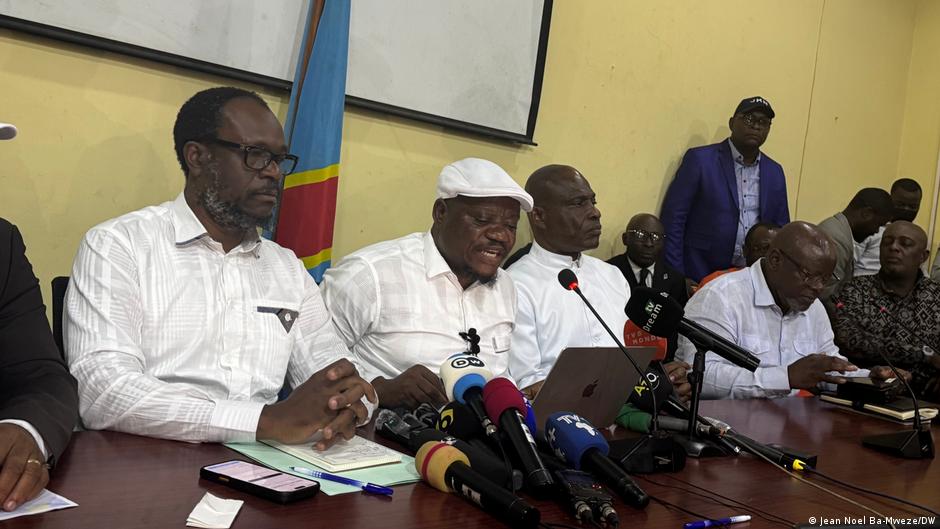
The C64, supported by approximately sixty civil society organizations, had demanded that the president abandon his proposed constitutional reform and, consequently, reject the referendum law by August 15. They also called for the initiation of an inclusive national dialogue. However, with the ultimatum’s deadline rapidly approaching, no date for such a dialogue has yet been announced.
Tshisekedi’s tactical withdrawal in response to pressure
Many had assumed the law governing the organization of the referendum was already in effect, given the constitutional provision (Article 140) for promulgation within fifteen days. Yet, President Félix Tshisekedi opted to return the text to Parliament.
The stated aim is a fresh deliberation incorporating the Constitutional Court’s observations.
Professor Bob Kabamba, a lecturer at the University of Liège in Belgium, views this decision as a strategic retreat by President Tshisekedi. However, he emphasizes that it does not signal a relinquishment of efforts to secure his position beyond 2028, the scheduled end of his second term.
“One must remember the significant pressure originating from both the opposition and regional nations. These pressures, coupled with consultations that took place, compelled Tshisekedi to backtrack, specifically by requesting a second reading of this pivotal law. It’s a concession, but one that won’t deter Tshisekedi from exploring other avenues to navigate past 2028,” he explained.
C64 promises new actions post-August 15
Meanwhile, the Article 64 coalition has welcomed the referendum law’s return to Parliament. Nevertheless, it continues to exert pressure on the Congolese president. With mere hours remaining until the August 15 ultimatum expires, the C64 is contemplating several operations, though their specific nature remains undisclosed.
“By midnight on August 15, we will simply observe that no progress has been made. We will then announce major ‘surgical operations’ to be deployed by our C64 laboratory to bring this regime to reason, a regime that has confiscated our freedom and is on the verge of confiscating our national sovereignty,” declared Franklin Tshiamala, Secretary-General of the Leadership for Governance and Development (LGD), the party of former Prime Minister Augustin Matata Ponyo.
The standoff intensifies
On the government’s side, the referendum process is steadfastly defended as a legitimate political and institutional undertaking. The C64’s ultimatum, conversely, is dismissed as an unwarranted injunction that cannot dictate the Head of State’s agenda.
“Regarding the C64’s ultimatum, you must understand it is their ultimatum. It was perhaps to please their benefactors. But the Republic continues to function normally,” affirmed Adolphe Amisi Makutano, a senior official within the Union for Democracy and Social Progress (UDPS), President Félix Tshisekedi’s party.
The power struggle thus remains unresolved. This Saturday, August 15, could therefore mark the commencement of a fresh political chapter in the Democratic Republic of Congo.