
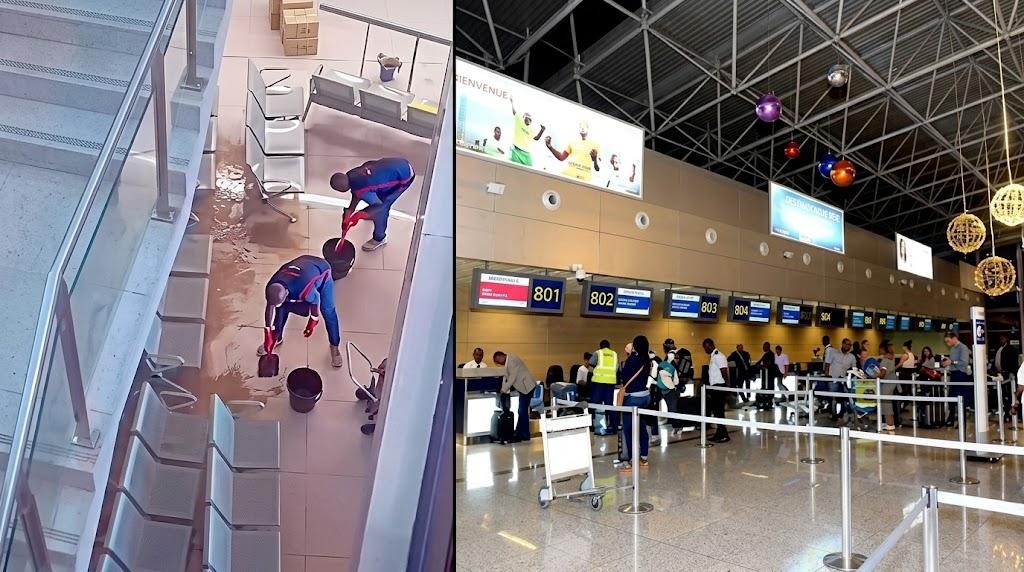
The scene at Lomé’s Gnassingbé Eyadéma International Airport on that fateful afternoon was one no traveler should ever witness. What began as a routine day rapidly descended into chaos when an aged sewage pipe—buried under years of deferred maintenance—ruptured under hydraulic pressure, unleashing a torrent of raw waste across the terminal’s public and operational areas.
The technical breakdown behind the disaster
Engineering reports accessed after the incident point to a systemic failure: the main sewage conduit, a fifty-year-old high-pressure vitrified clay pipe originally installed without corrosion-resistant lining, had been operating at near-capacity levels for over a decade. Internal pressure readings from 2022 maintenance logs show consistent spikes during heavy rainfall, indicating systemic overload.
The final collapse was triggered not by a single flaw, but by compounded neglect. Leaking joints, biofilm buildup, and unaddressed cracks allowed hydrogen sulfide gas to accumulate in the interstitial spaces above the false ceiling. When a pressure valve failed during a routine pump operation, the trapped gas ignited—a rare but documented phenomenon in aging sewer mains—producing a small but violent explosion that fractured the pipe and forced open a 1.2-meter breach.
The human shockwave: trauma in transit
Passengers and staff were not merely inconvenienced; they were assaulted. Security footage recovered from terminal C shows travelers running in disarray as fecal matter rained down from ceiling vents. In one frame, a woman shielding her child is drenched in dark effluent, her hijab discolored and clinging to her skin.
Health clinics at the airport reported dozens of acute exposures: chemical conjunctivitis, skin irritation, and respiratory distress among vulnerable groups. One nursing aide at a nearby clinic described treating a 45-year-old businessman who arrived with third-degree burns on his hands—likely caused by contact with contaminated condensate dripping from overhead fixtures.
From wastewater to web failure: the digital blackout
The sewage surge did not merely soil floors—it short-circuited critical infrastructure. Electrical cabling in the terminal’s basement corridors ran in close proximity to the failed pipe. Salt-rich wastewater seeped into junction boxes, tripping residual current devices and fusing busbars. Within 11 minutes, the airport’s entire IT backbone—baggage handling systems, immigration servers, and flight information displays—went offline.
Air traffic control recordings indicate that during the blackout, radio communication between control towers and incoming flights was lost for 41 minutes. Controllers resorted to manual logbooks to record flight paths, while airlines were forced to divert 42 incoming aircraft to Accra and Cotonou, costing regional carriers an estimated $1.8 million in rerouting fees.
Why warnings were ignored: a culture of cost over safety
Internal audit documents from the airport’s technical directorate reveal a pattern of repeated warnings. Five separate inspection reports dating back 24 months flagged the sewage pipe as “structurally compromised” and recommended immediate replacement. Budget allocations for 2022 and 2023 earmarked $140,000 for emergency repairs, but only 37% was actually disbursed due to reallocation to road infrastructure projects.
When civil engineers speaking on condition of anonymity were contacted, one stated: “This was a maintenance failure, but it was enabled by a procurement culture that prioritizes visible projects over invisible systems. No minister wants a bridge named after them, but everyone wants to cut ribbon on a new highway.”
The cost of shame: reputation and recovery
In the days following the disaster, embassies in Lomé summoned the Togolese Ministry of Transport for urgent consultations. The European Union Delegation lodged a formal complaint under the Cotonou Agreement, citing breach of Article 9 on public health and consumer safety. Tourism boards across West Africa report a 22% decline in European tour bookings destined for Togo, despite official reassurances.
The airport remains closed for deep cleaning and structural reinforcement. Reconstruction of the sewage line and replacement of all high-pressure pipes is expected to take six months at a projected cost of $3.2 million—not including compensation claims from affected passengers, which are already approaching $1.1 million through legal channels.
What travelers should know before flying through Lomé
- Terminal status: Currently closed to all scheduled passenger traffic.
- Compensation policy: Airlines are invoking force majeure; passengers are advised to contact carriers directly for refunds or rebooking.
- Safety standards: The airport is undergoing a full health and safety audit under the supervision of ICAO regional officials.
- Travel advisories: Several consular missions have issued caution notices, recommending travelers avoid layovers exceeding four hours in Lomé.
Lessons from the sewer rupture: accountability in public works
This incident is not isolated. Across West Africa, an estimated 68% of municipal water and wastewater networks built between 1965 and 1995 are classified as “at-risk” due to inadequate maintenance and chlorination bypasses. The Lomé event serves as a stark reminder: aging infrastructure hidden beneath public spaces can collapse without warning—and when they do, the damage is not just material, but moral.
For the Togolese government, the choice is clear. Either invest in long-term resilience against future crises or risk further erosion of public trust at home and abroad.