
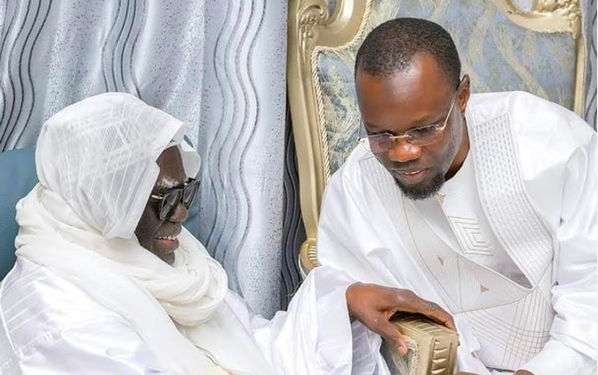
In a Senegal where secularism coexists with deep-rooted Sufi traditions, the interplay between faith and governance has never been more pronounced. Religious fervor often intersects with political strategy, as historical figures from Senegalese Islam are increasingly invoked in sovereignist narratives.
Political figures leverage religious legacy for national identity
From President Bassirou Diomaye Faye to Assembly President Ousmane Sonko, Senegal’s leadership is drawing on the legacies of Sufi guides to craft a vision of nationhood free from foreign interference. This strategic alignment with religious leaders ensures the indispensable support of Sufi brotherhoods, whose influence remains a cornerstone of national cohesion amid recurring political crises.
The recent visits by both leaders to Touba—home to the Mouride Brotherhood’s spiritual leader, Serigne Mountakha Mbacké—underscore this dynamic. Just days before the Grand Magal pilgrimage on July 26, President Faye paid homage to the khalife général, followed shortly after by Sonko. These institutional pilgrimages highlight the unparalleled sway of Sufi guides, described by analysts as “the bedrock of national unity”.
Sovereignist rhetoric rooted in anticolonial Islamic figures
Sonko’s ideological leap is particularly striking. During his visit, he explicitly aligned his policies with those of Cheikh Ahmadou Bamba, founder of the Mouride Brotherhood and a symbol of peaceful resistance against French colonial rule. By drawing parallels between his governance and Bamba’s legacy—renowned for rejecting French funding to preserve the independence of Muslim communities—Sonko framed his political agenda within a broader anticolonial narrative.
This revival of nationalist discourse through religious figures is not coincidental. It reflects a growing intellectual movement that reassesses the anticolonial contributions of Senegalese Islamic leaders. Cheikh Gueye, a Mouride scholar, notes, “There’s a rising tendency to reinterpret major figures of Senegalese Islam through an anticolonial and political lens.”
Beyond Bamba, other historical figures like El Hadj Oumar Tall of the Tidjaniya Brotherhood and Thierno Souleymane Baal—who established a theocratic state in the 18th century—are being championed by sovereignist movements such as Frapp. These figures are celebrated as “sources of political inspiration, without deifying them.”
Navigating historical complexities and contemporary aspirations
Yet this unifying narrative faces its share of historical complexities. Some of these revered anticolonial leaders later facilitated the recruitment of Senegalese tirailleurs for the French army, a duality that modern youth—more critical and independent-minded—are increasingly willing to acknowledge.
Mamadou Fall, editor of the forthcoming General History of Senegal, advocates for integrating these religious figures into school curricula while addressing their ambiguities. He reminds us that while some are celebrated as anticolonial heroes, others are perceived in certain regions as “conquerors who arrived with swords in hand.”
As Senegal grapples with its past and present, the fusion of religion and politics continues to shape the nation’s trajectory, blending tradition with a renewed quest for sovereignty.