
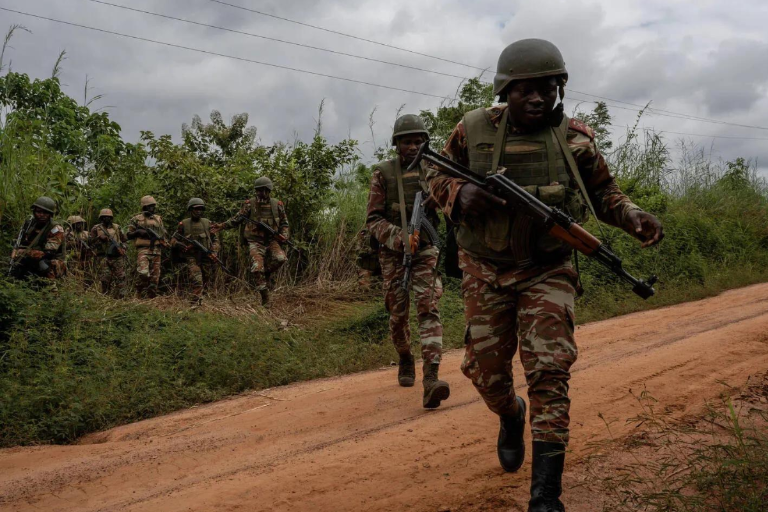
As terror threats escalate in northern Benin, Berlin is redefining its role in West Africa’s security landscape. The question now is whether this deepening partnership with Cotonou can provide the stability the region desperately needs.
The military cooperation between Germany and Benin is entering a critical phase. What began as equipment deliveries and training programs has evolved into a strategic partnership that could reshape security dynamics in the Gulf of Guinea. With northern Benin facing escalating terror threats, Berlin’s growing involvement raises a pivotal question: can this alliance serve as the cornerstone of regional stability?
Equipment transfers: the visible foundation of cooperation
Germany’s support is becoming increasingly tangible. Recent military deliveries to Benin’s armed forces include protective gear and advanced security equipment. In 2026 alone, 550 helmets and 1,266 portable breathing devices were supplied, following an earlier shipment worth three million euros featuring night vision and individual protection gear.
Yet these contributions represent only the first layer of a much broader strategy. Germany is expanding its engagement beyond hardware. A September 2026 proposal presented to Deputy Defense Minister Gildas Agonkan outlined plans to support Benin’s military engineering corps with specialized training and logistical equipment. This shift signals Berlin’s intention to build long-term operational capabilities rather than merely supplying tools.
A strategic shift in military exchanges
The most significant development came from Germany’s ambassador to Benin, Stefan Buchwald, who announced plans for high-level joint staff meetings and negotiations toward a new bilateral defense agreement in late 2026. While specific terms remain undisclosed, this initiative marks a clear evolution from technical cooperation to strategic alignment.
The historical depth of this relationship should not be overlooked. Over the past four decades, more than 350 Beninese soldiers have received training in Germany, establishing a foundation for deeper collaboration. The upcoming bilateral accord could formalize this growing partnership, setting the stage for more ambitious security initiatives.
Expert deployment: a new chapter in defense cooperation
Berlin is also considering sending six to eight military experts to Benin by the end of 2027. This would represent a significant expansion of Germany’s role in the country, focusing on advisory support rather than combat deployment. While the exact scope of their mission remains undefined, this move underscores Germany’s commitment to strengthening Benin’s defense infrastructure through knowledge transfer and technical assistance.
The focus remains on enhancing Benin’s military capabilities, particularly in intelligence, surveillance, and operational mobility—critical needs as terror threats spill over from northern Sahel nations.
Regional instability drives the partnership
The urgency of this collaboration stems from growing instability in Benin’s northern regions, particularly Atacora and Alibori. Bordering Burkina Faso and Niger, these areas have become hotspots for armed terrorist incursions. For Berlin, this presents both a challenge and an opportunity to counter the spread of Sahelian instability into coastal West Africa.
Germany’s strategy aligns with broader European objectives. The European Union has already committed 35 million euros in security assistance to Benin through its Peace Facility, with additional support channeled through the European Security and Defense Initiative for the Gulf of Guinea. Berlin’s bilateral efforts appear designed to complement these EU-wide initiatives, creating a more cohesive security framework.
A partnership with regional implications
For Benin, this diversification of military partnerships provides critical advantages. It expands access to training, equipment, and strategic expertise while reinforcing international cooperation. For Germany, Benin serves as a key partner in a region where Gulf of Guinea stability is increasingly linked to Sahel security dynamics.
The success of this evolving alliance will hinge on two key factors: the content of the upcoming bilateral agreement and the practical implementation of expert deployment. Both sides face high stakes. Benin must translate diplomatic progress into sustainable operational capacity, while Germany seeks to solidify its influence in a rapidly shifting geopolitical environment.
The next phase of this partnership will reveal whether this growing alliance can deliver the security dividends that both nations seek—or whether it will remain a work in progress amid regional turbulence.