
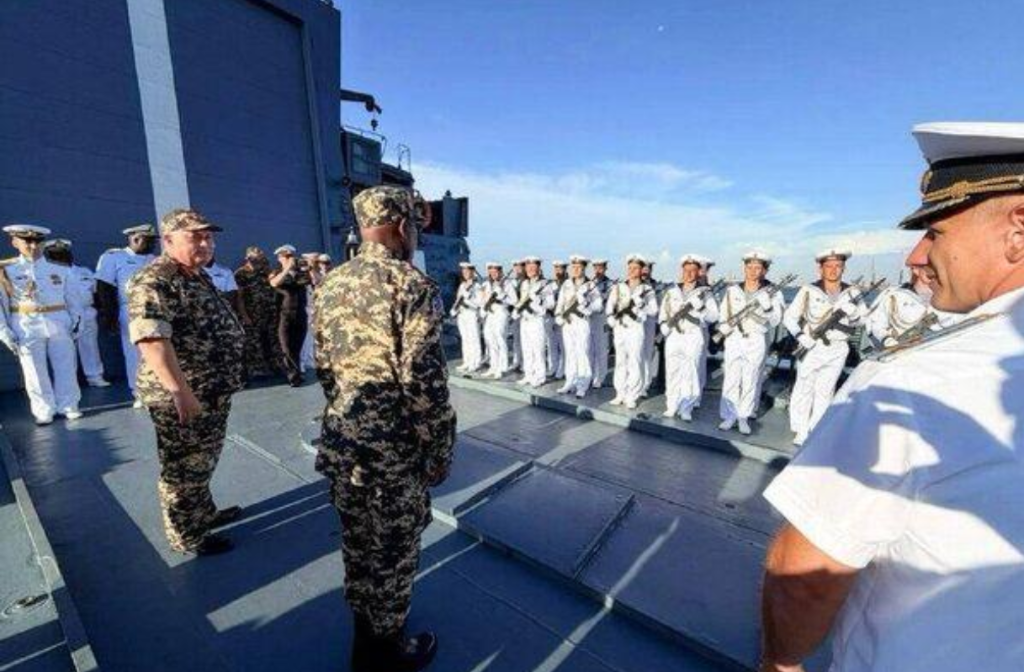
When the Russian navy’s training vessel Perekop docked at Walvis Bay on October 20, 2026, the official narrative framed the visit as routine maritime training. Yet, beneath the surface of this port call lies a deeper geopolitical question: is this a temporary educational stop—or the first move in a broader Russian naval strategy for Africa?
The Perekop, a Baltic Fleet training ship en route from Eurasian waters to African shores, had sailed over 1,800 nautical miles to reach Namibia’s Atlantic coastline. While Moscow portrays the mission as purely instructional, the timing and location of the stop raise strategic implications that extend far beyond classroom exercises.
Beyond the training narrative: what does Russia really gain?
Russian officials emphasize the ship’s role in training future naval officers, with cadets practicing navigation, route planning, and long-distance seamanship. And indeed, the Perekop is designed for exactly that purpose.
But naval training missions also serve a dual purpose: they function as diplomatic tools. Port visits allow navies to build relationships, exchange knowledge, and demonstrate presence—especially in regions where influence is contested. The Perekop’s arrival wasn’t just an operational move; it was accompanied by meetings between Russian naval officers, Namibian defense officials, and embassy representatives. These interactions, while publicly documented, remain within the bounds of official cooperation—not covert agreements.
Still, the question persists: is this a normal training exercise, or a strategic positioning step?
Why Walvis Bay matters in Russia’s African playbook
Walvis Bay isn’t just another African port. Located on the South Atlantic coast, it sits at the crossroads of key shipping lanes connecting southern Africa to global trade routes. Its deep-water harbor offers logistical advantages—refueling, repairs, and support for vessels on long deployments. For a Russian navy seeking to extend its operational reach without fixed bases, this kind of access is invaluable.
According to strategic analyses from defense research groups, naval stopovers and port access agreements are vital tools for maintaining maritime presence when permanent bases are scarce. But there’s a difference between a one-time port call and a sustained presence. So far, the Perekop’s visit suggests opportunity, not commitment. No permanent facilities have been announced. No formal military cooperation accords have been disclosed. The visit remains a single data point in a broader pattern of Russian naval activity across the continent.
The quiet power of naval diplomacy in Namibia
Russia has spent years strengthening defense ties with African nations through training programs, arms sales, and military cooperation. This isn’t just about operational capability—it’s about influence. Each port call, each meeting between officers, each exchange of expertise reinforces Russia’s presence in a region where Western powers have traditionally held sway.
For Namibia, the visit presents both opportunity and risk. The country may be positioning itself to diversify its partnerships, balancing relations with Western allies and emerging global actors like Russia. But so far, there’s no evidence that Walvis Bay is being positioned as a Russian stronghold—or that Namibia is distancing itself from traditional allies.
The real value of the Perekop’s stop may lie in the intangible benefits: reinforced military-to-military ties, increased familiarity between navies, and the potential for future joint exercises or training programs. These moves are subtle, but they build long-term influence.
Is this a challenge to Western interests in southern Africa?
In an era of heightened global tensions, naval movements often carry symbolic weight. When Russian ships appear in regions traditionally dominated by Western navies, the message is clear: Moscow still has partners, still has reach, and still matters on the global stage.Yet it would be premature to interpret the Perekop’s visit as a direct challenge to the United States, the United Kingdom, or France. No public evidence suggests this port call was designed as a provocation. Instead, it reflects a calculated effort to maintain visibility and engagement in a region where Russia seeks to expand its strategic footprint.
Analysts note that Russian naval activity in Africa serves both practical and political goals: practical in maintaining operational capabilities, political in asserting influence beyond traditional spheres.
What comes next? Watching the follow-through
Will this be a one-off visit, or the start of a pattern? The real test lies not in the ship’s departure, but in what follows:
- Frequency: Will Russian naval vessels return to Walvis Bay on a regular basis?
- Agreements: Are formal understandings being negotiated—on port access, logistical support, or joint operations?
- Presence: Will we see combat ships or support vessels making sustained stops—not just training ships?
Until such indicators appear, the Perekop’s visit remains a diplomatic gesture—one with potential for future expansion, but not yet proof of a strategic pivot. The Namibian government has not signaled any shift in policy, and no new military cooperation has been confirmed.
In the end, Walvis Bay’s role in Russia’s African ambitions will depend not on this single stop, but on the cumulative impact of such visits over time. For now, the question remains open: is this a training mission with diplomatic ripple effects—or the early stage of a deeper naval presence?