
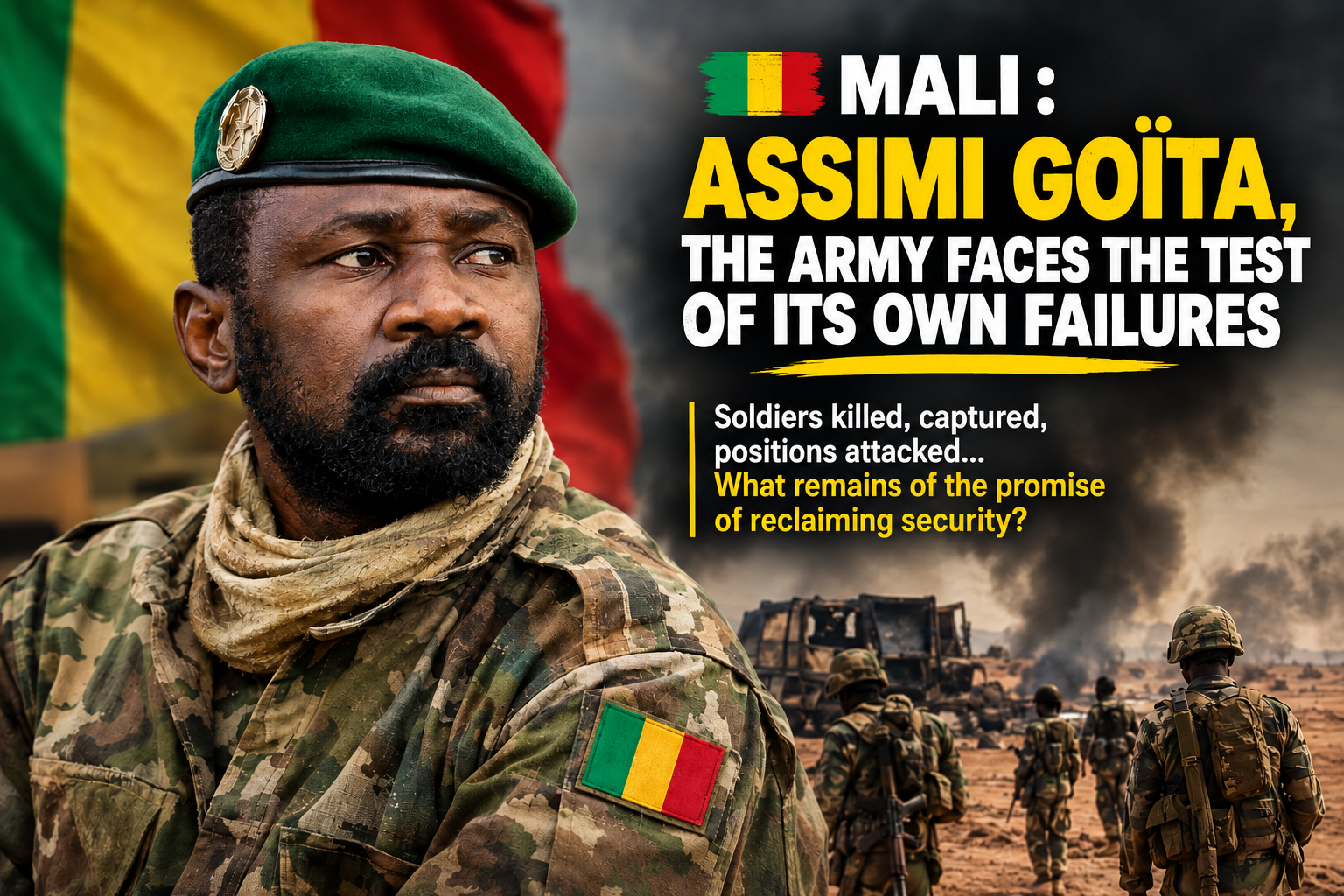
From battlefield setbacks to strategic reckoning in Mali
Bamako’s bold rhetoric of military resurgence now collides with a stark reality: Mali’s armed forces continue to suffer devastating reverses against jihadist forces. As losses mount whether in personnel, territory, or credibility the fundamental question facing Assimi Goïta’s government is no longer one of morale alone, but of strategy and leadership.
Critical failures that redefine Mali’s security landscape
The September 2026 assault on Dioura military camp marked a turning point not only in scale but in symbolism. Claimed by the Jama’at Nusrat ul-Islam wal-Muslimin (JNIM), the attack resulted in at least 100 Malian soldiers and five Russian members of Africa Corps killed, with dozens more captured and substantial military equipment lost. While casualty figures remain contested, the operational consequences are undeniable: the loss of a major garrison, the abandonment of heavy weaponry, and the erosion of troop morale.
Convoys under fire: the vulnerability of Mali’s military mobility
Just two months prior, in July 2026, a Malian military convoy in the northern region of Tabrichat fell victim to a devastating ambush along the Anéfis-Bourem axis. Rebel sources reported over 50 fighters killed, while multiple soldiers were taken captive. Official accounts acknowledged the attack but claimed airstrikes allowed the convoy to escape. However, subsequent investigations revealed a darker outcome: video evidence analyzed by human rights monitors confirmed the execution of at least 19 captured soldiers acts that may constitute war crimes under international law.
The human cost behind the headlines
These incidents are not isolated failures of individual units. They represent systemic vulnerabilities in reconnaissance, logistics, and command structure a disconnect between political ambition and battlefield reality. When soldiers are encircled, abandoned, or executed, responsibility extends beyond the frontline to the halls of power in Bamako.
A coordinated blitz targeting Mali’s heartland
April 2026 brought the threat to an unprecedented level. Coordinated assaults by JNIM and the Front de Libération de l’Azawad (FLA) struck key military zones: Kati, Bamako, Gao, Mopti, and Sévaré. The attack in Kati a garrison city just kilometers from the capital resulted in the death of Defense Minister Sadio Camara, a figure central to the junta’s security doctrine. The infiltration of such a fortified zone exposed critical flaws in intelligence and perimeter defense, casting doubt on the state’s ability to protect even its most sensitive installations.
Alliances and adversaries: has Mali traded one threat for another?
Since seizing power in 2020 and 2021, the Goïta administration has framed its military sovereignty around a strategic pivot toward non-Western partners, particularly Russia, with the deployment of Africa Corps advisors. Yet the escalation of jihadist violence in 2026 reaching historic highs across the Sahel raises urgent questions: Has this realignment altered the strategic calculus of Mali’s enemies? Or has it merely reshaped the battlefield without addressing core vulnerabilities in doctrine and preparedness?
The rise of JNIM and FLA suggests that territorial control, not ideological loyalty, defines the conflict today. Their ability to penetrate deep into Mali’s security apparatus targeting camps, convoys, and even ministerial residences indicates a high level of tactical adaptability and operational intelligence.
Beyond slogans: what it means to protect a nation’s soldiers
An army’s strength is measured not only by its firepower or the boldness of its statements, but by its capacity to safeguard personnel, secure supply lines, evacuate the wounded, and prevent the capture and execution of its troops. At Dioura and Tabrichat, the evidence points to a military struggling on all fronts: intelligence failures, delayed reinforcements, and inadequate protection of high-value installations.
The soldier on the ground is not the architect of national strategy yet it is the soldier who pays the price in blood and captivity. When reverses accumulate, the inquiry must shift from how many men were lost to why the losses continue despite new alliances and promises of resurgence.
Accountability in times of crisis
The current trajectory raises a sobering proposition: Can Mali’s military strategy endure without fundamental accountability at the highest level? The death of a defense minister in his own garrison is not merely a tactical failure it is a strategic indictment. It signals that the protection of Mali’s sovereignty begins not with weapons or rhetoric, but with competent command, accurate intelligence, and a leadership willing to confront the consequences of its choices.
As jihadist groups tighten their grip and operational failures mount, the moment for reckoning has arrived. The question is no longer whether Mali faces a turning point but whether its leadership is prepared to act.
By Yvette Tchuente — State political analyst