
Northern Mali plunged into chaos after devastating attack on military convoy
A brutal ambush on a Malian army and Russian-affiliated Africa Corps convoy near Tabrichat on July 18 has left the country reeling. With over 50 soldiers killed and dozens more captured, this attack stands as one of the deadliest in the region over the past fifteen years. The incident has exposed critical tactical flaws, raised serious concerns about prisoner treatment, and ignited public outrage over the conduct of foreign allies.
The ambush: a well-planned military trap
After weeks of intense fighting to maintain control over the strategic Anéfis camp, Malian forces and their Russian partners began a repositioning maneuver on July 18. A large convoy, consisting of armored vehicles and troop transports, departed Anéfis with Gao as its destination—the largest city in northern Mali.
The convoy was divided into two distinct sections: Russian mercenaries from the Africa Corps led the way, while Malian troops formed the rear. The ambush unfolded near Tabrichat, a small settlement north of Tarkint and close to the critical crossroads linking Gao, Bourem, and Kidal. Exploiting the convoy’s extended formation and rugged terrain, fighters from the Jamaat Nusrat al-Islam wal Muslimeen (JNIM) and the Cadre stratégique pour la défense du peuple de l’Azawad (FLA) launched a devastating coordinated assault.
The attack targeted almost exclusively the rear section of the convoy, leaving Malian troops isolated under relentless fire.
A grim toll: soldiers killed and prisoners executed
The clash left a trail of devastation. Initial reports indicate at least 50 Malian soldiers were killed, with another thirty unaccounted for or taken captive—one of the heaviest losses suffered by the Malian army in over a decade.
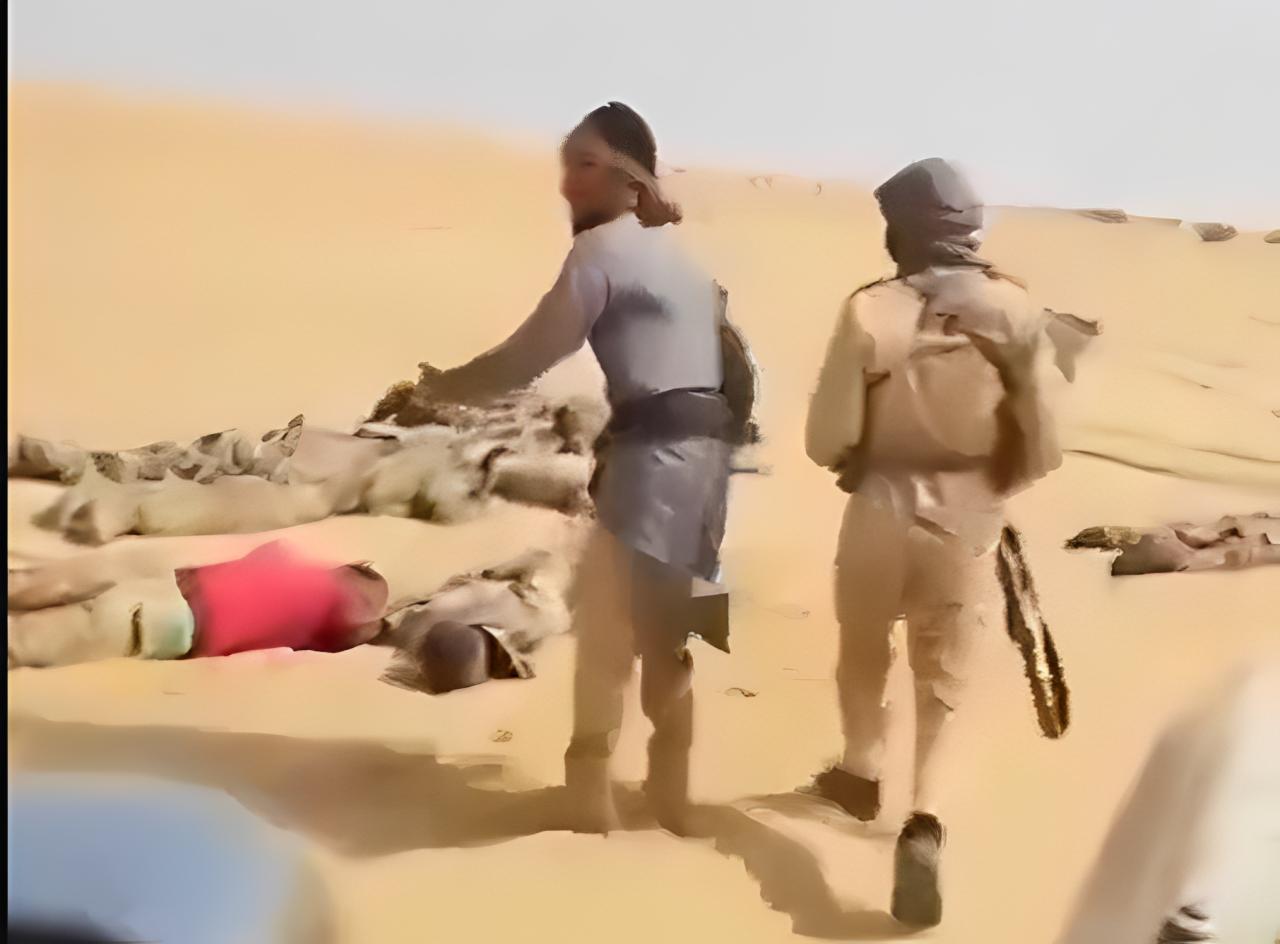
The situation worsened when captured soldiers were executed at close range. Despite being disarmed, ten Malian prisoners were killed in clear violation of international humanitarian law. The circulation of graphic images and videos documenting these atrocities has sparked widespread outrage across Mali.
What made the situation even more disturbing was the initial sharing of some of these videos through channels linked to the Africa Corps, deepening public skepticism about the role and accountability of foreign forces in the conflict.
New leadership on the battlefield: the rise of Hamza Ag Gali
Examination of footage and images from the ambush reveals a significant development: the presence of Hamza Ag Gali, son of Iyad Ag Gali, the longstanding leader of JNIM and founder of Ansar Dine. His involvement signals direct high-level insurgent command in the operation’s planning.
This appearance underscores a generational shift within the jihadist command and highlights the operational reality of the JNIM-FLA coalition. By combining their tactical capabilities along the Anéfis-Gao axis, these groups have demonstrated renewed mobility, intelligence gathering, and firepower—capabilities many believed had been weakened by recent security reorganizations.
Controversy surrounds Africa Corps’ retreat
The conduct of the Russian contingent has become a major point of contention. Despite leading the convoy, the Africa Corps suffered no casualties during the initial assault. Yet, as the Malian troops came under heavy fire just kilometers behind them, the Russian forces continued their advance toward Gao without turning back to assist their allies.
This decision has raised serious questions:
- Lack of coordination: How could two components of the same convoy operate with such minimal mutual support?
- Failure to act: Was this a deliberate choice to preserve forces, or an operational inability to respond under ambush conditions?
The absence of critical support for Malian troops in distress has cast doubt on the real effectiveness of mercenary assistance in northern Mali.
Public anger grows over security failures
From the streets of Bamako to the major towns of the North, public reaction has been swift and intense. While the nation mourns its fallen soldiers, frustration is mounting over the behavior of foreign partners. Calls are growing louder for official explanations from military and government leaders regarding the convoy’s security and the actions of the Africa Corps.
This tragedy has exposed the vulnerabilities of key communication routes in northern Mali and raised urgent questions about the sustainability of the current security strategy. With the JNIM-FLA coalition showing renewed resilience and aggression, the Tabrichat ambush may force authorities to fundamentally rethink coordination with their battlefield allies.