
How a dusty road in central Mali shattered Bamako’s security illusion
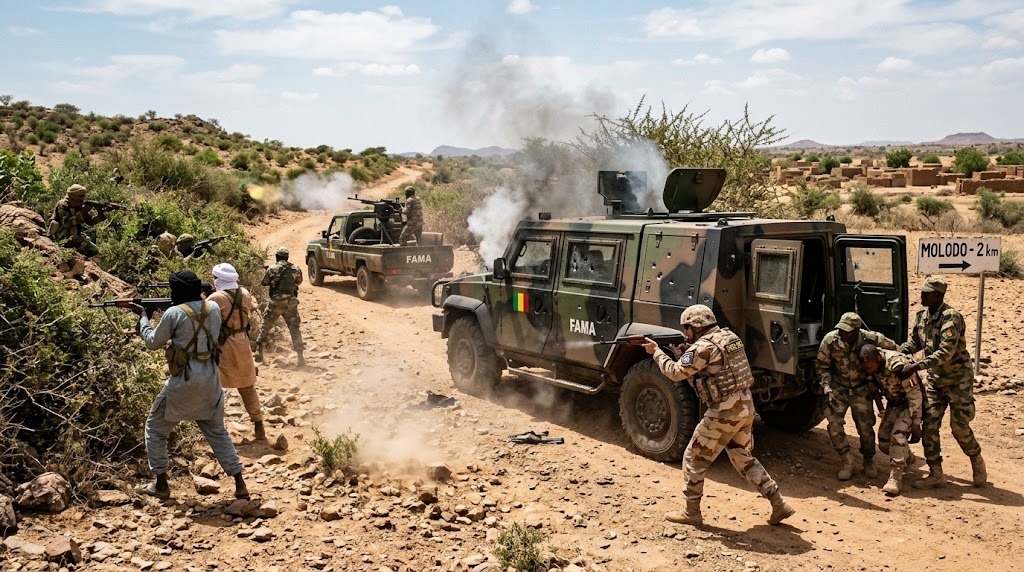
The morning of September 20, 2026, began like any other along the unpaved roads between Diabali and Niono. Yet for Mali’s military junta, this would become the day their carefully constructed security narrative collapsed in spectacular fashion. In the village of Molodo, located in the Ségou region—a zone supposedly under firm government control—a joint patrol of Malian soldiers and Russian paramilitaries from Africa Corps was ambushed by fighters from the Group for Supporters of Islam and Muslims (JNIM, Al-Qaeda’s Sahel affiliate).
The outcome was revealing: after just minutes of gunfire, the Russian recruits reverted to form, fleeing hastily and abandoning three armored vehicles on the roadside. These abandoned trucks bore the unmistakable insignia of Africa Corps—the stylized triangle that now marks Moscow’s direct military intervention in Africa, a rebranded successor to the infamous Wagner Group. The vehicles were left exposed, captured on camera by the attackers, and became an instant symbol of military failure.
From strategic partnership to strategic catastrophe
The Molodo ambush wasn’t merely another tactical setback in an unwinnable war—it marked the definitive collapse of a political gamble that has reshaped Mali’s trajectory. Since forcibly removing French troops, dismantling the UN’s MINUSMA mission, and scrapping peace agreements, the junta led by Colonel Assimi Goïta has staked its legitimacy on a single promise: regaining national sovereignty through partnership with Moscow. The message was clear—only Russia could secure Mali when Western allies refused to act.
Four years after the first Russian ‘instructors’ arrived on Malian soil, the results speak for themselves. Far from crushing jihadist threats, the presence of Africa Corps has rapidly expanded insurgent recruitment. The once-limited insecurity in northern regions has now engulfed central Mali, with economic blockades and roadside bombings tightening their grip around the capital.
The myth of invincible overlords
Molodo exposed something more fundamental: the Africa Corps fighters are neither invincible nor committed to Mali’s defense. Paid by a cash-strapped Malian state that has mortgaged critical mineral resources to Kremlin-linked companies, these mercenaries operate less like a liberation force and more like elite bodyguards for the regime. Their battlefield performance—marked by indiscriminate brutality in joint operations with Malian troops—has severed the army’s connection to rural communities, turning villages into recruitment grounds for extremists.
For Malians who once endured a decade of instability, the junta’s gamble has proven catastrophically expensive. The economic strain continues to deepen as public funds flow toward foreign military contractors, while civilian suffering mounts under the weight of collapsing infrastructure and relentless insecurity.
Bamako’s bunkered regime and the cost of silence
The junta’s response to this deteriorating reality reveals its true priorities. Rather than addressing the military failure at Molodo, the regime has doubled down on repression. Critical voices in civil society are systematically silenced. Independent media outlets face censorship or outright shutdown. Dissent against the Russian alliance is labeled treason, while the junta clings to power behind closed doors in Bamako, detached from the suffering it claims to protect.
But repression cannot obscure the evidence piling up across Mali. The abandoned Africa Corps vehicles—now circulating on social media—speak volumes. They tell a story that more Malians are whispering in private: the junta’s quest for ‘sovereignty’ has traded one flawed dependency for a dangerous one. Instead of breaking free from external control, Bamako has surrendered its security to a mercenary force incapable of securing the peace.
An irreversible descent into chaos?
The Molodo ambush wasn’t just a tactical defeat—it was a turning point. With no national reconciliation strategy, no credible political plan, and foreign forces that retreat at the first sign of danger, Mali’s state institutions continue to crumble. Rural communities find themselves abandoned, caught between extremist groups and war profiteers. Meanwhile, the junta persists in its ideological and military misadventure, accelerating the country’s tragic unraveling.
For a nation already weary from over a decade of conflict, the images from Molodo serve as a brutal reminder: some bargains come with a price too steep to pay.