
An unprecedented challenge to the established order
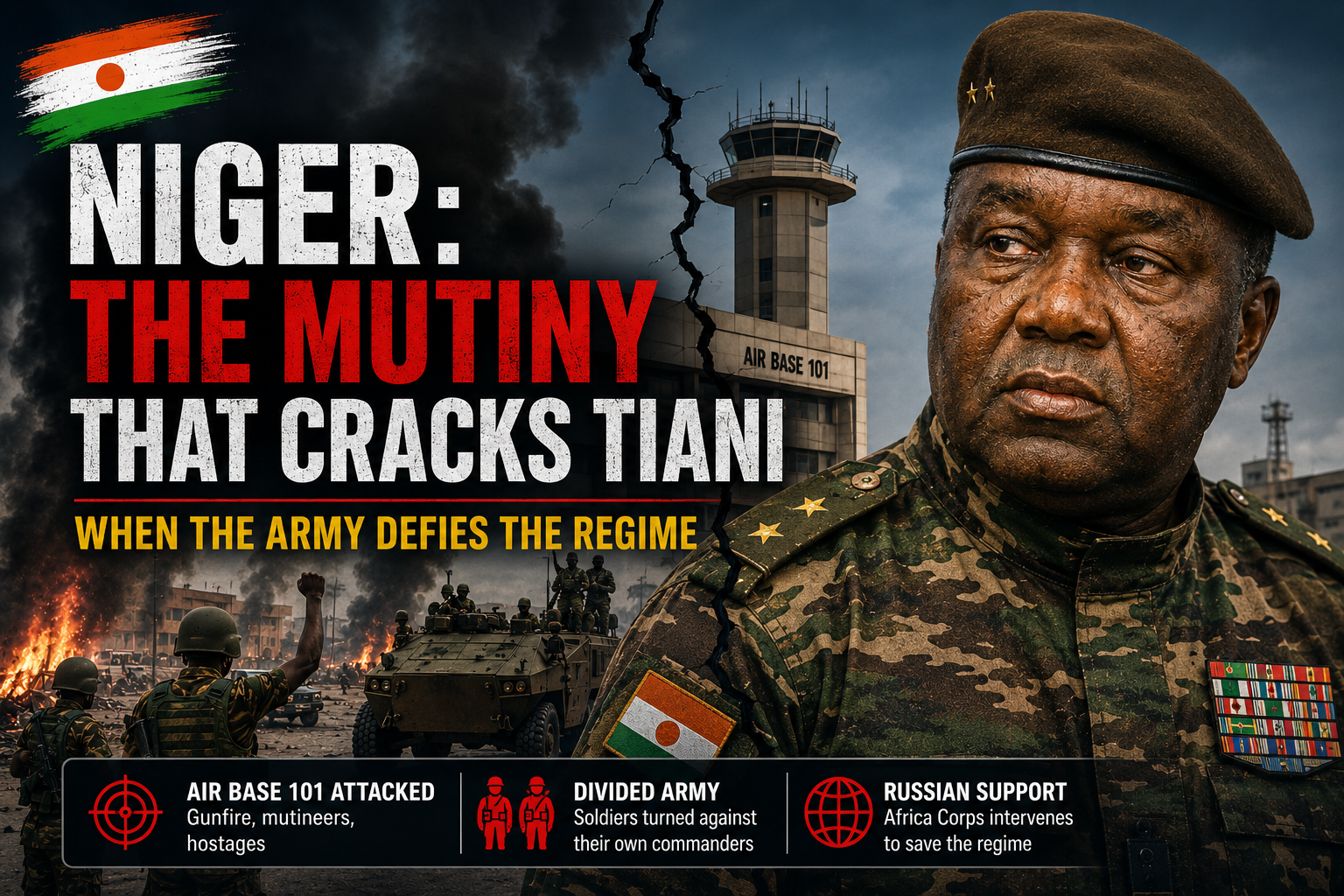
The events of August 29, 2026, in Niamey represent a critical inflection point in Niger’s recent political trajectory. Far from being a mere display of discontent among junior officers, the coordinated assault on Air Base 101 and multiple high-value installations in the capital signals a profound institutional fracture. Official statements acknowledging the detention of fellow soldiers by mutineers, followed by armed clashes near presidential and airport facilities, underscore the gravity of this development.
Institutional fissures revealed
The mutiny transcends ideological posturing. When Nigerien armed forces personnel target strategic assets within their own capital and engage in direct confrontation with loyalist troops, the crisis shifts from political to structural. The cohesion of the national military apparatus is now under scrutiny a force theoretically designed to withstand external pressures is now straining under internal pressures.
Reports indicate that mutineers originated from multiple regions, including Ouallam, Téra, and Dosso, suggesting a coordinated network rather than isolated dissent. This distribution of actors across operational theaters highlights the depth of dissatisfaction within the ranks.
A paradox of claimed sovereignty
Since assuming power in July 2023, the Tiani administration has positioned itself as the guarantor of national sovereignty, particularly in matters of security and defense restructuring. Yet, the mutiny exposes a glaring contradiction: a regime that professes to have consolidated control over the state apparatus now faces armed rebellion from within that same apparatus.
The temporary seizure of Air Base 101 a cornerstone of Nigerien defense demonstrates that the chain of command, despite claims of revitalization, remains vulnerable to internal rupture. The subsequent recapture of the base, reportedly with support from external forces, introduces further complications to the regime’s narrative of restored self-sufficiency.
The symbolic weight of foreign involvement
The role of external military actors in resolving the crisis introduces a complex layer to the conflict. While their intervention restored control over critical infrastructure, it simultaneously underscores the limitations of Niger’s own security capabilities. The reliance on allied forces to secure sovereign territory clashes with the regime’s foundational claim of regained autonomy.
For elements within the national military, this dependence may exacerbate existing grievances. The perception that foreign troops now share responsibility for safeguarding strategic sites could erode morale and fuel further dissent, particularly among those who view such partnerships as compromising national dignity.
A victory that does not resolve the crisis
The military recapture of Air Base 101 and the neutralization of mutineers constitute a tactical success for the regime. However, the underlying causes of the uprising remain unaddressed. The fundamental question persists: why did soldiers sworn to defend the nation turn against their own command structure?
Repression alone cannot restore cohesion within an institution now fractured by mistrust. The challenge ahead for the Tiani administration is not merely to suppress dissent but to rebuild confidence among the ranks an endeavor that demands more than military force.
Security promises under scrutiny
The mutiny occurs against a backdrop of persistent jihadist threats, which the regime had pledged to eradicate. Recent attacks on military and airport facilities in 2026 reveal a disturbing pattern: despite restructuring efforts, the security landscape remains perilous. Now, the regime must contend with dual pressures external insurgencies and internal military discontent.
The juxtaposition of these challenges exposes a critical vulnerability. A government that once positioned itself as the unifying force against both political decay and foreign interference now faces fissures within the very institution tasked with ensuring its survival.
The erosion of perceived unity
Historically, the military leadership presented itself as a monolithic bloc, unified against the failures of the previous civilian order and the encroachment of external powers. The August 29 mutiny shatters this illusion. The contestation is no longer confined to the political opposition; it has emerged from within the ranks of the institution sworn to uphold stability.
For General Tiani, this is an existential challenge. A regime may withstand external opposition or international censure, but when its own military turns against it, the foundations of power become precarious. The mutiny did not topple the administration, but it exposed a fissure that could widen if unaddressed.
A warning rather than a concluded chapter
While loyalist forces have reasserted control over Niamey’s strategic sites, the episode serves as a stark reminder of the regime’s vulnerabilities. This was not a routine disciplinary matter but the most serious military challenge to the Tiani administration since the 2023 coup.
The mutiny failed to achieve its immediate objectives, yet it succeeded in revealing a critical weakness: beneath the regime’s carefully constructed image of invulnerability, fractures now run through the very institution meant to sustain it. The question now is whether Tiani can address these fractures before they undermine his authority entirely.