
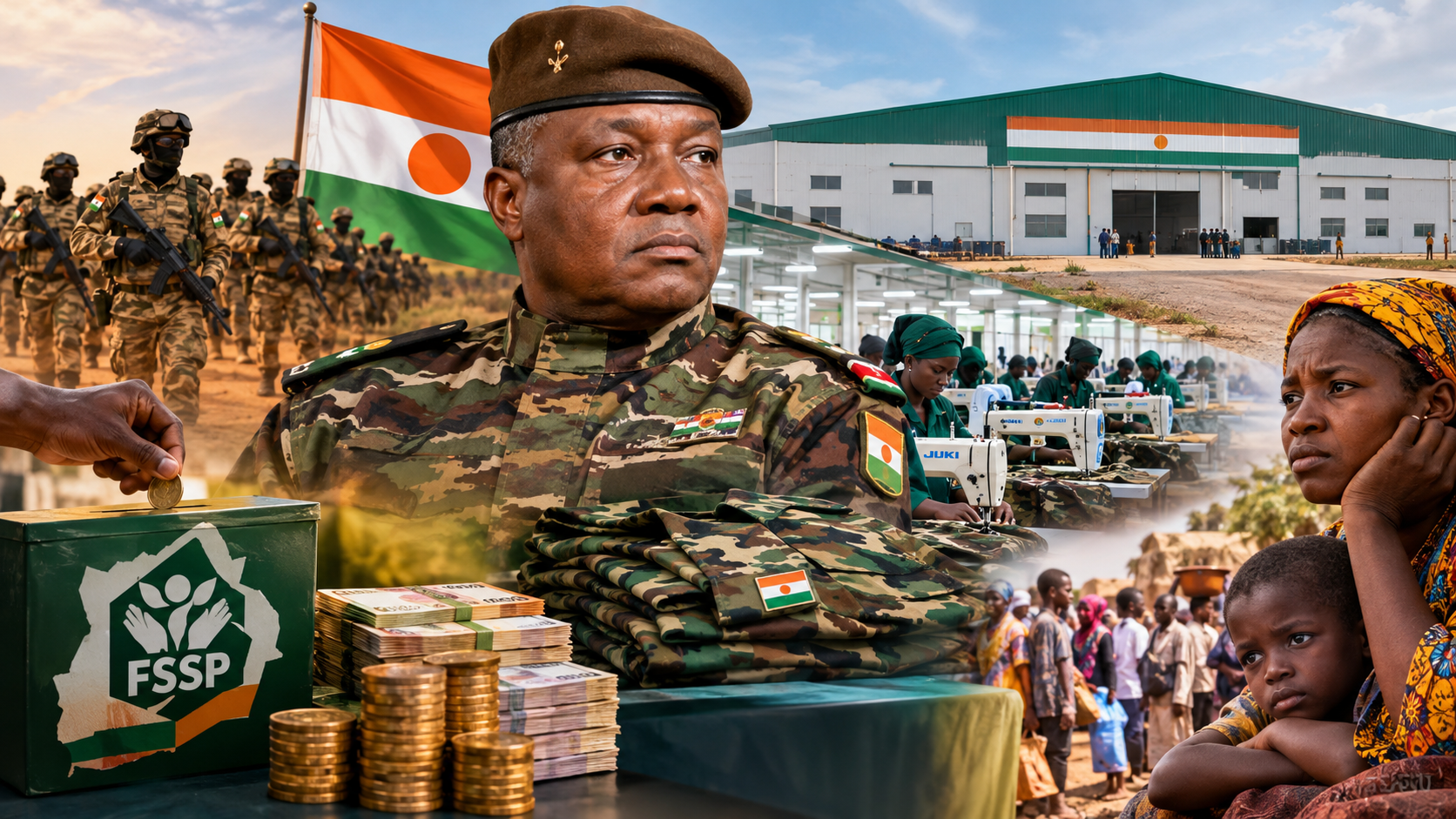
The inauguration ceremony of a military uniform production facility in Niger, boasting a capacity of 1,000 outfits per day and funded entirely by the Patriotic Solidarity Fund (FSSP), has reignited debates over the country’s pressing priorities. With persistent security threats and widespread socio-economic hardships affecting the population, a critical question emerges: does this new infrastructure genuinely address the nation’s most urgent needs?
Military self-sufficiency vs. citizen priorities
Local production of military apparel is framed as a strategic move to reduce import dependence and streamline troop supply. Yet, fundamental questions persist: What are the project’s defined objectives, total cost, and expected concrete outcomes? In a country grappling with multiple security and economic challenges, citizens rightfully demand clarity on how this initiative will tangibly benefit their daily lives.
While self-reliance in military production presents potential advantages, its practical impact remains uncertain. The production of 365,000 uniforms annually assuming full operational capacity raises further inquiries: What specific needs does this vast output address? How many uniforms do Niger’s armed forces currently require? Where will these supplies be deployed, and under what distribution framework?
Security implications: beyond uniforms
Uniforms are integral to military operations, yet they represent only one component in the broader fight against armed groups. Security outcomes depend on multifaceted factors including operational capacity, intelligence, logistics, training, and community protection capabilities. The authorities must demonstrate not only the necessity of this facility but also its contribution to tangible improvements in security across affected regions.
Public funds under scrutiny: transparency and accountability
The project’s funding through the FSSP, a solidarity fund financed by public contributions, introduces another layer of scrutiny. With households facing food insecurity, economic strain, and the daily realities of violence, citizens deserve a transparent breakdown of how these resources are allocated across national priorities.
This is not a rejection of military needs or industrial initiatives in principle. Rather, it underscores the necessity for authorities to justify expenditures with measurable outcomes. Key inquiries include: What is the project’s total cost? How many jobs will it generate? What revenues will it produce, and by when? Without concrete answers, skepticism regarding the project’s value will persist.
The Sahel industrial push: alignment or duplication?
The military uniform plant reflects a broader trend among Sahel Alliance member states Niger, Mali, and Burkina Faso aiming to bolster local production and reduce external dependence. While this ambition is understandable, doubts remain about its strategic coherence. Are these projects rooted in each nation’s assessed needs, or do they risk replicating initiatives without sufficient public assessment of their viability?
True industrialization transcends the launch of facilities or declared production capacities. It hinges on sustainable job creation, cost efficiency, raw material availability, market demand, and tangible socio-economic benefits. Without verifiable data on these dimensions, premature declarations of success are unwarranted. Authorities must outline long-term operational, maintenance, and financing strategies to prevent this project from becoming an unsustainable fiscal burden.
Production capacity: volume vs. necessity
The plant’s theoretical annual output of 365,000 uniforms is mathematically derived from a daily production of 1,000 units. However, theoretical capacity does not guarantee realized output. Actual production will depend on operational efficiency, order volume, supply chains, and resource allocation. The critical question remains: does this capacity align with actual military demands?
If orders are insufficient, idle capacity may result, undermining the project’s economic rationale. Conversely, high demand could alleviate supply bottlenecks. Only through transparent data on needs, costs, and contracts can the project’s economic viability be accurately assessed.
Moreover, the cost per unit and comparative pricing against imported uniforms are essential metrics. Local production does not inherently translate to cost savings; its success hinges on meticulous planning, execution, and management.
Addressing citizen concerns: security beyond the barracks
For many Nigeriens, the most pressing challenges lie beyond military logistics. Access to adequate food, stable incomes, healthcare, and essential services remains a daily struggle. Authorities must articulate how this investment integrates with broader socio-economic policies.
What resources are allocated to food security? How are vulnerable households supported? What investments ensure the resilience of public services and purchasing power? These priorities are not mutually exclusive with national defense; rather, they are intrinsically linked. A population with improved living conditions, economic opportunities, and future prospects is better equipped to withstand crises, including those rooted in insecurity.
Measuring success: beyond declarations
The military uniform production unit cannot be evaluated solely on its announced capacity. Its true worth will be determined by its real-world utility, economic sustainability, contribution to security, and overall impact on Niger’s development. Authorities bear the responsibility of presenting verifiable figures, justifying FSSP fund utilization, and demonstrating that this project addresses a clearly defined national need.
For citizens contributing to the national effort, the proliferation of announced infrastructure cannot replace tangible results. The bar must be set high: concrete improvements in security, employment, and quality of life are the metrics that will ultimately define this initiative’s success.
By Henri Nkeng — Journaliste / Rédacteur