

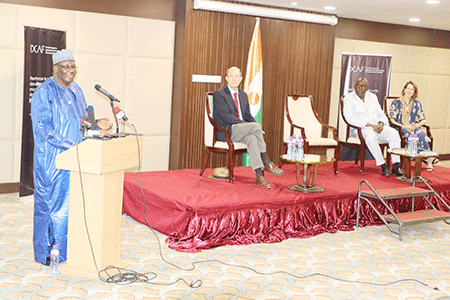
In Niamey, the President of the National Human Rights Commission (CNDH), Maty El Hadj Moussa, inaugurated a regional conference centered on human rights oversight within the Sahel’s volatile security landscape. The discussion specifically targeted the “Three Borders” zone, which includes Burkina Faso, Mali, and Niger. High-level officials, including the German Ambassador to Niger and the Africa Director of DCAF, joined the Ministry of Justice for the opening session.
Strengthening oversight and governance
The primary goal of this two-day summit is to educate regional stakeholders on the most effective strategies for human rights preservation. By training participants on prevention tools and legal mechanisms, the event seeks to bolster the rule of law. Furthermore, it aims to empower both internal and external monitoring institutions to perform their duties more effectively, thereby enhancing regional governance.
Maty El Hadj Moussa pointed out that the insecurity currently plaguing the border areas of Niger, Mali, and Burkina Faso has led to widespread rights violations. He noted that these abuses are committed by unidentified militant groups terrorizing the public, as well as by some members of the defense and security forces involved in counter-insurgency operations. He described the conflict as an asymmetric war where civilians are trapped in a climate of extreme violence and fear.
Collaborative solutions for regional stability
The CNDH President stressed that the persistent nature of this crisis demands immediate action from human rights defenders. He called for deep reflection to find solutions that align with the population’s desire for peace and security. Adding to this, Moussa Sahirou Tchida from the Ministry of Justice highlighted that stabilizing the Sahel requires a unified approach from all regional actors.
Support from international partners, particularly European Union member states, was recognized as essential for these initiatives. The Ministry of Justice reaffirmed its commitment to working alongside partners to bring stability back to the tri-border region.
Addressing the humanitarian and security crisis
Anne Benette, representing DCAF Africa, explained that the Sahel is currently facing a complex mixture of political, social, and environmental challenges. This rising insecurity and the presence of transnational criminal networks are slowly eroding the region’s social cohesion. She emphasized that this conference serves as a vital platform for exchanging best practices to protect the rule of law against these growing threats.
The German Ambassador, Herman Nicolai, echoed these concerns, noting that the Sahel is witnessing a faster rise in violence than any other part of the continent. He highlighted that over the past decade, extremist activities have led to thousands of deaths and forced countless civilians to flee their homes, creating a dire humanitarian situation.